
eScore
adobe.comThe eScore is a comprehensive evaluation of a business's online presence and effectiveness. It analyzes multiple factors including digital presence, brand communication, conversion optimization, and competitive advantage.
Adobe demonstrates a world-class digital presence, commanding immense domain authority and dominating branded and high-intent non-branded search queries. Its multi-channel presence is exceptionally consistent, leveraging its vast content ecosystem (tutorials, Behance community) to align with user intent at every stage of the customer journey. While already a leader, its specific optimization for conversational voice search could be more pronounced, though its strong featured snippet presence provides a solid foundation.
Unparalleled content authority driven by a massive ecosystem of tutorials, user-generated content (Behance), and thought leadership, which captures a vast range of search intents.
Proactively create and optimize content specifically for conversational, long-tail voice search queries, focusing on 'how-to,' 'what-is,' and 'best-for' formats to capture more answer engine results.
Adobe's brand messaging is masterful at inspiring its core audience of creative professionals with an empowering and innovative voice. The messaging for different user segments like students and individuals is clear and effective. However, the communication hierarchy on the homepage heavily favors individual creators, potentially leaving high-value business and enterprise customers feeling underserved until they navigate deeper into the site.
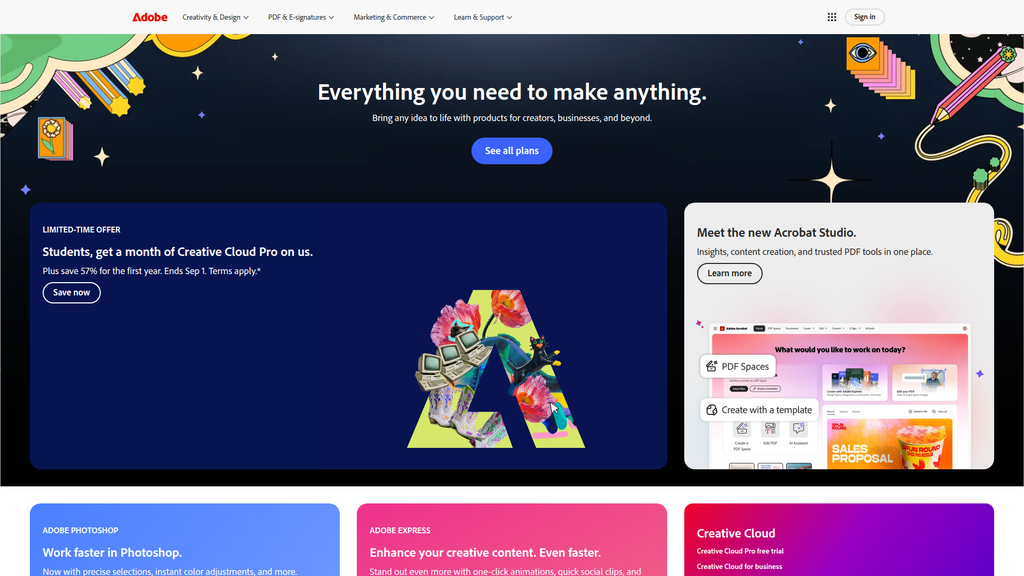
A strong, aspirational core message ('Everything you need to make anything') that effectively captures the brand's empowering essence and resonates deeply with its creative audience.
Revise the homepage message architecture to create a more prominent and distinct entry point for business/enterprise audiences, immediately showcasing the value proposition beyond individual creative tools.
The on-site conversion experience for signing up for trials and purchasing plans is visually clear, with a low cognitive load and excellent cross-device consistency. However, the overall score is significantly penalized by the subscription cancellation process, which is the subject of an FTC lawsuit for being intentionally burdensome. This major friction point in the post-conversion journey severely undermines user trust and the overall experience.
A visually intuitive and streamlined user flow for initial trial sign-ups and plan purchases, with clear calls-to-action and logical information architecture.
Radically overhaul the subscription cancellation process to be transparent and user-friendly, making it as easy to cancel as it is to sign up, thereby resolving the core issue of the FTC lawsuit and rebuilding customer trust.
Adobe's credibility is a story of contrasts; it has immense brand authority, robust data security (SOC 2, ISO 27001), and strong third-party validation as the industry standard. However, this is severely undermined by the high-risk FTC lawsuit alleging deceptive subscription practices, which has created significant reputational damage. While Adobe has made positive strides in transparency regarding AI data usage, the ongoing lawsuit remains a major unresolved credibility issue.
Proactive and clear policy on AI ethics, explicitly stating that user content is not used for training generative AI models, which builds significant trust in a high-stakes emerging technology.
Urgently resolve the FTC lawsuit concerning subscription practices. This is the most significant legal and reputational risk, and its resolution is paramount to restoring full credibility with consumers.
Adobe's competitive moat is exceptionally strong and sustainable, built on the trifecta of a deeply integrated product ecosystem, its status as the ubiquitous industry standard, and powerful network effects from its massive user community. Switching costs for professionals and enterprises are extremely high due to entrenched workflows and proprietary file formats. The rapid integration of its proprietary, commercially-safe Firefly AI across the entire suite has created a new, powerful layer of differentiation that standalone competitors struggle to match.
The deeply integrated three-cloud ecosystem (Creative, Document, Experience) creates a seamless workflow and high switching costs that point-solution competitors cannot replicate.
Accelerate the development of cloud-native, collaboration-first versions of core applications to neutralize the primary architectural advantage of competitors like Figma and future-proof its ecosystem.
Adobe's SaaS business model is highly scalable, boasting impressive gross margins and strong operational leverage. The company shows clear expansion potential by targeting the large SMB and creator economy markets with Adobe Express and developing new revenue streams from generative AI. While its core professional market is maturing, leading to slower overall growth (around 10-11% YoY), these new expansion vectors and AI monetization present significant future potential.
A highly scalable SaaS model with over 80% gross margins and a massive, predictable recurring revenue base, providing substantial free cash flow to reinvest in new growth areas like AI.
Establish a dedicated, agile business unit with a product-led growth (PLG) focus to more effectively penetrate the high-volume, low-spend SMB and creator economy markets currently dominated by Canva.
Adobe's subscription-based revenue model is highly optimized and profitable, with a clear focus on its three core clouds. The company demonstrates strong strategic focus by deeply integrating its key innovation (Firefly AI) across the entire product portfolio. However, the business model's coherence is weakened by a misalignment between its aggressive annual subscription terms (with early termination fees) and consumer protection standards, as highlighted by the FTC lawsuit.
A successful and highly profitable transition to a subscription model that generates over 94% of its revenue as predictable, recurring income, fueling continuous innovation.
Re-evaluate and simplify the subscription terms, particularly the 'annual, paid monthly' plan, to ensure crystal-clear transparency and fairness regarding early termination fees, aligning the model with customer trust.
Adobe wields immense market power, holding a dominant market share in the professional creative software industry and functioning as the definitive industry standard. This position grants it significant pricing power and the ability to influence market direction, as seen with its push into generative AI. While facing strong competition in niche segments (like UI/UX design from Figma), its comprehensive ecosystem and brand equity create a formidable barrier to entry, ensuring a stable and leading market share trajectory.
Dominant market share (~58%) and status as the entrenched 'industry standard,' which creates powerful network effects in hiring, education, and collaboration, continuously reinforcing its market leadership.
Develop and market a clearer competitive narrative for the Experience Cloud that emphasizes the unique value of its integration with Creative Cloud, better leveraging its market power in creation to win against marketing-only competitors like Salesforce.
Business Overview
Business Classification›
Software as a Service (SaaS)
Platform & Ecosystem
Software
Sub Verticals›
- •
Creative & Design Software
- •
Digital Marketing & Experience Management
- •
Document Management Solutions
Mature
Maturity Indicators›
- •
Dominant market share in core professional segments.
- •
Highly predictable, subscription-based recurring revenue model.
- •
Global brand recognition and industry-standard product status.
- •
Consistent profitability and strong free cash flow.
- •
Strategic shift from product-led to platform-led growth, focusing on AI and ecosystem lock-in.
Enterprise
Steady
Revenue Model›
Primary Revenue Streams›
| # | Customer Segment | Description | Estimated Importance | Estimated Margin | Stream Name |
|---|---|---|---|---|---|
# 1 | Customer Segment Creative Professionals, Businesses (All sizes), Students & Educators | Description Subscription fees for access to a suite of software for graphic design, video editing, web development, photography, and more. Key products include Photoshop, Illustrator, Premiere Pro, and After Effects. | Estimated Importance Primary | Estimated Margin High | Stream Name Creative Cloud Subscriptions |
# 2 | Customer Segment Medium to Large Enterprises, Marketing & E-commerce Teams | Description Subscription fees for a suite of products for marketing, analytics, advertising, and commerce. Helps businesses manage, personalize, and optimize customer experiences. | Estimated Importance Primary | Estimated Margin High | Stream Name Experience Cloud Subscriptions |
# 3 | Customer Segment Business Professionals, Consumers, Enterprises | Description Subscription fees for products like Adobe Acrobat Pro DC, Adobe Sign, and Scan, which allow users to create, edit, sign, and manage PDF documents. | Estimated Importance Secondary | Estimated Margin High | Stream Name Document Cloud Subscriptions |
Recurring Revenue Components›
- •
Monthly & Annual Subscriptions (Creative, Experience, Document Clouds)
- •
Enterprise Term License Agreements (ETLAs)
- •
Consumption-based pricing for AI features (e.g., Generative Credits for Firefly).
Pricing Strategy›
Tiered Subscription
Premium
Transparent
Pricing Psychology›
- •
Tiered Pricing (e.g., Single App, All Apps, Creative Cloud Pro).
- •
Bundling (Creative Cloud suite offers more value than single apps).
- •
Promotional Pricing (Student and teacher discounts).
- •
Decoy Effect (A mid-tier plan can make the premium plan look more attractive).
Monetization Assessment›
Strengths›
- •
Extremely high percentage of revenue is recurring and predictable.
- •
Strong pricing power due to industry-standard status and deep integration into workflows.
- •
Successful transition from perpetual licenses to a subscription model.
- •
New AI-driven monetization vector through generative credits and premium-tier subscriptions.
Weaknesses›
- •
High price point can be a barrier for individuals and SMBs, creating an opening for lower-cost competitors.
- •
Dependence on the subscription model creates vulnerability to 'subscription fatigue'.
- •
Complexity in enterprise licensing can be a friction point.
Opportunities›
- •
Upselling existing customers to higher 'Pro' tiers with advanced AI capabilities.
- •
Expanding consumption-based pricing for compute-intensive AI tasks (video, 3D).
- •
Penetrating the non-professional/casual creator market with more accessible tools like Adobe Express.
- •
Deeper integration of creative tools into the enterprise-focused Experience Cloud to drive bundle adoption.
Threats›
- •
Aggressive competition from more accessible and lower-cost tools like Canva and Figma, particularly in the non-professional segment.
- •
Disruption from AI-native startups that could build more efficient, specialized creative tools from the ground up.
- •
Potential for market saturation in core creative professional segments.
- •
Economic downturns leading to reduced software spending by businesses and freelancers.
Market Positioning›
Industry Standard & Premium Technology Leader
Dominant in professional creative software; Strong challenger in digital experience and document management.
Target Segments›
- Segment Name:
Creative & Marketing Professionals
Description:Individuals and teams whose primary job function involves creating digital content. This includes graphic designers, video editors, web designers, UX/UI designers, photographers, and enterprise marketing teams.
Demographic Factors›
- •
Professionals aged 25-55
- •
Higher education in arts, design, or marketing
- •
Employed by agencies, corporations, or as high-value freelancers
Psychographic Factors›
- •
Value quality, precision, and control over their tools.
- •
Perceive Adobe products as the professional standard.
- •
Career and reputation are tied to proficiency with Adobe software.
- •
Seek efficiency and seamless workflows.
Behavioral Factors›
- •
Deeply integrated into the Adobe ecosystem.
- •
High willingness to pay for tools that improve productivity and output quality.
- •
Actively follow industry trends and software updates.
Pain Points›
- •
Pressure to produce high-quality content faster.
- •
Need for seamless collaboration with team members and clients.
- •
Keeping up with new tools, features, and technologies like AI.
- •
Managing complex, multi-application workflows.
Fit Assessment:Excellent
Segment Potential:Medium
- Segment Name:
Business Professionals & Consumers
Description:A broad segment including knowledge workers, small business owners, and general consumers who need to create, edit, and sign documents, or produce simple marketing materials without professional design skills.
Demographic Factors›
Wide age range
Various professional roles outside of creative industries
Psychographic Factors›
- •
Value simplicity, speed, and ease-of-use.
- •
Often price-sensitive.
- •
Task-oriented; looking for a tool to solve an immediate problem (e.g., sign a PDF, create a flyer).
Behavioral Factors›
- •
Less brand-loyal; may use a variety of tools (e.g., Canva, DocuSign).
- •
Lower engagement and usage frequency compared to professionals.
- •
Influenced by freemium models and accessibility.
Pain Points›
- •
Professional design tools are too complex and expensive.
- •
Lack of time and skill to create professional-looking content.
- •
Difficulty with document compatibility and security.
Fit Assessment:Good
Segment Potential:High
- Segment Name:
Students & Educators
Description:Individuals and institutions in the education sector who use creative and document tools for learning, teaching, and academic projects.
Demographic Factors›
Aged 13-25 (students) and 30-65 (educators).
Enrolled in or employed by educational institutions.
Psychographic Factors›
- •
Highly price-sensitive.
- •
Motivated by learning and skill development.
- •
Seek to learn industry-standard tools to improve future career prospects.
Behavioral Factors›
Acquisition is driven by heavily discounted educational pricing.
High potential for future conversion to full-priced plans upon graduation.
Pain Points›
- •
Affordability of professional tools on a limited budget.
- •
Steep learning curve for complex software.
- •
Need for access to tools for coursework and portfolio building.
Fit Assessment:Excellent
Segment Potential:High
Market Differentiation›
| # | Factor | Strength | Sustainability |
|---|---|---|---|
# 1 | Factor Integrated Ecosystem (Creative, Document, Experience Clouds) | Strength Strong | Sustainability Sustainable |
# 2 | Factor Proprietary AI Models (Firefly & Sensei) | Strength Strong | Sustainability Sustainable |
# 3 | Factor Industry Standard Status & Brand Equity | Strength Strong | Sustainability Sustainable |
# 4 | Factor Vast User Base and Community (e.g., Behance) | Strength Moderate | Sustainability Sustainable |
# 5 | Factor Enterprise-grade Security and Commercial Indemnification for AI | Strength Strong | Sustainability Sustainable |
Value Proposition›
An integrated ecosystem of industry-standard applications and services for digital content creation, marketing, and document management, supercharged with generative AI to enhance creativity and productivity for everyone from students to global enterprises.
Excellent
Key Benefits›
- Benefit:
Professional-Grade Creative Tools
Importance:Critical
Differentiation:Somewhat unique
Proof Elements›
Decades of use as the industry standard in creative fields.
Vast feature sets in flagship products like Photoshop and Premiere Pro.
- Benefit:
Seamless Workflow Integration
Importance:Critical
Differentiation:Unique
Proof Elements›
Interoperability between Creative Cloud applications (e.g., Photoshop files in After Effects).
Centralized asset management via Creative Cloud Libraries.
- Benefit:
AI-Powered Efficiency and Creativity
Importance:Important
Differentiation:Unique
Proof Elements›
- •
Generative Fill in Photoshop powered by Firefly.
- •
Acrobat AI Assistant for document summaries and insights.
- •
Commercially safe AI models trained on licensed content.
- Benefit:
Scalable Enterprise Solutions
Importance:Critical
Differentiation:Somewhat unique
Proof Elements›
Comprehensive Experience Cloud platform for marketing and analytics.
Enterprise-level security, administration, and support.
Unique Selling Points›
| # | Defensibility | Sustainability | Usp |
|---|---|---|---|
# 1 | Defensibility Strong | Sustainability Long-term | Usp The only company offering a deeply integrated, end-to-end solution spanning content creation (Creative Cloud), customer experience management (Experience Cloud), and document workflows (Document Cloud). |
# 2 | Defensibility Strong | Sustainability Medium-term | Usp Adobe Firefly, a family of commercially safe generative AI models, natively integrated into core creative workflows, providing IP indemnification for generated content. |
# 3 | Defensibility Strong | Sustainability Long-term | Usp Ownership of the PDF format and the industry-standard Acrobat toolset, now enhanced with AI capabilities. |
Customer Problems Solved›
| # | Problem | Severity | Solution Effectiveness |
|---|---|---|---|
# 1 | Problem Creating high-quality, professional digital content is complex and time-consuming. | Severity Critical | Solution Effectiveness Complete |
# 2 | Problem Managing and delivering consistent, personalized customer experiences at scale is difficult. | Severity Critical | Solution Effectiveness Partial |
# 3 | Problem Ensuring seamless collaboration and asset management across creative and marketing teams. | Severity Major | Solution Effectiveness Complete |
# 4 | Problem Securely creating, sharing, and getting signatures on digital documents. | Severity Major | Solution Effectiveness Complete |
Value Alignment Assessment›
High
Adobe's products are deeply aligned with the market's ongoing digital transformation, the increasing demand for digital content, and the strategic importance of customer experience management.
High
For its core audience of creative professionals, Adobe's value proposition is exceptionally well-aligned, providing the industry-standard tools they require. Alignment is improving for the business/consumer segment through offerings like Adobe Express.
Strategic Assessment›
Business Model Canvas›
Key Partners›
- •
Hardware Manufacturers (Apple, Microsoft, NVIDIA)
- •
Cloud Infrastructure Providers (Amazon Web Services, Microsoft Azure).
- •
Technology Partners (OpenAI, Google, Meta).
- •
Solution & Channel Partners (Consulting firms, resellers, agencies like Publicis Groupe).
- •
Educational Institutions.
Key Activities›
- •
Research & Development (especially in AI and cloud technologies).
- •
Software Development & Engineering.
- •
Sales & Global Marketing.
- •
Customer Support & Success.
- •
Strategic Acquisitions & Partnerships.
Key Resources›
- •
Extensive Intellectual Property Portfolio (Patents, Trademarks).
- •
Global Brand Equity & Reputation.
- •
Large, loyal customer base and developer ecosystem.
- •
Vast datasets for training AI models.
- •
Highly skilled workforce in engineering and design.
Cost Structure›
- •
Research & Development Expenses.
- •
Sales and Marketing Costs.
- •
General and Administrative Expenses.
- •
Cloud Infrastructure Hosting Costs.
- •
Employee Salaries and Benefits.
Swot Analysis›
Strengths›
- •
Dominant market leadership in the professional creative software segment.
- •
Highly defensible ecosystem with strong user lock-in.
- •
Robust, predictable recurring revenue from a mature subscription model.
- •
Strong brand recognition and reputation for quality.
- •
Advanced, proprietary AI capabilities (Firefly) integrated directly into workflows.
Weaknesses›
- •
Premium pricing may limit adoption among casual users and emerging markets.
- •
Perception of product complexity and steep learning curves for non-professionals.
- •
Slowing revenue growth compared to previous years, indicating market maturation.
- •
Historically slower to adapt to web-first, collaborative models compared to newer entrants.
Opportunities›
- •
Monetizing generative AI through new subscription tiers, add-ons, and consumption-based models.
- •
Expanding the more accessible Adobe Express to capture the casual creator market from competitors like Canva.
- •
Driving growth in the enterprise segment through the Experience Cloud and GenStudio.
- •
Leveraging AI to create new product categories and workflows (e.g., video and 3D generation).
- •
Expanding into new geographic markets with tailored offerings.
Threats›
- •
Intensifying competition from accessible, web-native, and often lower-cost tools like Canva and Figma.
- •
Disruption from agile, AI-native startups that could leapfrog legacy workflows.
- •
General 'subscription fatigue' among consumers and businesses.
- •
Potential antitrust and regulatory scrutiny due to market dominance.
- •
Software piracy, particularly in developing markets.
Recommendations›
Priority Improvements›
| # | Area | Expected Impact | Recommendation |
|---|---|---|---|
# 1 | Area Market Penetration (SMB & Consumer) | Expected Impact High | Recommendation Aggressively enhance and market Adobe Express as a direct, user-friendly competitor to Canva, focusing on seamless integration with the professional Creative Cloud suite as a key differentiator. Simplify the entry-level user experience. |
# 2 | Area AI Monetization Strategy | Expected Impact High | Recommendation Develop and clearly communicate a flexible, hybrid monetization model for AI that combines tier-based access (unlimited standard features in Pro plans) with a transparent consumption-based model (pay-per-use for high-compute tasks like video generation). This caters to both power users and occasional users. |
# 3 | Area Product Innovation | Expected Impact High | Recommendation Prioritize R&D in agentic AI capabilities to automate complex, multi-step workflows across applications (e.g., 'Create a marketing campaign for product X using our brand assets'). This would transform Adobe from a tool provider to a true creative and marketing co-pilot, solidifying its moat. |
Business Model Innovation›
- •
Introduce a 'Workflow-as-a-Service' model for enterprises, offering automated, AI-driven solutions for specific business outcomes (e.g., 'on-brand social media content generation') rather than just access to tools.
- •
Explore a marketplace model where third-party developers can build and sell AI-powered plugins and actions directly within Adobe applications, creating a network effect and fostering innovation.
- •
Develop a modular subscription offering that allows users to build custom tool bundles, appealing to specialized professionals who don't need the entire 'All Apps' plan but require more than one tool.
Revenue Diversification›
- •
Expand Adobe Stock to include AI-generated assets, 3D models, and video templates, with a clear compensation model for creators whose work helps train the AI models.
- •
Offer premium consulting and implementation services for the Experience Cloud and GenStudio, helping enterprises maximize their investment in Adobe's marketing technology stack.
- •
Launch a certified education and talent platform, connecting businesses with Adobe-proficient freelancers and agencies, and taking a commission on projects.
Adobe's business model is a masterclass in strategic evolution, having successfully transitioned from a perpetual license model to a highly profitable and predictable SaaS subscription powerhouse. Its primary strength lies in its deeply entrenched and integrated three-cloud ecosystem (Creative, Experience, Document), which creates a formidable competitive moat and significant customer lock-in. The company's status as the 'industry standard' in the creative professional market has afforded it strong pricing power and brand loyalty. The current strategic imperative is the integration of generative AI. Adobe Firefly is not merely a feature addition; it is a fundamental evolution of the core value proposition, designed to enhance productivity and creativity while simultaneously introducing a powerful new monetization layer through generative credits and premium subscription tiers. This positions Adobe to capture additional value from its existing user base and defend against disruption.
However, Adobe faces significant challenges. Its mature core market is experiencing slower growth, and the rise of more accessible, collaborative, and often cheaper competitors like Canva and Figma poses a serious threat, particularly in the non-professional and SMB segments. The primary strategic risk is being outmaneuvered by more agile, AI-native startups that are not encumbered by legacy architecture. To secure future growth, Adobe must execute a dual strategy: 1) Defend its professional core by deepening its AI integration and workflow automation to a level competitors cannot replicate, and 2) Aggressively attack the high-growth casual creator market with a simplified and compelling offering in Adobe Express. The evolution from a 'tool provider' to an 'AI-powered system for digital creation and experience' will be critical for sustaining its market leadership and growth trajectory in the coming years.
Competitors
Competitive Landscape›
Mature
Oligopoly
Barriers To Entry›
| # | Barrier | Impact |
|---|---|---|
# 1 | Barrier Ecosystem Lock-In & High Switching Costs | Impact High |
# 2 | Barrier Brand Reputation & Industry Standard Status | Impact High |
# 3 | Barrier High R&D Investment for Professional-Grade Tools | Impact High |
# 4 | Barrier Extensive Intellectual Property Portfolio | Impact Medium |
Industry Trends›
| # | Impact On Business | Timeline | Trend |
|---|---|---|---|
# 1 | Impact On Business Fundamental shift in content creation, necessitating rapid innovation (e.g., Firefly) to maintain leadership and creating opportunities for new, AI-native competitors. | Timeline Immediate | Trend Generative AI Integration |
# 2 | Impact On Business Drives competition from players like Canva and Figma, forcing Adobe to invest in and promote simpler applications like Adobe Express to capture the mass-market segment. | Timeline Immediate | Trend Demand for Simplified, Web-Based Tools |
# 3 | Impact On Business Increases pressure to enhance real-time collaboration features across the Creative Cloud suite to compete with natively collaborative platforms like Figma. | Timeline Near-term | Trend Cloud-Based Collaboration |
# 4 | Impact On Business Potential for customer churn and price sensitivity, especially among freelancers and small businesses, creating an opening for competitors with perpetual licenses or more flexible pricing. | Timeline Near-term | Trend Subscription Model Fatigue |
Direct Competitors›
https://www.canva.com
Significant and growing, particularly in the non-professional/SMB segment.
High
The easy-to-use design platform for everyone, from individuals to enterprise teams.
Strengths›
- •
Superior ease of use and intuitive interface for non-designers.
- •
Vast library of templates and assets, especially in the free and lower-priced tiers.
- •
Strong brand recognition among marketers, educators, and SMBs.
- •
Effective freemium model that drives user acquisition.
- •
Generous cloud storage on paid plans.
Weaknesses›
- •
Less powerful and precise than Adobe's professional tools for complex design tasks.
- •
Limited integration with professional creative workflows (e.g., video, 3D).
- •
AI feature transparency can be less clear compared to Adobe's Firefly.
- •
Perceived as less 'professional' in traditional design agencies.
Differentiators›
- •
Simplicity-first design philosophy.
- •
Template-driven workflow.
- •
Focus on team collaboration for marketing and business assets.
https://www.figma.com
Dominant in the UI/UX design and product prototyping space.
Medium
The collaborative interface design tool for teams.
Strengths›
- •
Best-in-class real-time collaboration features.
- •
Web-based accessibility across all platforms.
- •
Strong community and extensive plugin ecosystem.
- •
Streamlined workflow from design to development (Dev Mode).
- •
Powerful AI-powered features for automating design tasks.
Weaknesses›
- •
Niche focus on UI/UX, lacks the broad creative suite of Adobe.
- •
Less capable for complex vector illustration or photo manipulation compared to Illustrator/Photoshop.
- •
Offline capabilities are more limited than desktop-native applications.
Differentiators›
- •
Collaboration-native architecture.
- •
Browser-first approach.
- •
Unified platform for design, prototyping, and developer handoff.
https://www.blackmagicdesign.com/products/davinciresolve
Growing, estimated around 15% of the video editing market, challenging Premiere Pro.
Medium
The all-in-one solution for professional video editing, color correction, visual effects, and audio post-production.
Strengths›
- •
Extremely powerful free version with professional-grade features.
- •
Industry-leading color grading capabilities.
- •
Integrated workflow (editing, color, VFX, audio) in a single application.
- •
One-time purchase for the 'Studio' version (no subscription).
Weaknesses›
- •
Steeper learning curve compared to Premiere Pro for basic editing.
- •
Less seamless integration with graphic design and motion graphics tools (unlike Premiere Pro with Photoshop/After Effects).
- •
The user base, while passionate, is smaller than Adobe's.
Differentiators›
- •
All-in-one post-production workflow.
- •
Legendary color science.
- •
Disruptive pricing model (powerful free tier and perpetual license).
https://www.salesforce.com/products/marketing-cloud/overview/
Market leader in CRM, with a strong position in marketing automation, holding a slightly larger market share than Adobe in some campaign management segments.
High
The #1 AI CRM for connecting with customers.
Strengths›
- •
Dominant position in the CRM market provides a massive existing customer base.
- •
Strong AI capabilities (Einstein) integrated into workflows.
- •
Extensive ecosystem of third-party apps (AppExchange).
- •
Perceived as highly effective for B2C use cases.
Weaknesses›
- •
Lacks the integrated content creation tools that Adobe Experience Cloud offers.
- •
Can require significant technical IT support to run effectively.
- •
Considered to have a steeper learning curve than some competitors.
- •
Complex and often higher pricing.
Differentiators›
- •
CRM-centric approach to marketing.
- •
Unified customer data platform (Data Cloud).
- •
Strong focus on sales and service cloud integrations.
https://www.docusign.com
Market leader in the e-signature space.
High
The trusted way to agree, with a focus on the entire agreement workflow.
Strengths›
- •
Strong brand recognition and market leadership in e-signatures.
- •
Extensive library of over 400 integrations with other business systems.
- •
Focus on the entire contract lifecycle management, not just signatures.
- •
Perceived to have more advanced workflow automation than Adobe Sign.
Weaknesses›
- •
Core focus is narrower than Adobe Document Cloud, which includes robust PDF editing.
- •
Pricing can be higher, with advanced integrations often requiring more expensive tiers.
- •
Less seamless integration with creative and marketing document workflows.
Differentiators›
- •
Specialization and depth in e-signature and agreement automation.
- •
Broadest integration ecosystem for business processes.
- •
'Agreement Cloud' platform vision.
Indirect Competitors›
N/A
Companies offering powerful, standalone, AI-native tools for specific creative tasks like image generation, video editing, and voice synthesis.
High
High, as they could bundle services to create a competing creative suite.
N/A
Free, community-developed software that provides powerful alternatives to Adobe's products, especially in 3D modeling (Blender) and image editing (GIMP).
Medium
Low, they compete on price but lack the cohesive ecosystem, support, and enterprise focus of Adobe.
https://www.microsoft.com
Microsoft competes indirectly through Office 365 (PowerPoint, Word), which serves basic design and document needs for businesses, and through its Azure cloud platform, which competes on an infrastructure level.
Medium
Medium, especially if they more deeply integrate their AI Designer tools into the Office suite and Teams.
https://workspace.google.com/
Google competes with its Workspace suite (Docs, Slides) for document collaboration and with Google Analytics and Google Ads in the digital marketing space.
Medium
Low in creative tools, but remains a major competitor in marketing analytics and advertising.
Competitive Advantage Analysis›
Sustainable Advantages›
| # | Advantage | Competitor Replication Difficulty | Sustainability Assessment |
|---|---|---|---|
# 1 | Advantage Integrated Ecosystem (Creative, Document, Experience Clouds) | Competitor Replication Difficulty Hard | Sustainability Assessment Highly sustainable due to deep integration, established workflows, and high switching costs for professionals and enterprises. |
# 2 | Advantage Industry Standard Status & Brand Equity | Competitor Replication Difficulty Hard | Sustainability Assessment Highly sustainable; file formats (.psd, .ai, .pdf) and product names (Photoshop) are industry vernacular, creating a powerful network effect. |
# 3 | Advantage Large, Loyal Professional User Base & Community | Competitor Replication Difficulty Medium | Sustainability Assessment Sustainable, as this community provides extensive tutorials, plugins, and a hiring pool skilled in Adobe products, reinforcing its incumbent position. |
Temporary Advantages›
First-Mover Advantage in Deeply Integrated Generative AI (Firefly)
12-24 months
Disadvantages›
| # | Addressability | Disadvantage | Impact |
|---|---|---|---|
# 1 | Addressability Moderately | Disadvantage High Subscription Cost & Perceived 'Subscription Fatigue' | Impact Major |
# 2 | Addressability Difficult | Disadvantage Product Complexity & Steep Learning Curve for Core Applications | Impact Major |
# 3 | Addressability Moderately | Disadvantage Software Performance & 'Bloat' | Impact Minor |
Strategic Recommendations›
Quick Wins›
| # | Expected Impact | Implementation Difficulty | Recommendation |
|---|---|---|---|
# 1 | Expected Impact Medium | Implementation Difficulty Easy | Recommendation Launch aggressive marketing campaigns for Adobe Express targeting Canva's core user base, highlighting AI features and Creative Cloud integration. |
# 2 | Expected Impact Medium | Implementation Difficulty Moderate | Recommendation Simplify Creative Cloud pricing tiers to reduce confusion and better showcase value for different user segments. |
Medium Term Strategies›
| # | Expected Impact | Implementation Difficulty | Recommendation |
|---|---|---|---|
# 1 | Expected Impact High | Implementation Difficulty Moderate | Recommendation Double down on AI-driven workflow automation, not just content generation, to significantly increase user productivity within the suite. |
# 2 | Expected Impact High | Implementation Difficulty Moderate | Recommendation Develop a 'Creative Cloud Lite' subscription tier that bundles key simplified apps (Express, Rush, Photoshop on iPad) to better compete with Canva's pricing. |
# 3 | Expected Impact High | Implementation Difficulty Difficult | Recommendation Acquire niche AI startups with unique technology that can be integrated into the core product suite to accelerate the innovation roadmap. |
Long Term Strategies›
| # | Expected Impact | Implementation Difficulty | Recommendation |
|---|---|---|---|
# 1 | Expected Impact High | Implementation Difficulty Difficult | Recommendation Invest in building a new, cloud-native, collaboration-first suite of professional tools to future-proof against competitors like Figma. |
# 2 | Expected Impact High | Implementation Difficulty Difficult | Recommendation Expand the 'GenStudio' concept to create AI-powered, end-to-end solutions for specific enterprise verticals (e.g., pharmaceuticals, manufacturing) beyond marketing. |
Position Adobe as the indispensable, AI-powered platform for professionals and enterprises, where serious creative and business outcomes are achieved through an integrated, end-to-end workflow.
Differentiate through the seamless integration of best-in-class, professional-grade applications with ethically sourced, production-ready generative AI, creating a powerful, defensible ecosystem that simpler tools cannot replicate.
Whitespace Opportunities›
| # | Competitive Gap | Feasibility | Opportunity | Potential Impact |
|---|---|---|---|---|
# 1 | Competitive Gap No existing platform effectively integrates project management with a deep understanding of creative assets. A tool could analyze assets, automate versioning, suggest workflows, and generate client-ready reports. | Feasibility Medium | Opportunity AI-Powered Creative Project Management | Potential Impact High |
# 2 | Competitive Gap A gap exists between complex 3D tools (like Substance 3D) and simple 2D design tools (like Canva). An offering for marketers to easily create and customize 3D product mockups for campaigns is needed. | Feasibility High | Opportunity Simplified, Collaborative 3D for Marketing Teams | Potential Impact Medium |
# 3 | Competitive Gap While Canva is strong in education, there is an opportunity for a suite focused on creating interactive learning materials, leveraging Adobe's capabilities in animation, video, and PDF forms. | Feasibility Medium | Opportunity Interactive Content Creation Suite for Education | Potential Impact Medium |
Adobe operates from a position of immense strength, anchored by a mature, oligopolistic market in professional creative software. Its primary competitive advantage is a deeply integrated ecosystem spanning creation (Creative Cloud), documents (Document Cloud), and marketing (Experience Cloud), which creates high switching costs and reinforces its status as the industry standard. However, the competitive landscape is being reshaped by two powerful forces: the demand for simplicity and the rise of generative AI.
Direct competitors like Canva and Figma are effectively 'unbundling' the creative suite, capturing large user segments with more accessible, collaborative, and often more affordable web-based tools. Canva poses a significant threat to Adobe's growth in the SMB and non-professional creator market, while Figma has become the dominant force in the high-value UI/UX design space. In video, Blackmagic Design's DaVinci Resolve presents a disruptive challenge with its powerful free version and perpetual license model, directly attacking Premiere Pro's subscription revenue. In the enterprise space, Adobe faces stiff competition from giants like Salesforce, who leverage their CRM dominance to offer compelling marketing automation platforms.
The primary disruptive threat comes from a new wave of AI-native startups. These agile competitors are building tools from the ground up around generative AI, potentially leapfrogging Adobe's capabilities in specific areas. Adobe's strategic response, Firefly, has been strong, integrating generative AI directly into its existing, dominant applications. This is a powerful defensive move, leveraging its ecosystem as a key differentiator.
Adobe's key disadvantages are its high price point and the complexity of its professional software, which created the market gap that competitors like Canva have exploited. Future success will depend on a dual strategy: first, defending its professional core by continuing to integrate cutting-edge AI and enhancing collaborative workflows; and second, aggressively competing for the mass market by simplifying its offerings and effectively marketing its accessible tools like Adobe Express. The primary strategic whitespace lies in bridging the gap between simple content creation and complex professional workflows, particularly through AI-powered automation and specialized tools for enterprise verticals.
Messaging
Message Architecture›
Key Messages›
| # | Clarity Score | Location | Message | Prominence |
|---|---|---|---|---|
# 1 | Clarity Score High | Location Homepage Hero | Message Everything you need to make anything. | Prominence Primary |
# 2 | Clarity Score High | Location Homepage Hero Sub-headline | Message Bring any idea to life with products for creators, businesses, and beyond. | Prominence Primary |
# 3 | Clarity Score High | Location Creative Cloud Page Hero | Message Start your Creative Cloud free trial. | Prominence Secondary |
# 4 | Clarity Score High | Location Creative Cloud Page | Message 20+ creative apps. Infinite possibilities. | Prominence Secondary |
# 5 | Clarity Score High | Location Homepage Promotional Banner | Message Students, get a month of Creative Cloud Pro on us. | Prominence Tertiary |
# 6 | Clarity Score Medium | Location Homepage - GenStudio Section | Message Empower marketing teams. Generate high-performing on-brand campaign content. | Prominence Tertiary |
The message hierarchy is effective but heavily skewed towards the individual creator. The primary message, 'Everything you need to make anything,' is broad and aspirational, successfully capturing the brand's core mission. This is supported by funneling users into specific product categories (Creative Cloud, Acrobat) and audience segments (Students). However, messages for business and enterprise customers are tertiary and appear much further down the page, potentially causing these high-value segments to feel underserved by the initial impression.
Messaging is highly consistent within the 'creator' and 'individual user' funnels. The aspirational and empowering language of the homepage is carried through to the Creative Cloud page, which logically breaks down the 'anything' into tangible apps and possibilities. There's a slight disconnect between the all-encompassing 'make anything' message and the very specific, solution-oriented message for 'Performance Marketing,' suggesting a different messaging strategy is employed for B2B products.
Brand Voice›
Voice Attributes›
- Attribute:
Empowering
Strength:Strong
Examples›
- •
Bring any idea to life...
- •
Amazing apps. Endless possibilities.
- •
Empower marketing teams.
- Attribute:
Innovative
Strength:Strong
Examples›
- •
Your all-in one AI content creation app.
- •
Create beautiful images in just a few words.
- •
Now with precise selections, instant color adjustments, and more.
- Attribute:
Accessible
Strength:Moderate
Examples›
- •
Start your Creative Cloud free trial.
- •
See plans for students and teachers...
- •
Online PDF tools
- Attribute:
Professional
Strength:Strong
Examples›
- •
Creative Cloud for business
- •
Work faster in Photoshop.
- •
Trusted PDF tools in one place.
Tone Analysis›
Inspirational
Secondary Tones›
- •
Promotional
- •
Educational
- •
Action-Oriented
Tone Shifts›
- •
Shifts from broad, inspirational language in headlines ('Endless possibilities') to more direct, benefit-driven language in product descriptions ('Work faster...').
- •
Adopts a promotional and urgent tone for specific offers ('LIMITED-TIME OFFER... Ends Sep 1.').
- •
Becomes more functional and educational in the FAQ and 'More than great apps' sections.
Voice Consistency Rating›
Good
Consistency Issues›
The voice is highly consistent for the Creative Cloud and Document Cloud offerings targeting individuals and creative professionals. The tone for enterprise-level products like 'GenStudio' feels more corporate and less inspirational, which is appropriate for the audience but creates a slight voice fragmentation on the homepage.
Value Proposition Assessment›
Adobe provides an integrated, industry-standard ecosystem of creative and digital document tools, supercharged by AI, that empowers everyone from individual creators to global enterprises to bring any digital experience to life.
Value Proposition Components›
- Component:
Comprehensive Suite of Tools
Clarity:Clear
Uniqueness:Unique
Examples›
20+ creative apps. Infinite possibilities.
- Component:
AI-Powered Innovation
Clarity:Clear
Uniqueness:Somewhat Unique
Examples›
Adobe Firefly creative AI for images, video, and audio.
Your all-in one AI content creation app.
- Component:
Industry Standard & Professional Grade
Clarity:Clear
Uniqueness:Unique
Examples›
Work faster in Photoshop.
Trusted PDF tools...
- Component:
Cross-Device & Cloud Integration
Clarity:Somewhat Clear
Uniqueness:Somewhat Unique
Examples›
Get the complete toolkit for creativity...
Creative ways to collaborate
- Component:
Community & Learning Resources
Clarity:Clear
Uniqueness:Somewhat Unique
Examples›
Membership perks include tutorials, fonts, templates, and more.
Behance — Show your stuff and see what others are doing
Adobe's primary differentiation lies in its comprehensive, integrated ecosystem of professional-grade tools. While competitors like Canva focus on simplicity or Affinity on a one-time purchase model, Adobe's value is in being the all-in-one, industry-standard solution where different powerful apps work together. The recent aggressive integration of generative AI (Firefly) is a key new differentiator, positioning Adobe not just as a tool provider but as an innovative partner in the creative process.
The messaging positions Adobe as the undisputed market leader and the gold standard for creative professionals. It simultaneously works to democratize creativity through accessible tools like Adobe Express and student pricing, addressing competition from more user-friendly platforms. The enterprise messaging for GenStudio positions Adobe as a strategic partner for business growth, moving beyond just creative tools to content supply chain optimization.
Audience Messaging›
Target Personas›
- Persona:
Students & Educators
Tailored Messages›
- •
Students, get a month of Creative Cloud Pro on us.
- •
Plus save 57% for the first year.
- •
See plans for students and teachers
Effectiveness:Effective
- Persona:
Individual Creators (Photographers, Designers, etc.)
Tailored Messages›
- •
Everything you need to make anything.
- •
20+ creative apps. Infinite possibilities.
- •
Combine, retouch, and remix your pics.
Effectiveness:Effective
- Persona:
Small & Medium Businesses (SMBs)
Tailored Messages›
Creative Cloud for business
See plans for... small and medium businesses.
Effectiveness:Somewhat
- Persona:
Enterprise Marketing Teams
Tailored Messages›
- •
Adobe GenStudio for Performance Marketing
- •
Empower marketing teams.
- •
Generate high-performing on-brand campaign content.
Effectiveness:Somewhat
Audience Pain Points Addressed›
- •
Need for a wide range of powerful, professional tools
- •
Pressure to create high-quality content quickly ('Work faster', 'Even faster')
- •
Managing complex document workflows ('Create, edit, review, and sign PDFs')
- •
Budget constraints for students and individuals ('LIMITED-TIME OFFER', 'Student pricing')
Audience Aspirations Addressed›
- •
Bringing creative ideas to life ('Bring any idea to life')
- •
Achieving professional results ('Create something beautiful')
- •
Boosting productivity
- •
Gaining recognition within a creative community ('Show your stuff')
Persuasion Elements›
Emotional Appeals›
- Appeal Type:
Aspiration & Empowerment
Effectiveness:High
Examples›
- •
Everything you need to make anything.
- •
Endless possibilities.
- •
Bring any idea to life.
- Appeal Type:
Curiosity & Innovation
Effectiveness:Medium
Examples›
Meet the new Acrobat Studio.
Create beautiful images in just a few words.
Social Proof Elements›
- Proof Type:
Media Mentions / Authority
Impact:Moderate
Examples›
'In the news' section highlighting new product launches and partnerships.
- Proof Type:
Community
Impact:Strong
Examples›
Mentions of Behance, Adobe Live, and Adobe MAX create a sense of a large, active user community.
Trust Indicators›
- •
Strong, globally recognized brand name
- •
Clear links to pricing and terms ('See terms', 'View plans and pricing')
- •
Showcasing partnerships with major companies like Meta
Scarcity Urgency Tactics›
LIMITED-TIME OFFER
Ends Sep 1.
Calls To Action›
Primary Ctas›
| # | Clarity | Location | Text |
|---|---|---|---|
# 1 | Clarity Clear | Location Homepage Hero | Text See all plans |
# 2 | Clarity Clear | Location Homepage Student Offer | Text Save now |
# 3 | Clarity Clear | Location Multiple Product Sections | Text Learn more |
# 4 | Clarity Clear | Location Adobe Express Section | Text Try now |
# 5 | Clarity Clear | Location Creative Cloud Pricing Section | Text Buy now |
# 6 | Clarity Clear | Location Adobe MAX Section | Text Register now |
The CTAs are highly effective. They are clear, concise, and use a strong action verb. There is a good mix of low-commitment CTAs ('Learn more') and high-commitment CTAs ('Buy now', 'Save now'), guiding users through the funnel appropriately. The design and placement of the CTAs give them high visibility.
Messaging Gaps Analysis›
Critical Gaps›
The homepage lacks a clear, prominent entry point for business/enterprise customers. The value proposition for Adobe's other major divisions, like the Experience Cloud, is not represented in the primary messaging.
The message of synergy between the different product clouds (e.g., how Creative Cloud assets seamlessly flow into Experience Manager for marketing campaigns) is a major missed opportunity on the homepage.
Contradiction Points›
There's a subtle tension between the 'for everyone' message ('make anything') and the clear positioning as the 'professional standard'. While managed through product segmentation (e.g., Express vs. Photoshop), the initial message might be too broad to resonate strongly with high-end enterprise buyers looking for specific solutions.
Underdeveloped Areas›
Storytelling is underdeveloped on the homepage. While it mentions creating things, it doesn't show compelling customer success stories or case studies that would bring the 'make anything' promise to life.
Messaging around the value of the subscription model itself (continuous updates, access to new features like AI, cloud services) could be more explicit, especially on the Creative Cloud page, to counter competitors with one-time purchase models.
Messaging Quality›
Strengths›
- •
Strong, aspirational, and empowering core message that captures the essence of creativity.
- •
Clear segmentation of products and plans for individuals, especially within the Creative Cloud page.
- •
Effective use of benefit-oriented headlines for specific products ('Work faster in Photoshop').
- •
Excellent brand voice that is both professional and inspiring.
Weaknesses›
- •
Over-emphasis on the creative/individual user on the main homepage, potentially alienating large business and enterprise visitors.
- •
Lack of clear narrative connecting the different parts of the Adobe ecosystem.
- •
Relies heavily on brand recognition rather than explicitly stating competitive advantages like ecosystem integration.
Opportunities›
- •
Create distinct homepage journeys or prominent navigation paths for different core audiences (Individual, SMB, Enterprise) to deliver more relevant messaging upfront.
- •
Develop a stronger narrative around the 'Content Supply Chain', showing how Adobe is the only company that can manage the entire lifecycle of digital content from creation to delivery and analytics.
- •
Integrate more customer storytelling and visual case studies to provide concrete proof of the value proposition.
Optimization Roadmap›
Priority Improvements›
| # | Area | Expected Impact | Recommendation |
|---|---|---|---|
# 1 | Area Homepage Audience Segmentation | Expected Impact High | Recommendation Implement a clear navigational choice or distinct content blocks near the top of the homepage for 'Individuals/Creators', 'Business', and 'Enterprise' audiences to guide them to relevant value propositions and products immediately. |
# 2 | Area Ecosystem Value Proposition | Expected Impact High | Recommendation Craft and feature a key message and visual that explains the power of the integrated Adobe ecosystem. For example: 'From first spark to final sale, one seamless platform for your entire content workflow.' |
# 3 | Area Customer Storytelling | Expected Impact Medium | Recommendation Replace one of the generic product feature blocks on the homepage with a dynamic customer success story module, showcasing incredible work created with Adobe tools, with links to a more detailed case study. |
Quick Wins›
- •
Add a 'For Business' link directly in the hero section of the homepage.
- •
A/B test the main headline 'Everything you need to make anything' against a more benefit-focused alternative, such as 'The future of creativity is here. And you're in control.'
- •
Make the 'Creative Cloud for business' CTA more prominent.
Long Term Recommendations›
- •
Develop a unified messaging framework that clearly articulates the value proposition of each Cloud (Creative, Document, Experience) and how they work together to power digital business.
- •
Invest in creating more persona-based content journeys that guide different users (e.g., a marketing manager vs. a video editor) through a curated experience on the site.
- •
Shift from a product-centric to a solution-centric messaging approach, especially for business audiences, focusing on outcomes like 'Accelerate Content Velocity' or 'Deliver Personalization at Scale'.
Adobe's strategic messaging is masterful in capturing the spirit of creativity and empowering its core audience of individuals and creative professionals. The primary message, 'Everything you need to make anything,' is broad, aspirational, and effectively positions the Creative Cloud as the ultimate toolkit. The brand voice is consistent, inspiring, and professional, building on decades of market leadership. Persuasion techniques are well-executed, with clear CTAs, trust indicators, and effective use of promotional offers for specific segments like students.
The primary weakness in the current strategy is its homepage's heavy skew towards the individual creator. This focus risks undervaluing and potentially alienating the equally important business and enterprise segments, whose needs and buying criteria are fundamentally different. While Adobe has powerful offerings for these audiences, such as Experience Cloud and GenStudio , their value propositions are relegated to secondary or tertiary positions. This creates a messaging gap where the full, integrated power of the Adobe ecosystem—its most significant competitive advantage —is not clearly articulated. The website communicates the strength of its individual products but misses the larger, more powerful story of how these products connect to form a singular platform for digital transformation. To optimize, Adobe should evolve its homepage messaging to create clearer pathways for its key audience segments and elevate the narrative to focus on the unique, integrated power of its entire ecosystem.
Growth Readiness
Growth Foundation›
Product Market Fit›
Strong
Evidence›
- •
Dominant market share in core creative professional segments (e.g., Photoshop, Premiere Pro).
- •
Revenue of $22.60 billion in the last twelve months, with consistent ~11% year-over-year growth, indicating strong, ongoing demand.
- •
Transitioned a massive user base from perpetual licenses to a recurring revenue subscription model (SaaS), which now accounts for over 94% of revenue.
- •
Industry-standard file formats (.PSD, .AI, .PDF) create high switching costs and network effects.
- •
Large, active user community and third-party ecosystem (e.g., Behance, plugins, tutorials) that reinforces its market position.
Improvement Areas›
- •
Simplify user experience for entry-level and SMB users to better compete with challengers like Canva.
- •
Enhance web-based and collaborative features to counter the appeal of cloud-native competitors like Figma.
- •
Improve monetization and value proposition of generative AI (Firefly) to justify premium pricing and drive upgrades.
Market Dynamics›
Digital Content Creation Market: ~13-14% CAGR. Digital Experience Platform (DXP) Market: ~11-13% CAGR.
Mature
Market Trends›
| # | Business Impact | Trend |
|---|---|---|
# 1 | Business Impact Massive opportunity to create a new competitive moat and drive upgrades; also a threat as AI-native startups emerge. Adobe's Firefly is a strategic response. | Trend Generative AI Integration |
# 2 | Business Impact Expands the total addressable market beyond creative professionals but requires simpler, more accessible tools (e.g., Adobe Express) to capture. | Trend Rise of the Creator Economy & SMBs |
# 3 | Business Impact Drives growth for the Adobe Experience Cloud, putting it in competition with Salesforce, Oracle, and others in the enterprise DXP space. | Trend Demand for Personalized Digital Experiences |
# 4 | Business Impact Creates pressure to re-architect legacy desktop applications for the web and improve real-time collaboration features across the suite. | Trend Shift to Cloud-Native and Collaborative Workflows |
Critical. The generative AI wave represents both the single largest growth opportunity and a significant disruptive threat. Adobe's market leadership depends on its ability to successfully integrate AI across its product ecosystem faster and more effectively than competitors.
Business Model Scalability›
High
Highly scalable SaaS model with high gross margins (consistently over 80%). The cost of serving an additional customer is minimal.
Strong. As a mature software company, Adobe has significant operational leverage. Revenue growth from subscriptions directly impacts profitability with minimal incremental operational cost.
Scalability Constraints›
- •
Market saturation in core professional segments, leading to decelerating revenue growth from ~20%+ to 10-12% YoY.
- •
Complexity of managing a vast, and sometimes fragmented, product portfolio.
- •
High price points for the full Creative Cloud suite can be a barrier for individuals and small businesses, limiting penetration in high-growth, lower-spend segments.
Team Readiness›
Very Strong. Experienced leadership team that has successfully navigated the massive shift from perpetual licenses to a cloud-based subscription model.
Mature but complex. The organization is structured around its three core clouds (Creative, Document, Experience). The key challenge is fostering cross-cloud innovation and agility to respond to nimble competitors.
Key Capability Gaps›
- •
Agility in product development to rapidly iterate on web-first, simplified products for the creator economy.
- •
Deepening expertise in vertical-specific enterprise solutions to compete more effectively with players like Salesforce in the Experience Cloud market.
- •
Talent acquisition in the hyper-competitive generative AI research and engineering space.
Growth Engine›
Acquisition Channels›
| # | Channel | Effectiveness | Optimization Potential | Recommendation |
|---|---|---|---|---|
# 1 | Channel Direct & Organic Search | Effectiveness High | Optimization Potential Medium | Recommendation Leverage strong brand equity to create more content targeting long-tail keywords related to generative AI use cases and competitor comparisons (e.g., 'Adobe Firefly vs. Midjourney'). |
# 2 | Channel Freemium & Free Trials | Effectiveness High | Optimization Potential High | Recommendation Optimize the user journey from free tools like Adobe Express and Acrobat Reader to paid single-app or full Creative Cloud subscriptions. Focus on showcasing AI-powered features as a key upgrade incentive. |
# 3 | Channel Enterprise Sales | Effectiveness High | Optimization Potential Medium | Recommendation Focus on cross-selling and bundling Creative Cloud, Document Cloud, and Experience Cloud solutions for large enterprise customers to increase deal size and create a more integrated platform offering. |
# 4 | Channel Paid Advertising | Effectiveness Medium | Optimization Potential High | Recommendation Shift budget towards campaigns targeting non-professional creators and SMBs, emphasizing the simplicity and AI power of Adobe Express to compete with Canva. |
Customer Journey›
Well-defined multi-path journey: Free trials for pro tools, freemium access via Adobe Express and Acrobat, and enterprise sales motions. Clear up-sell and cross-sell paths are in place.
Friction Points›
- •
The complexity and perceived steep learning curve of professional applications like Photoshop and Premiere Pro can deter new users.
- •
Price sensitivity, especially for the full Creative Cloud Pro subscription, for individual creators and small businesses.
- •
Navigating the vast ecosystem of different apps and services can be overwhelming for newcomers.
Journey Enhancement Priorities›
Onboarding
Develop highly personalized, AI-driven onboarding flows that guide new users based on their stated goals and skill level, especially for those starting with free trials.
Freemium-to-Paid Conversion
Embed more compelling AI features from premium apps into the free versions (with usage limits) to clearly demonstrate the value of upgrading.
Retention Mechanisms›
| # | Effectiveness | Improvement Opportunity | Mechanism |
|---|---|---|---|
# 1 | Effectiveness High | Improvement Opportunity Continue to build out cloud-based asset libraries and collaborative features that lock users and teams into the Adobe ecosystem, making it harder to migrate projects and workflows elsewhere. | Mechanism High Switching Costs |
# 2 | Effectiveness High | Improvement Opportunity Further integrate Behance and Frame.io into core creative workflows to strengthen the community and collaborative feedback loops, increasing the platform's stickiness. | Mechanism Ecosystem & Network Effects |
# 3 | Effectiveness High | Improvement Opportunity Maintain a rapid pace of innovation, especially in generative AI. The integration of Firefly across the suite is the single most important retention driver currently. | Mechanism Continuous Innovation |
Revenue Economics›
Very Strong. The SaaS model with high gross margins ensures excellent per-customer profitability. A significant portion of revenue is recurring and predictable.
Estimated to be very high for its core professional user base due to high retention, strong pricing power, and mature, efficient acquisition channels.
High. Adobe demonstrates strong revenue generation relative to its operational costs, evidenced by its robust operating margins and cash flow.
Optimization Recommendations›
- •
Develop tiered pricing for generative AI features (e.g., generative credit packs) to increase Average Revenue Per User (ARPU).
- •
Drive adoption of the new, higher-priced 'Creative Cloud Pro' plan by highlighting exclusive AI and collaboration features.
- •
Create bundled offerings for SMBs that combine elements of Creative, Document, and Experience Clouds at an accessible price point.
Scale Barriers›
Technical Limitations›
| # | Impact | Limitation | Solution Approach |
|---|---|---|---|
# 1 | Impact Medium | Limitation Legacy Desktop-First Architecture | Solution Approach Continue investing heavily in re-architecting core applications for web-first, collaborative environments to match the user experience of cloud-native competitors. |
# 2 | Impact Medium | Limitation Seamless Cross-Cloud Integration | Solution Approach Deepen the technical integration between Creative Cloud, Document Cloud, and Experience Cloud to deliver on the promise of a unified content supply chain for enterprise customers. |
Operational Bottlenecks›
| # | Bottleneck | Growth Impact | Resolution Strategy |
|---|---|---|---|
# 1 | Bottleneck Organizational Silos | Growth Impact Can slow down the consistent implementation of strategic initiatives, like generative AI, across the entire product portfolio. | Resolution Strategy Empower cross-functional, mission-oriented teams (e.g., an 'AI Growth Team') with the authority to drive initiatives horizontally across the organization. |
# 2 | Bottleneck Go-to-Market for New Segments | Growth Impact The existing sales and marketing engine, optimized for creative professionals and enterprises, may not be suited to efficiently capture the high-volume, low-spend creator economy. | Resolution Strategy Build out a dedicated, product-led growth (PLG) team focused exclusively on the Adobe Express user base and the SMB market. |
Market Penetration Challenges›
| # | Challenge | Mitigation Strategy | Severity |
|---|---|---|---|
# 1 | Challenge Intensifying Competition in Simplified Creative Tools | Mitigation Strategy Aggressively invest in Adobe Express, focusing on ease of use, AI-powered workflows, and freemium acquisition funnels to directly challenge Canva's market position. | Severity Critical |
# 2 | Challenge Market Saturation in Core Professional Markets | Mitigation Strategy Focus on increasing ARPU through new AI-powered services and higher-tier plans rather than solely on new user acquisition. Drive expansion into adjacent professional domains like 3D and immersive design. | Severity Major |
# 3 | Challenge Enterprise DXP Competition | Mitigation Strategy Leverage Adobe's unique advantage in content creation (Creative Cloud) as a key differentiator for its Experience Cloud offering, providing an end-to-end solution from creation to personalization that competitors like Salesforce cannot match. | Severity Major |
Resource Limitations›
Talent Gaps›
- •
Top-tier AI/ML research scientists and engineers.
- •
Product managers with deep experience in product-led growth (PLG) models.
- •
Enterprise sales executives with expertise in specific verticals (e.g., healthcare, finance) for the Experience Cloud.
Low. The company generates substantial free cash flow ($8.06 billion in FY24) and does not have significant capital constraints for organic growth initiatives.
Infrastructure Needs›
Continued investment in scalable cloud infrastructure to power compute-intensive generative AI models.
Expansion of data center capacity in emerging markets to support global growth and ensure low-latency performance.
Growth Opportunities›
Market Expansion›
| # | Expansion Vector | Implementation Complexity | Potential Impact | Recommended Approach |
|---|---|---|---|---|
# 1 | Expansion Vector Small and Medium Businesses (SMBs) | Implementation Complexity Medium | Potential Impact High | Recommended Approach Create tailored subscription bundles that combine Adobe Express, Acrobat, and light versions of professional tools with simple administration and billing. |
# 2 | Expansion Vector The Creator Economy (Social Media Creators, Influencers) | Implementation Complexity Medium | Potential Impact High | Recommended Approach Lead with a mobile-first strategy for Adobe Express and Premiere Rush, integrating features that streamline social media content creation, scheduling, and publishing. |
# 3 | Expansion Vector Geographic Expansion in Asia-Pacific | Implementation Complexity High | Potential Impact High | Recommended Approach Develop localized pricing, marketing campaigns, and product features. Establish strategic partnerships with regional tech companies and educational institutions. |
Product Opportunities›
| # | Development Recommendation | Market Demand Evidence | Opportunity | Strategic Fit |
|---|---|---|---|---|
# 1 | Development Recommendation Accelerate R&D and integrate Firefly-powered video/audio generation and editing features directly into Premiere Pro and Adobe Express. | Market Demand Evidence Explosive interest in generative AI for multimedia content creation, driven by platforms like OpenAI's Sora and RunwayML. | Opportunity Generative Video and Audio (Firefly) | Strategic Fit High. A natural extension of Adobe's dominance in video (Premiere Pro) and audio (Audition) editing. |
# 2 | Development Recommendation Launch an integrated 'GenStudio' offering that allows marketing teams to generate, manage, and deploy on-brand content at scale, using Firefly trained on their own brand assets. | Market Demand Evidence Enterprises struggle to create on-brand content at the scale required for personalized marketing. | Opportunity AI-Powered Enterprise Content Supply Chain | Strategic Fit High. Connects the value propositions of Creative Cloud, Document Cloud, and Experience Cloud. |
# 3 | Development Recommendation Deepen integrations between 2D and 3D workflows and build simpler tools for non-experts to create and use 3D assets. | Market Demand Evidence Growing demand for 3D content for gaming, e-commerce, and the metaverse. The partnership with Meta for Substance 3D Reviewer is a key indicator. | Opportunity Immersive and 3D Design Tools | Strategic Fit High. Leverages the existing Substance 3D product line and integrates with Photoshop and Illustrator. |
Channel Diversification›
| # | Channel | Fit Assessment | Implementation Strategy |
|---|---|---|---|
# 1 | Channel Embedded/API-first Offering | Fit Assessment High | Implementation Strategy Offer Firefly and core editing capabilities as APIs that other platforms (e.g., e-commerce sites, marketing automation tools) can embed, creating a new B2B revenue stream. |
# 2 | Channel Hardware Bundling | Fit Assessment Medium | Implementation Strategy Expand partnerships with OEMs like Microsoft, Apple, and Nvidia to pre-install or offer bundled subscriptions to Creative Cloud on devices targeted at creative professionals. |
Strategic Partnerships›
- Partnership Type:
AI & Cloud Infrastructure
Potential Partners›
- •
Nvidia
- •
Microsoft Azure
- •
Google Cloud
Expected Benefits:Ensure access to state-of-the-art GPU infrastructure for training and running AI models. Co-marketing opportunities to enterprise customers.
- Partnership Type:
Platform Integration
Potential Partners›
- •
Microsoft (Teams, Office 365)
- •
Google (Workspace)
- •
Salesforce
Expected Benefits:Embed Adobe's creative and document workflows directly into the productivity and CRM platforms where business users spend their time, increasing usage and stickiness.
- Partnership Type:
Vertical-Specific Software
Potential Partners›
- •
Veeva (Life Sciences)
- •
Shopify (E-commerce)
- •
Autodesk (AEC & Manufacturing)
Expected Benefits:Create integrated solutions for specific industries, using Adobe's tools as the creative engine within specialized vertical platforms.
Growth Strategy›
North Star Metric›
Weekly Active Creators using AI Features
This metric shifts focus from simply acquiring/retaining subscribers to driving deep, valuable engagement with Adobe's most strategic technology (Generative AI). It measures adoption of the key differentiator, correlates with perceived value, and acts as a leading indicator for retention and upgrades.
Increase by 50% over the next 12 months.
Growth Model›
Hybrid: Product-Led Growth (PLG) + Sales-Led Growth (SLG)
Key Drivers›
- •
PLG: Freemium offerings (Adobe Express), free trials, and self-serve upgrades for individuals and SMBs.
- •
SLG: Enterprise sales teams driving large, multi-year deals for integrated cloud solutions.
- •
Innovation Flywheel: New AI features drive user engagement, which generates data to improve the AI, which creates better features, reinforcing the cycle.
Invest in a dedicated PLG organization to optimize the freemium funnel, while simultaneously equipping the enterprise sales team with training and collateral to sell the integrated 'Content Supply Chain' vision.
Prioritized Initiatives›
| # | Expected Impact | First Steps | Implementation Effort | Initiative | Timeframe |
|---|---|---|---|---|---|
# 1 | Expected Impact High | First Steps Launch an aggressive performance marketing campaign focused on SMBs and creators. Double the R&D team for Express, with a mandate to simplify workflows and integrate best-in-class AI features. | Implementation Effort High | Initiative Accelerate Adobe Express as a 'Canva Killer' | Timeframe 12-18 months |
# 2 | Expected Impact High | First Steps Launch 'Firefly for Business' allowing enterprises to train the model on their own brand assets for commercially safe, on-brand content generation. Price this as a premium add-on to Creative Cloud for Business. | Implementation Effort Medium | Initiative Monetize Firefly with Enterprise-Grade Features | Timeframe 6-9 months |
# 3 | Expected Impact Medium | First Steps Create a bundled solution for e-commerce retailers that combines Photoshop, Adobe Express (for social content), Substance 3D (for product visuals), and Adobe Experience Manager (for site content). | Implementation Effort Medium | Initiative Launch Vertical-Specific Solution Bundles | Timeframe 9-12 months |
Experimentation Plan›
High Leverage Tests›
| # | Area | Hypothesis | Test Name |
|---|---|---|---|
# 1 | Area Pricing & Packaging | Hypothesis A consumption-based model for generative AI credits will drive higher ARPU than a flat 'unlimited' tier for heavy users. | Test Name AI Credit vs. Unlimited Tiers |
# 2 | Area Product/Onboarding | Hypothesis An optional, simplified user interface for Photoshop targeted at casual users will increase activation and retention for single-app subscribers. | Test Name Simplified UI for Photoshop |
# 3 | Area Cross-Sell | Hypothesis Triggering in-app prompts in Creative Cloud about Experience Cloud analytics when a user exports marketing assets will increase qualified enterprise leads. | Test Name Cross-Cloud Upsell Prompts |
Utilize a standard framework (e.g., A/B testing platform) to measure impact on key metrics: conversion rate, ARPU, feature adoption rate, and churn.
Run concurrent experiments across product, marketing, and sales teams on a bi-weekly sprint cycle.
Growth Team›
A hybrid model: A central 'Growth Strategy' team that sets the North Star and identifies macro opportunities, alongside embedded 'Growth Pods' within each major product line (e.g., Express, Photoshop, Experience Cloud) responsible for execution and experimentation.
Key Roles›
- •
Head of Growth (Central)
- •
Product Manager, Growth (Embedded in Pods)
- •
Data Scientist/Analyst (Embedded in Pods)
- •
Marketing Automation Specialist
Establish a central 'Growth University' program to train product managers and marketers across the company in experimentation, data analysis, and PLG principles.
Adobe is a mature, highly profitable software giant with an exceptionally strong growth foundation, built on dominant product-market fit, a scalable SaaS business model, and deeply entrenched ecosystem effects. Its primary growth engine is robust, but facing the law of large numbers, with revenue growth decelerating from historical highs to a steady 10-12%.
The company is at a critical inflection point. The rise of generative AI represents the most significant opportunity—and threat—in a decade. Adobe's strategic imperative is to successfully weave its Firefly AI technology across its entire product suite to create a new, defensible moat and reignite growth. This involves not just enhancing existing tools but creating entirely new, AI-native workflows that provide a 10x improvement in productivity for its users.
The most significant scale barriers are not technical or financial, but competitive and organizational. Intense pressure from nimble, cloud-native competitors like Canva and Figma in the high-growth SMB and creator segments threatens to erode Adobe's addressable market. Internally, the challenge is to maintain agility and a unified product strategy across its vast and sometimes siloed organization.
Key growth opportunities lie in three main vectors: 1) Capturing the SMB and creator economy by aggressively investing in the simplification and AI-power of Adobe Express. 2) Deepening enterprise penetration by selling an integrated 'Content Supply Chain' vision that connects Creative, Document, and Experience clouds. 3) Expanding product capabilities into new high-growth areas like generative video, 3D, and immersive content.
To succeed, Adobe must adopt a dual-pronged strategy. First, it must defend and enhance its core professional market by leading the charge in generative AI innovation. Second, it must attack the broader creator market with a focused, product-led growth motion centered on Adobe Express. The recommended North Star Metric, 'Weekly Active Creators using AI Features,' aligns the entire organization around the core driver of future value. Executing this strategy will require not just technological prowess, but a cultural commitment to speed, experimentation, and a deep understanding of new, emerging customer segments.
Legal Compliance
Adobe provides a comprehensive and multi-layered Privacy Policy, accessible via its Privacy Center. The policy details the types of personal information collected (e.g., identifiers, network activity, payment information), the purposes for collection (service provision, marketing, fraud prevention), and sharing practices with third parties, including service providers and advertising partners. It is structured to address global requirements, with specific sections and mechanisms for jurisdictions like the EU and North America, indicating a mature approach to data privacy. The policy transparently states its use of cookies and similar technologies for tracking and provides links to opt-out mechanisms. It also covers information collected from both individuals and business customers, outlining Adobe's dual role as a data controller for its own services and a data processor for its enterprise clients.
Adobe's General Terms of Use have recently been a subject of significant public scrutiny and subsequent clarification, particularly concerning content ownership and AI data training. Following customer backlash, Adobe updated its terms to explicitly state that it does not train its generative AI models on user content stored locally or in the cloud, unless that content is submitted to the Adobe Stock marketplace. The terms grant Adobe a license to access and use customer content, but this is now clarified to be solely for the operational purposes of providing and improving the services, such as generating thumbnails or screening for illegal content. However, the most critical legal challenge facing Adobe's terms relates to its subscription model. The U.S. Federal Trade Commission (FTC) has filed a lawsuit alleging that Adobe traps consumers in year-long subscriptions with hidden early termination fees and an overly complex cancellation process, potentially violating the Restore Online Shoppers' Confidence Act. This lawsuit represents a significant legal and reputational risk, overshadowing other aspects of their terms.
Adobe's website uses a variety of cookies for purposes ranging from strictly necessary functions to analytics and targeted advertising, as detailed in its Cookies Policy. Upon visiting the site, a cookie consent banner is displayed, providing options to accept or manage preferences. The policy explains the types of cookies used (e.g., Adobe Analytics, Adobe Media Optimizer) and their purposes. It provides a "Cookie preferences" link in the footer for users to manage their consent on an ongoing basis. While the mechanisms are in place, the effectiveness of the consent process in meeting the high bar for 'explicit and informed consent' under GDPR can be nuanced. The design and clarity of the initial banner and the ease of rejecting non-essential cookies are critical for compliance, an area where many large platforms face scrutiny.
Adobe demonstrates a strong commitment to data protection through its established privacy programs and security certifications. They have a Chief Privacy Officer, an EU Data Protection Officer, and dedicated teams. Their data protection framework, the Adobe Common Controls Framework, is compliant with standards like SOC 2 and ISO 27001, providing a solid security foundation. For EU data transfers, Adobe previously relied on the Privacy Shield but now uses Standard Contractual Clauses, a valid mechanism post-Schrems II. Adobe provides tools for both individual users and enterprise customers to manage data subject rights requests under GDPR and CCPA, such as access and deletion. A significant and recent development is their policy on AI. After public outcry over ambiguous terms, Adobe explicitly clarified that user content is not used for training generative AI models, which is a critical step in maintaining user trust and mitigating future regulatory risk in the evolving landscape of AI regulation.
Adobe maintains a public and robust commitment to accessibility, aligning with its mission of creativity for all. The company has a dedicated accessibility page outlining its principles: Partnership, Transparency, and Innovation. Their products, such as Adobe Experience Manager, are developed to maximize compliance with Web Content Accessibility Guidelines (WCAG) 2.1. Adobe actively incorporates accessibility features into its software, like Speech to Text in Premiere Pro and PDF accessibility tools in Acrobat, demonstrating a 'Privacy by Design' equivalent for accessibility. The company's active participation in setting accessibility standards, with employees contributing to the W3C's WCAG, further solidifies its position as a leader in this area.
As a major global software and digital services provider, Adobe is subject to several key industry-specific regulations.
1. Consumer Protection Laws (Subscriptions): The most pressing issue is the FTC lawsuit regarding its subscription and cancellation practices, which falls under consumer protection laws like the Restore Online Shoppers' Confidence Act. The suit alleges deceptive practices related to early termination fees and difficult cancellation processes, which represents a severe compliance failure and business risk.
2. EU Digital Services Act (DSA): Adobe is subject to the DSA for its online platform services like Behance and Adobe Stock. They are complying with DSA requirements, such as publishing their average monthly active users in the EU and implementing know-your-trader rules for their marketplaces. This positions them to maintain market access in the EU but requires ongoing diligence.
3. AI Regulation: With its Firefly suite of generative AI tools, Adobe is at the forefront of emerging AI regulations like the EU AI Act. Their recent, explicit policy of not training AI on customer content is a crucial strategic move to align with the principles of these forthcoming laws, which emphasize transparency, fairness, and user control.
Compliance Gaps›
- •
Deceptive Subscription Model: The core allegation in the FTC lawsuit is that the 'annual, billed monthly' plan is not clearly disclosed as a year-long commitment with a substantial early termination fee.
- •
Burdensome Cancellation Process: The FTC alleges that the cancellation process is intentionally difficult, involving multiple pages and customer service hurdles, which violates consumer protection principles.
- •
Ambiguity in Historical Terms of Service: The recent public backlash over terms related to content access and AI training, while now clarified, revealed a gap in clear, proactive communication, leading to significant reputational damage.
Compliance Strengths›
- •
Comprehensive Global Privacy Program: Adobe maintains a mature privacy framework with dedicated personnel (DPO), clear policies, and mechanisms to address jurisdictional requirements like GDPR and CCPA.
- •
Robust Data Security Measures: Adherence to recognized security standards like SOC 2 and ISO 27001 provides a strong foundation for data protection.
- •
Proactive Stance on AI Ethics: Following initial missteps, Adobe has adopted a clear and user-friendly policy of not training generative AI on customer content, positioning itself as a more trustworthy partner in the AI space.
- •
Leadership in Accessibility: Strong public commitment and integration of accessibility features (WCAG 2.1) into product development serves as a competitive differentiator and reduces legal risk.
- •
Compliance with EU Digital Services Act: Proactively meeting DSA requirements for its online platforms ensures continued market access in a key regulated territory.
Risk Assessment›
| # | Recommendation | Risk Area | Severity |
|---|---|---|---|
# 1 | Recommendation Immediately overhaul the subscription enrollment and cancellation processes to comply with FTC expectations. This includes providing crystal-clear disclosure of the annual commitment and any early termination fees at the point of sale and creating a simple, one-click online cancellation path. Settle the FTC lawsuit to mitigate financial penalties and reputational damage. | Risk Area Subscription and Cancellation Practices | Severity High |
# 2 | Recommendation Continue to refine Terms of Service using plain language, as promised in recent blog posts. Proactively communicate any changes that could be perceived as affecting user rights or content ownership to prevent future public outcries. Use video and FAQ formats to explain complex legal terms, as recently demonstrated. | Risk Area Clarity of Terms of Service | Severity Medium |
# 3 | Recommendation Solidify the 'no AI training on customer content' policy as a core brand promise in all marketing and legal documentation. Develop a clear and accessible AI ethics portal that details how models are trained (e.g., on Adobe Stock) and what safeguards are in place. This turns a past weakness into a strategic strength. | Risk Area AI Data Usage and Transparency | Severity Low |
# 4 | Recommendation Continuously monitor the evolving legal landscape for EU-US data transfers. While Standard Contractual Clauses are currently sufficient, maintain readiness to adapt to new frameworks or regulatory guidance to ensure uninterrupted service for EU customers. | Risk Area Cross-Border Data Transfers | Severity Low |
High Priority Recommendations›
- •
Resolve the FTC lawsuit regarding subscription cancellation practices. This is the most significant and immediate legal threat, carrying financial and severe reputational risk.
- •
Implement a radically simplified and transparent subscription cancellation process. The process should be as easy to exit as it is to join, with all terms clearly disclosed upfront.
- •
Continue proactive and clear communication regarding Terms of Service, especially concerning user content, privacy, and AI. Rebuilding trust after recent controversies is paramount.
Adobe's legal positioning is a tale of two extremes. On one hand, it exhibits the maturity of a global technology leader with robust, well-resourced programs for privacy, data security, and accessibility. Its proactive compliance with emerging regulations like the EU's Digital Services Act and its public pivot to a user-centric AI data policy demonstrate strategic foresight. These strengths are critical business assets, fostering trust with enterprise customers and ensuring market access in highly regulated jurisdictions like the EU.
However, this sophisticated compliance posture is dangerously undermined by a critical failure in fundamental consumer protection, as evidenced by the ongoing FTC lawsuit over its subscription and cancellation practices. The allegations of deceptive design and hidden fees strike at the core of customer trust and have created a severe legal and reputational liability. This single issue threatens to overshadow all the good work done elsewhere, positioning the company as adversarial to its individual and small business customers.
Strategically, Adobe is at a crossroads. Its future success depends not only on maintaining its leadership in complex areas like AI ethics and global data protection but also on urgently remediating basic failures in consumer trust and transparency. The highest priority must be to resolve the FTC action and fundamentally redesign its subscription model to be transparent and user-friendly. Failure to do so will continue to erode brand equity and invite further regulatory scrutiny globally, turning a solvable compliance gap into a long-term strategic handicap.
Visual
Design System›
Creative & Corporate Professionalism
Excellent
Advanced
User Experience›
Navigation›
Horizontal Mega-Menu
Intuitive
Excellent
Information Architecture›
Logical
Clear
Light
Conversion Elements›
| # | Effectiveness | Element | Improvement | Prominence |
|---|---|---|---|---|
# 1 | Effectiveness Effective | Element Hero Section 'See all plans' CTA | Improvement A/B test button copy to emphasize value over action, e.g., 'Find your Creative Cloud' vs. 'See all plans'. | Prominence High |
# 2 | Effectiveness Effective | Element Creative Cloud 'Start free trial' CTA | Improvement Consider adding a small, non-intrusive sub-text highlighting a key benefit, such as 'Access 20+ apps, including Photoshop'. | Prominence High |
# 3 | Effectiveness Effective | Element Pricing Plan Selection | Improvement Use a visual checkmark or icon to more clearly distinguish the features included in the 'Creative Cloud Pro' plan to speed up comparison. | Prominence Medium |
# 4 | Effectiveness Effective | Element Limited-Time Offer Banner | Improvement Incorporate a subtle countdown timer or urgency cue to enhance the time-sensitive nature of the offer. | Prominence High |
Assessment›
Strengths›
| # | Aspect | Description | Impact |
|---|---|---|---|
# 1 | Aspect Unified Brand Identity | Description The website showcases an exceptionally strong and consistent brand identity. The use of the signature Adobe red, clean typography (Adobe Clean), and high-quality, inspiring user-generated and professional visuals creates a cohesive and recognizable experience that screams creativity and professionalism. This reinforces brand trust and authority. | Impact High |
# 2 | Aspect Clear Value Proposition & Product Segmentation | Description The site effectively communicates its core value proposition: 'Everything you need to make anything'. It immediately segments its vast product suite into logical categories like 'Creativity & Design', 'PDF & E-signatures', and 'Marketing & Commerce', guiding diverse user personas (individuals, students, businesses) to relevant solutions. | Impact High |
# 3 | Aspect Visually Engaging & Dynamic Content | Description The use of interactive elements (like the Photoshop 'Upper clothes' selector demo) and vibrant, dynamic visuals effectively showcases product capabilities. This 'show, don't just tell' approach is highly engaging and helps users understand the power of Adobe's tools. | Impact Medium |
# 4 | Aspect Logical Information Architecture | Description Despite the complexity of Adobe's offerings, the website's structure is logical and user-friendly. The navigation is clear, and content is chunked into digestible sections with clear headings and CTAs, minimizing cognitive load and facilitating exploration. | Impact High |
Weaknesses›
| # | Aspect | Description | Impact |
|---|---|---|---|
# 1 | Aspect Potential for Overwhelm | Description While well-organized, the sheer number of products and plans could still be overwhelming for new users unfamiliar with the Adobe ecosystem. The path to choosing the 'right' single app versus a full suite isn't always immediately obvious from the homepage. | Impact Low |
# 2 | Aspect Subtle Distinction in Plan Features | Description In the pricing section, the visual differentiation between the 'Single App' and 'Creative Cloud Pro' plans is subtle. Key differentiators like access to '20+ creative apps' could be more visually emphasized to quickly convey the superior value of the Pro plan. | Impact Low |
# 3 | Aspect Generic CTA Microcopy | Description Call-to-action buttons use standard, functional copy like 'Learn More', 'Try now', and 'See all plans'. While clear, there's an opportunity to use more benefit-driven language to increase click-through motivation (e.g., 'Explore Creative Cloud', 'Start Creating'). | Impact Low |
Priority Recommendations›
| # | Effort Level | Impact Potential | Rationale | Recommendation |
|---|---|---|---|---|
# 1 | Effort Level High | Impact Potential High | Rationale To combat potential user overwhelm from the vast product selection, create a short, quiz-like tool. It would ask users about their role (e.g., photographer, video editor, student) and goals to recommend the most suitable product or plan, personalizing the user journey and increasing conversion confidence. | Recommendation Implement an Interactive 'Plan Finder' Tool |
# 2 | Effort Level Low | Impact Potential Medium | Rationale Improve the scannability of the pricing section by using more distinct visual icons and highlighting the most popular or best-value option (Creative Cloud Pro). This reduces cognitive load during the comparison process, making the decision to purchase quicker and easier. | Recommendation Enhance Visual Cues in Pricing Tables |
# 3 | Effort Level Low | Impact Potential Medium | Rationale Systematically test more inspiring and benefit-driven language on primary and secondary CTAs across the site. Even small uplifts in click-through rates on these high-traffic elements can lead to significant increases in trial sign-ups and plan purchases. | Recommendation A/B Test Benefit-Oriented CTA Copy |
Mobile Responsiveness›
Excellent
The design adapts seamlessly across breakpoints. Content reflows logically, navigation collapses into an intuitive mobile pattern, and interactive elements remain touch-friendly without sacrificing functionality.
Mobile Specific Issues›
Desktop Specific Issues›
The Adobe website is a world-class example of a mature and highly effective digital presence that masterfully balances a complex product portfolio with a clear, engaging, and conversion-focused user experience. Its design system is a testament to a deep understanding of its brand identity, projecting an aesthetic that is both creatively inspiring and corporately reliable.
1. Design System & Brand Identity:
The site's visual language is exceptionally coherent. It leverages Adobe's signature red as a strategic accent for key interactive elements, creating a clear path for the user's eye. Typography is clean, legible, and consistently applied, adhering to a mature design system. The brand's personality—innovative, professional, and empowering—is expressed through high-quality imagery and videos that showcase the incredible potential of its software. This creates a powerful emotional connection with its target audience of creators and professionals.
2. Visual Hierarchy & Information Architecture:
The information architecture is a key strength. The homepage effectively uses size, color, and placement to establish a clear visual hierarchy. The primary value proposition, "Everything you need to make anything," is immediately visible, followed by a prominent call-to-action. The page is logically segmented to serve different user needs, from showcasing individual flagship products like Photoshop and Creative Cloud to providing entry points for different customer types (individuals, businesses, students). This structured approach significantly reduces cognitive load.
3. Navigation & User Flow:
Navigation is intuitive, employing a standard horizontal mega-menu on desktop that provides clear, structured access to the main product categories and resources. This pattern is well-understood by users and allows for easy exploration of Adobe's extensive offerings. User flows, from the homepage to product pages and pricing tables, are logical and streamlined. The path to conversion, whether it's starting a free trial or viewing plans, is consistently clear and accessible.
4. Mobile Experience:
The mobile responsiveness is excellent. The layout adapts fluidly to smaller screens, with content stacking vertically for easy scrolling. The complex desktop navigation cleanly collapses into a standard, accessible mobile menu. Touch targets are appropriately sized, and the overall experience on mobile devices is uncompromised, ensuring a consistent brand experience across all platforms.
5. Conversion Elements & CTA Effectiveness:
Visual conversion elements are strategically placed and designed. High-contrast CTA buttons in the brand's signature red draw immediate attention. The use of clear, action-oriented language like "Start free trial" and "See all plans" effectively prompts user action. The pricing page is well-structured, although minor enhancements in visual differentiation could further accelerate the decision-making process for users comparing different subscription tiers.
6. Visual Storytelling & Content Presentation:
Adobe excels at visual storytelling. Instead of relying solely on text, it uses compelling visuals and interactive modules to demonstrate product features in context. For example, showing a before-and-after image manipulation for Photoshop instantly communicates its value. This approach is far more engaging and persuasive than feature lists, aligning perfectly with its creative audience and effectively communicating the power and possibility inherent in its tools.
Discoverability
Market Visibility Assessment›
Adobe possesses immense brand authority, functioning as the industry standard for creative and document software. Its brand is so powerful that 'Photoshop' has become a verb for image editing. This authority is reinforced through a vast ecosystem of products (Creative Cloud, Document Cloud, Experience Cloud), extensive educational resources (tutorials, blogs), and a global creative community (Behance, Adobe MAX). In search, Adobe dominates branded queries and ranks authoritatively for a wide array of high-intent, non-branded keywords related to creative and document workflows, solidifying its position as a primary thought leader.
Adobe maintains a dominant market share in the professional creative software space, with its Creative Cloud suite holding over 80% of the market. Photoshop alone is used by over 90% of creative professionals worldwide. However, its visibility is increasingly contested by more accessible, user-friendly platforms like Canva and specialized tools like Figma. Figma leads in the collaborative design and prototyping space with approximately 37-40% market share. While Adobe still commands the professional market, competitors are capturing significant visibility among non-professionals, small businesses, and specific design niches, signaling a diversification of the market.
Adobe's customer acquisition potential through digital presence is exceptionally high, driven by its powerful brand and comprehensive content strategy. The website effectively segments audiences (individuals, students, businesses) and guides them toward relevant product suites. Prominent calls-to-action for 'Free Trial' and clear plan comparisons facilitate a direct path to conversion. Furthermore, its vast library of 'how-to' content, tutorials, and user-generated content on platforms like Behance acts as a powerful organic acquisition engine, attracting users at all stages of the customer journey.
Adobe has a profound global market presence, serving customers worldwide with localized product offerings and marketing. The US is its largest single market, accounting for a majority of its customers for products like Creative Cloud and Document Cloud. However, it has significant customer bases in the UK, Germany, France, and India. Its global events like Adobe MAX and a worldwide creative community further enhance its international penetration, making it a globally recognized and accessible brand.
Adobe's digital presence demonstrates unparalleled expertise across a vast spectrum of industry topics, including graphic design, photography, video editing, web development, UI/UX design, and digital marketing. This is achieved through its detailed product pages, the official Adobe Blog, extensive HelpX support centers, Adobe Live streams, and the Behance community platform. By covering everything from beginner tutorials to advanced professional techniques and emerging trends like generative AI, Adobe establishes itself as the definitive source of knowledge in the digital creative and marketing industries.
Strategic Content Positioning›
Adobe's content is meticulously aligned with the entire customer journey. Awareness is built through inspirational content on Behance and thought leadership on its blog. The consideration phase is supported by detailed product pages, feature comparisons, and free trials. The decision stage is facilitated by clear pricing tiers for different user segments. Post-purchase, Adobe excels at retention and advocacy through an enormous ecosystem of tutorials, community forums, and inspirational content from Adobe MAX, fostering long-term user loyalty and skill development.
Adobe is already a dominant thought leader, particularly in integrating AI into creative workflows with offerings like Firefly and GenStudio. The primary opportunity is to lead the narrative around the business impact of creative AI, moving beyond feature announcements to showcase quantifiable ROI for enterprises. By publishing case studies and data-driven reports on how their integrated AI ecosystem boosts marketing campaign performance and content production efficiency, Adobe can solidify its leadership position against both traditional competitors and emerging AI-native startups.
While Adobe excels in content for creative professionals, a gap exists in addressing the 'prosumer' and small business segments that find their professional tools intimidating. Competitors like Canva have capitalized on this by offering simple, template-driven content. Adobe's opportunity is to create more bridge content that showcases the ease-of-use of Adobe Express and provides clear, simple pathways for users to graduate to more powerful tools like Photoshop or Premiere Pro as their skills grow. This would help counter the narrative that Adobe products are exclusively for high-end professionals.
Adobe's brand messaging is exceptionally consistent across its digital platforms. The core message of empowering creativity and digital experiences resonates from the homepage ('Everything you need to make anything') through to its product pages and community platforms. The branding is unified, professional, and reinforces its position as the industry-standard toolkit for creators and businesses alike, ensuring a cohesive user experience at every touchpoint.
Digital Market Strategy›
Market Expansion Opportunities›
- •
Target the growing creator economy and small business segment by aggressively promoting Adobe Express with content focused on simplicity, speed, and professional results without a steep learning curve.
- •
Expand into the enterprise marketing technology sector by creating dedicated content funnels for Adobe GenStudio, focusing on ROI, on-brand content generation at scale, and workflow efficiency.
- •
Develop content partnerships with educational institutions and online learning platforms to embed Adobe's tools as the standard for digital literacy, capturing the next generation of creators early.
Customer Acquisition Optimization›
- •
Leverage the vast library of user-generated content from Behance and tutorials from HelpX to target long-tail, 'how-to' search queries, driving highly qualified organic traffic at a low CAC.
- •
Create competitive comparison content that highlights the strength of Adobe's integrated ecosystem versus single-point solutions (e.g., Canva, Figma), emphasizing seamless workflows from creation to collaboration.
- •
Optimize free trial onboarding to showcase high-value, AI-powered features early, increasing the trial-to-paid conversion rate by demonstrating immediate, tangible benefits.
Brand Authority Initiatives›
- •
Publish an annual 'State of Creativity & AI' report, using proprietary data and industry surveys to become the definitive source on creative trends, cementing thought leadership.
- •
Launch a certification program for 'AI-Enhanced Creative Workflows' to standardize skills around tools like Firefly and position Adobe as the educator of the future creative workforce.
- •
Host executive-level webinars and roundtables focused on the strategic business implications of generative AI for CMOs and Chief Creative Officers, reinforcing its authority in the enterprise space.
Competitive Positioning Improvements›
- •
Shift marketing messaging from a focus on individual tools to the power of the integrated 'Creative Cloud Ecosystem,' a key differentiator that standalone competitors cannot match.
- •
Position Adobe Firefly not just as an image generator, but as a foundational AI service that enhances creativity within established professional workflows (Photoshop, Illustrator), contrasting with standalone AI tools.
- •
Actively counter the 'Canva is for beginners, Adobe is for pros' narrative by showcasing professional-quality work created entirely within Adobe Express and highlighting its seamless integration with the broader Creative Cloud suite.
Business Impact Assessment›
Market share will be primarily indicated by organic search visibility for high-value, non-branded keywords (e.g., 'video editing software,' 'AI image generator') versus key competitors. A secondary indicator is Share of Voice (SoV) in online media and industry publications, particularly in discussions around creative AI.
Key acquisition metrics include the volume of free trial sign-ups originating from organic search, the conversion rate from free trial to paid subscription, and the Customer Acquisition Cost (CAC) segmented by channel (organic, paid, social). Tracking the growth of Adobe Express users is critical for measuring penetration in the prosumer market.
Brand authority can be measured by tracking trends in branded search volume, the number and quality of backlinks from authoritative technology and creative industry domains, and engagement rates (shares, comments) on thought leadership content published on the Adobe Blog and social channels.
Success in competitive positioning will be benchmarked by tracking search ranking performance against competitors like Canva and Figma for overlapping keywords. User sentiment analysis from social media and review sites comparing Adobe's integrated suite to competitor point solutions will provide qualitative benchmarks on brand perception.
Strategic Recommendations›
High Impact Initiatives›
- Initiative:
Launch 'The Adobe Ecosystem Advantage' Campaign
Business Impact:High
Market Opportunity:Counter the threat from single-point solution competitors (e.g., Canva, Figma) by clearly articulating the value of Adobe's integrated creative suite. This addresses the market's fragmentation and reinforces Adobe's core competitive moat.
Success Metrics›
- •
Increase in organic search traffic for 'Adobe vs. [Competitor]' keywords
- •
Higher conversion rates on landing pages emphasizing the ecosystem
- •
Improved user sentiment scores related to workflow efficiency
- Initiative:
Develop an 'AI for Business ROI' Content Hub
Business Impact:High
Market Opportunity:Capture the enterprise market by moving the AI conversation from features to financial results. This addresses the need for business leaders to justify investment in generative AI technologies.
Success Metrics›
- •
Number of marketing qualified leads (MQLs) for GenStudio and Experience Cloud
- •
Backlinks from high-authority business and marketing publications
- •
Engagement rate on ROI-focused case studies and whitepapers
- Initiative:
Expand the Adobe Express 'Bridge' Program
Business Impact:Medium
Market Opportunity:Directly compete with Canva for the non-professional creator market and create a formal funnel to upsell these users to the full Creative Cloud suite as their needs and skills mature.
Success Metrics›
- •
Growth in Adobe Express active user base
- •
Conversion rate from Express users to paid Creative Cloud subscribers
- •
Improved search rankings for 'easy graphic design' and related keywords
Adobe should position itself as the indispensable, AI-powered 'Creative and Marketing Engine' for both individuals and enterprises. The strategy is to shift the market narrative from a comparison of individual tools to the unparalleled value of a fully integrated, end-to-end ecosystem. This positions Adobe not as a software vendor, but as a strategic partner for creativity, productivity, and business growth in the age of AI.
Competitive Advantage Opportunities›
- •
Leverage the massive, proprietary dataset from Adobe Stock and Behance to train superior, more commercially-safe generative AI models—a significant advantage over competitors relying on public data.
- •
Deepen the integration between Creative Cloud, Document Cloud, and Experience Cloud to offer a unified workflow from content creation to marketing analytics that no competitor can replicate.
- •
Utilize the Adobe MAX conference and Behance community to create an unmatched network effect, fostering a loyal user base that is deeply embedded in the Adobe ecosystem.
Digital Market Presence Analysis: Adobe Inc.
Overall Assessment:
Adobe possesses one of the most formidable digital market presences in the world, built on decades of industry dominance, immense brand authority, and a deeply integrated product ecosystem. Its website, adobe.com, functions as a highly effective hub for customer acquisition, education, and community engagement. The company's strategy of segmenting its offerings into Creative Cloud, Document Cloud, and Experience Cloud allows it to effectively target diverse audiences, from individual creators to global enterprises. In the digital landscape, Adobe is the established incumbent, setting the standard for professional creative software.
Strategic Positioning and Competitive Landscape:
Adobe's core strategic advantage lies in its comprehensive, integrated ecosystem. While competitors like Canva and Figma have successfully captured significant market share by focusing on ease of use and collaboration in specific niches, neither can match the breadth and depth of Adobe's end-to-end workflow solutions. Adobe's market position is that of the premium, professional standard. However, the rise of 'good enough' tools presents a strategic challenge, requiring Adobe to balance its professional focus with accessibility for the growing market of non-professional creators.
The introduction and deep integration of generative AI (Adobe Firefly, GenStudio) represents Adobe's most critical strategic pivot. This initiative not only enhances its existing products but also positions the company at the forefront of the next technological wave, creating a powerful defense against disruption. The company successfully uses its digital presence to showcase these innovations, framing AI not as a replacement for creativity but as a powerful co-pilot.
Strategic Recommendations:
-
Champion the 'Ecosystem' Narrative: Adobe's primary strategic imperative is to shift the market conversation from a feature-by-feature comparison against point solutions to the holistic value of its integrated ecosystem. Marketing content should aggressively highlight the seamless workflow advantages—from AI-powered ideation in Firefly, to professional editing in Photoshop, to social media scheduling in Express, and finally to campaign analysis in Experience Cloud. This reinforces a competitive moat that standalone products cannot cross.
-
Bridge the Gap to the Prosumer Market: To counter the growth of Canva, Adobe must use its digital presence to more effectively position Adobe Express as a powerful, accessible tool for everyone, not just a lite version of its professional apps. This involves creating targeted content funnels that attract users seeking simplicity but also demonstrate a clear, unintimidating upgrade path to the full Creative Cloud suite as their skills evolve. This strategy transforms a competitive threat into a customer acquisition funnel.
-
Lead the 'AI for Business ROI' Conversation: Beyond demonstrating impressive AI features, Adobe's enterprise strategy should focus on proving the tangible business impact of its AI tools. The digital presence should feature a dedicated content hub with case studies, ROI calculators, and whitepapers specifically for business leaders (CMOs, CIOs). This will solidify Adobe's position not just as a creative tool provider, but as a strategic partner delivering measurable growth and efficiency through AI.
Conclusion:
Adobe's digital market presence is a masterclass in brand authority and product-led growth. While facing credible competition in specific market segments, its strategic embrace of AI and the inherent strength of its integrated ecosystem provide a durable competitive advantage. By refining its messaging to emphasize the holistic value of its ecosystem and creating clearer pathways for non-professional users, Adobe can successfully defend its market leadership and continue to define the future of digital creativity and marketing.
Strategic Priorities
Strategic Priorities›
The active FTC lawsuit and customer backlash over subscription practices represent the single most significant threat to Adobe's brand reputation and long-term customer loyalty. Proactively overhauling the subscription enrollment and cancellation processes from a point of friction to a model of transparency is critical to mitigate immense legal/financial risk and rebuild trust with the user base.
This initiative transforms a critical business liability and source of negative brand perception into a competitive differentiator. By establishing the industry's most transparent and user-friendly subscription model, Adobe can strengthen customer loyalty, reduce churn, and neutralize a key talking point for competitors.
Success Metrics›
- •
Successful resolution or settlement of the FTC lawsuit
- •
30% reduction in customer service complaints related to billing and cancellation
- •
Measurable improvement in brand trust and customer satisfaction (NPS) scores
HIGH
Strategic Initiative (3-12 months)
Customer Strategy
Adobe is ceding the high-growth SMB and 'prosumer' creator market to more accessible, user-friendly competitors like Canva. The current organizational structure, optimized for professional tools, cannot effectively compete. A dedicated, agile business unit with P&L responsibility is required to drive a product-led growth (PLG) strategy focused exclusively on this segment.
This move creates a powerful new growth engine to counteract the maturation of Adobe's professional market. It builds a direct competitive challenge to Canva, establishes a funnel to upsell promising users to the full Creative Cloud, and secures Adobe's relevance with the next generation of creators.
Success Metrics›
- •
Increase in Adobe Express Monthly Active Users (MAU) by 50% YoY
- •
Growth in conversion rate from Adobe Express free users to paid subscribers
- •
Increase in market share within the simplified design tool segment
HIGH
Strategic Initiative (3-12 months)
Market Position
Adobe's most defensible advantage—the integration of Creative, Document, and Experience Clouds—is not the primary focus of its enterprise sales and marketing. Competing as separate entities weakens its position against specialized rivals. A strategic pivot is needed to sell the holistic 'Content Supply Chain' as a unified solution that no competitor can offer.
This strategy elevates Adobe's positioning from a vendor of tools to a strategic partner for digital transformation. It creates a powerful competitive moat, significantly increases the potential for multi-cloud enterprise deals, and justifies a premium pricing strategy based on unique, integrated value.
Success Metrics›
- •
Increase in the number of enterprise customers licensing products from two or more Clouds
- •
Growth in average enterprise deal size
- •
Improved win-rate against key competitors like Salesforce in the digital experience market
HIGH
Strategic Initiative (3-12 months)
Brand Strategy
Generative AI (Firefly) is Adobe's most important technological shift, but its long-term monetization is undefined. A purely consumption-based model risks alienating users, while a purely subscription-based model leaves value on the table. A clear, hybrid framework is needed to maximize revenue while encouraging widespread adoption.
This establishes generative AI as a primary, sustainable driver of future revenue growth. A well-designed framework will increase Average Revenue Per User (ARPU) by capturing value from power users while using AI as a powerful incentive to upgrade to higher-tier subscriptions, solidifying Adobe's innovation leadership.
Success Metrics›
- •
Year-over-year growth in revenue attributed to AI credits and AI-inclusive premium plans
- •
Increase in the percentage of Creative Cloud subscribers on 'Pro' or higher tiers
- •
High customer adoption rates for premium, monetized AI features
HIGH
Quick Win (0-3 months)
Revenue Model
Adobe's core creative applications are built on a legacy desktop-first architecture, which is a key vulnerability against cloud-native competitors like Figma who lead on real-time collaboration. A dedicated, long-term R&D initiative is required to re-architect core products for a web-first, collaboration-centric future.
This initiative future-proofs Adobe's core business against its most significant architectural threat. It neutralizes the primary competitive advantage of rivals, unlocks new possibilities for AI-driven workflows in the browser, and ensures Adobe's flagship products remain the industry standard for the next decade.
Success Metrics›
- •
Successful beta launch of a fully collaborative, browser-based version of a core app (e.g., Illustrator or Photoshop)
- •
Achieve feature parity for 80% of professional use cases within 24 months
- •
Positive user sentiment scores on collaboration features compared to benchmarks
MEDIUM
Long-term Vision (12+ months)
Operations
Adobe must defend its professional core by solidifying its lead in generative AI and pivoting its enterprise strategy to the high-value 'Integrated Content Supply Chain'. Simultaneously, it must launch an aggressive offensive to capture the high-growth SMB market with a simplified product suite and rebuild fundamental customer trust by transforming its subscription model into a transparent asset.
A deeply integrated, end-to-end ecosystem spanning content creation, document management, and customer experience, now supercharged with commercially-safe generative AI that is embedded directly into professional workflows.
Successfully monetizing enterprise-grade generative AI as a core driver of ARPU, while simultaneously unlocking a new customer acquisition funnel by winning the simplified creative tools market with Adobe Express.