

eScore
arista.comThe eScore is a comprehensive evaluation of a business's online presence and effectiveness. It analyzes multiple factors including digital presence, brand communication, conversion optimization, and competitive advantage.
Arista demonstrates a highly sophisticated digital presence tailored to its expert audience. The content strategy is deeply aligned with the search intent of network architects and AI infrastructure leaders, focusing on high-authority topics like AI networking, low-latency performance, and open standards via the Ultra Ethernet Consortium. Their multi-channel presence is strong for a B2B player, leveraging technical blogs, industry events, and analyst reports to build significant content authority. Global reach is evident through strategic initiatives in key markets like India, reinforcing their worldwide operational footprint.
Exceptional content authority and thought leadership in the high-growth AI networking niche, effectively owning the narrative around open, Ethernet-based AI fabrics.
Improve voice and conversational search optimization by creating FAQ-style content that directly answers technical and business-level questions about implementing AI networking and migrating from competitors.
Arista's brand communication is powerful and consistent in its core message: being the leader in high-performance, AI-driven networking. This message is authoritative and resonates strongly with their primary technical audience, clearly differentiating them from legacy competitors by focusing on open standards. However, the messaging is heavily skewed towards technical personas, lacking a clear communication track for C-suite executives that translates features into tangible business outcomes like TCO and ROI. There is also a notable lack of customer logos and testimonials on the homepage, a missed opportunity for immediate social proof.
A crystal-clear, consistent, and authoritative brand message focused on leadership in AI networking that deeply resonates with their core technical audience.
Develop a dedicated 'For Business Leaders' content track that explicitly translates technical advantages (e.g., single OS, low latency) into quantifiable business outcomes (e.g., lower operational cost, faster AI model training times).
For its target B2B audience, Arista's conversion experience is well-optimized toward education and lead generation rather than direct sales. The website has a clean information architecture and low cognitive load, making it easy for technical users to find whitepapers, case studies, and product details. The primary conversion paths lead to high-value engagement tools like 'Arista Labs' and technical documentation, which are effective for a considered purchase cycle. The main weakness identified in the provided analysis is the use of passive, generic CTA language ('Learn More') and a lack of accessibility conformance (WCAG 2.1), which could be optimized to drive higher engagement and broaden market reach.
The user journey is effectively optimized for a technical audience, guiding them towards high-value, non-salesy conversion points like hands-on labs and in-depth documentation that align with a long B2B sales cycle.
A/B test call-to-action language across the site, moving from passive phrases like 'Read Blog' to more compelling, benefit-oriented CTAs such as 'Get the AI Fabric Guide' or 'Explore CloudVision's Power'.
Arista's credibility is exceptionally high, anchored by its status as a profitable, debt-free public company with a strong balance sheet and record-breaking financial performance. Third-party validation is robust, including a strong position in Gartner Magic Quadrants and a leadership role in the Ultra Ethernet Consortium, which includes industry giants. The company openly publishes numerous customer case studies and testimonials, providing clear evidence of customer success. The primary minor risk is the noted compliance gap on the website regarding a specific CCPA link, which is an easily addressable issue.
Outstanding financial health, with record revenue, high profitability, a massive cash reserve, and zero debt, providing immense stability and trustworthiness.
Increase the prominence of customer success evidence by adding a 'Trusted By' logo bar featuring key 'Cloud Titan' and enterprise customers directly on the homepage for immediate social proof.
Arista's competitive moat is deep and sustainable, centered on its superior, unified Extensible Operating System (EOS) and the CloudVision management platform. This software-first approach creates high switching costs and operational simplicity that competitors with fragmented OS portfolios struggle to replicate. Their innovation is demonstrated by their market leadership in high-speed Ethernet for AI and their foundational role in the UEC, effectively shaping the future market. While facing fierce competition from Nvidia in AI and Cisco in enterprise, Arista's focus on open standards provides a powerful defense against vendor lock-in.
The unified Extensible Operating System (EOS) running across the entire product portfolio provides a powerful, sustainable software-driven moat that delivers operational simplicity and automation, creating high switching costs.
Develop and aggressively market migration tools and services specifically designed to reduce the friction and perceived risk for large enterprises to switch from entrenched Cisco campus networks.
Arista's scalability potential is immense, evidenced by its stellar financial performance and efficient, high-margin business model. The company is perfectly positioned at the epicenter of the AI infrastructure build-out, a multi-year secular growth trend. Strategic acquisitions like VeloCloud have immediately opened up the vast enterprise SD-WAN and campus markets, providing a clear path for revenue diversification and market expansion away from customer concentration in the cloud sector. Their strong cash position allows for continued strategic M&A and aggressive R&D investment to fuel further growth.
Perfect market timing and alignment with the explosive growth of AI workloads, which directly drives demand for their core high-performance Ethernet products and provides a massive tailwind for growth.
Build out a more robust channel partner program and certification track to effectively scale the go-to-market motion for the newly acquired VeloCloud portfolio and attack the enterprise market.
Arista's business model is highly coherent and effective, combining high-margin hardware sales with a growing, sticky base of recurring software (CloudVision) and support (A-Care) revenue. Their strategic focus is clear: defend and dominate the data center/AI market while aggressively expanding into the enterprise campus and edge. This dual-front strategy is well-funded by their exceptional profitability and directly addresses their primary weakness of customer concentration. The acquisition of VeloCloud is a perfectly timed strategic move that adds a market-leading SD-WAN solution, making their enterprise offering immediately more compelling.
A highly profitable and synergistic model where a superior software ecosystem (EOS/CloudVision) drives sales of premium hardware and creates a growing, high-margin recurring revenue stream from services and subscriptions.
Further evolve software monetization by exploring tiered licensing for advanced CloudVision features, such as AIOps and predictive analytics, to better capture the value delivered by software innovation.
Arista exhibits significant market power, particularly in its core high-speed data center niche where it has surpassed competitors in market share. Its pricing power is evident in its consistently high gross margins, even while serving the largest cloud titans. The company's most significant display of market influence is its leadership role in the Ultra Ethernet Consortium, where it is actively co-defining the next industry standard for AI networking to counter proprietary solutions. While its influence in the broader enterprise campus market is still developing, its technical superiority and recent acquisitions position it as a growing threat to incumbents.
Demonstrated ability to shape and influence the market's direction by leading the Ultra Ethernet Consortium, positioning its preferred open Ethernet standard as the future of AI networking against proprietary alternatives.
Address customer concentration risk by successfully executing the enterprise expansion strategy, thereby reducing revenue dependency on the capex cycles of a few hyperscale customers.
Business Overview
Business Classification›
Hardware & Software Sales
Recurring Services & Subscriptions
Network Infrastructure
Sub Verticals›
- •
Data Center & Cloud Networking
- •
AI Networking
- •
Enterprise Campus & Branch Networking
- •
Cybersecurity Services (NDR)
- •
Wide Area Networking (SD-WAN)
Mature
Maturity Indicators›
- •
Consistent strong revenue growth and high profitability.
- •
Established leadership position in core data center market.
- •
Expansion into adjacent markets (Campus, Branch, AI, Security) through R&D and strategic acquisitions.
- •
Strong balance sheet with significant cash reserves and no debt.
- •
Publicly traded for over a decade with a significant market capitalization.
Large Enterprise
Steady
Revenue Model›
Primary Revenue Streams›
| # | Customer Segment | Description | Estimated Importance | Estimated Margin | Stream Name |
|---|---|---|---|---|---|
# 1 | Customer Segment Cloud Titans, Large Enterprises, Service Providers | Description Sale of high-performance network switches, routers, and access points. This includes the perpetual license for the core Extensible Operating System (EOS) software that runs on the hardware. This is the largest revenue component, accounting for approximately 84-86% of total revenue. | Estimated Importance Primary | Estimated Margin Medium-High | Stream Name Product Sales (Hardware & Software) |
# 2 | Customer Segment All Segments | Description Recurring revenue from 'A-Care' maintenance and support contracts, which provide technical assistance (TAC), software updates, and advance hardware replacement. Also includes Professional Services for network design, deployment, and consulting. This segment is growing faster than product sales and represents about 14-16% of total revenue. | Estimated Importance Secondary | Estimated Margin High | Stream Name Services (Support & Professional Services) |
# 3 | Customer Segment Enterprises, Cloud Providers | Description Subscription-based revenue for software platforms like CloudVision for network automation and management, and Awake Security for Network Detection and Response (NDR). This represents a growing and strategic recurring revenue stream. | Estimated Importance Tertiary | Estimated Margin High | Stream Name Cloud Services & Subscriptions |
Recurring Revenue Components›
- •
A-Care Maintenance and Support Contracts
- •
CloudVision Software Subscriptions (SaaS and On-prem)
- •
Awake Security Service Subscriptions (IR Retainers, MNDR)
- •
Professional Services Retainers
Pricing Strategy›
Value-Based & Tiered Services
Premium
Opaque
Pricing Psychology›
- •
Tiered Offerings (e.g., A-Care support levels, IR Retainer levels)
- •
Bundling (Hardware, EOS, and support are typically sold together)
- •
Subscription Models (For CloudVision and Security Services to create lock-in and predictable revenue)
Monetization Assessment›
Strengths›
- •
Strong, high-margin recurring service revenue stream that is growing consistently.
- •
High customer retention due to the quality of EOS software and A-Care support.
- •
Expansion into subscription-based software (CloudVision, Security) diversifies revenue away from pure hardware sales.
Weaknesses›
Heavy reliance on a concentrated number of large 'Cloud Titan' customers like Microsoft and Meta.
Gross margins can be pressured by high-volume, discounted sales to largest customers.
Opportunities›
- •
Cross-sell new campus, branch (VeloCloud SD-WAN), and security solutions to the existing data center customer base.
- •
Capitalize on the AI boom by positioning premium AI networking hardware and software as essential infrastructure.
- •
Expand subscription-based offerings to increase the percentage of recurring revenue.
Threats›
- •
Intense competition from incumbents like Cisco and emerging threats from Nvidia in AI networking.
- •
A slowdown in capital expenditures from major cloud providers could significantly impact product revenue.
- •
Potential for commoditization of hardware and rise of white-box networking solutions.
Market Positioning›
Technology Leader in High-Performance, Software-Driven Networking
Challenger/Niche Leader (Dominant in high-speed data center switching, but a smaller challenger to Cisco in the overall enterprise networking market).
Target Segments›
- Segment Name:
Cloud & AI Titans
Description:Hyperscale cloud service providers and large AI companies (e.g., Meta, Microsoft) requiring massive scale, ultra-low latency, and extreme reliability for their data centers and AI clusters. This is Arista's core market, representing nearly half of its revenue.
Demographic Factors›
- •
Global operations
- •
Massive capital expenditure budgets for IT infrastructure
- •
Tens of thousands to hundreds of thousands of servers
Behavioral Factors›
- •
Demand cutting-edge technology (e.g., 400G/800G Ethernet).
- •
Require deep programmability and automation (open APIs, Linux-based OS).
- •
Value open standards over proprietary vendor lock-in.
Pain Points›
- •
Network bottlenecks slowing down AI training workloads.
- •
Operational complexity of managing massive, multi-vendor networks.
- •
High power consumption and cooling costs in data centers.
Fit Assessment:Excellent
Segment Potential:High
- Segment Name:
Large Enterprises & Financial Services
Description:Fortune 500 companies, financial institutions, and other large organizations that operate significant private or hybrid cloud data centers. They prioritize performance, reliability, and automation. This segment represents over a third of revenue.
Demographic Factors›
- •
High revenue (> $1B)
- •
Large employee count (>1000)
- •
Industries: Finance, Tech, Healthcare, Media.
Behavioral Factors›
- •
Value stability and proven solutions.
- •
Increasingly adopting cloud principles ('NetOps') for on-prem infrastructure.
- •
High security and compliance requirements.
Pain Points›
- •
Legacy network infrastructure hindering digital transformation.
- •
Difficulty in achieving end-to-end network visibility and control.
- •
Securing a complex and expanding network attack surface.
Fit Assessment:Good
Segment Potential:Medium
- Segment Name:
Distributed Enterprises (Campus/Branch)
Description:A newer, strategic growth market for Arista. These are organizations with multiple physical locations (campuses, branch offices) that need unified, secure, and automated wired and wireless networking, now including SD-WAN via the VeloCloud acquisition.
Demographic Factors›
- •
Multiple office locations
- •
Mix of on-site and remote employees
- •
Industries: Retail, Education, Healthcare, Corporate
Behavioral Factors›
- •
Seeking simplified, centralized network management (client-to-cloud).
- •
Transitioning from legacy WAN technologies to SD-WAN.
- •
Increasing adoption of IoT devices requires robust network access control.
Pain Points›
- •
Inconsistent user experience across different locations.
- •
High operational cost of managing distributed network infrastructure.
- •
Securing network access for a wide variety of users and devices (BYOD, IoT).
Fit Assessment:Fair (Improving)
Segment Potential:High
Market Differentiation›
| # | Factor | Strength | Sustainability |
|---|---|---|---|
# 1 | Factor Single Network Operating System (EOS) | Strength Strong | Sustainability Sustainable |
# 2 | Factor CloudVision Management Platform | Strength Strong | Sustainability Sustainable |
# 3 | Factor Performance Leadership in AI Networking | Strength Strong | Sustainability Temporary |
# 4 | Factor Open Standards Philosophy | Strength Moderate | Sustainability Sustainable |
Value Proposition›
Arista delivers data-driven, client-to-cloud networking solutions that provide industry-leading performance, reliability, and automation for large AI, data center, campus, and routing environments.
Excellent
Key Benefits›
- Benefit:
Operational Simplicity & Automation
Importance:Critical
Differentiation:Unique
Proof Elements›
- •
Single binary image of EOS across all products.
- •
CloudVision platform for turnkey, multi-domain network automation and real-time telemetry.
- •
Zero Touch Provisioning (ZTP) capabilities.
- Benefit:
High Performance & Scalability
Importance:Critical
Differentiation:Somewhat unique
Proof Elements›
- •
Leadership in high-speed Ethernet (400G/800G) for AI and cloud data centers.
- •
Low-latency architecture ideal for demanding workloads like AI/ML and high-frequency trading.
- •
Proven scale at the world's largest cloud providers.
- Benefit:
Reliability & High Availability
Importance:Critical
Differentiation:Somewhat unique
Proof Elements›
- •
State-based, modular architecture of EOS minimizes downtime.
- •
Smart System Upgrade (SSU) for seamless software patching in live environments.
- •
High customer satisfaction and retention rates.
Unique Selling Points›
| # | Defensibility | Sustainability | Usp |
|---|---|---|---|
# 1 | Defensibility Strong | Sustainability Long-term | Usp A single, consistent, Linux-based Extensible Operating System (EOS) runs across every device, from the largest data center spine to a campus access switch, dramatically simplifying network operations. |
# 2 | Defensibility Strong | Sustainability Long-term | Usp CloudVision provides a 'single pane of glass' for network-wide automation, real-time state streaming telemetry, and analytics, moving beyond legacy device-by-device management. |
# 3 | Defensibility Moderate | Sustainability Medium-term | Usp Purpose-built Etherlink portfolio and software features (e.g., advanced load balancing) optimized for building lossless Ethernet fabrics for large-scale AI clusters. |
Customer Problems Solved›
| # | Problem | Severity | Solution Effectiveness |
|---|---|---|---|
# 1 | Problem Network Complexity and High Operational Costs | Severity Critical | Solution Effectiveness Complete |
# 2 | Problem Poor Network Performance for AI/ML Workloads | Severity Critical | Solution Effectiveness Complete |
# 3 | Problem Lack of Visibility Across Hybrid Environments | Severity Major | Solution Effectiveness Partial |
# 4 | Problem Fragmented Management of Campus, Branch, and Data Center Networks | Severity Major | Solution Effectiveness Partial (Improving) |
Value Alignment Assessment›
High
Arista's focus on high-performance, automated networking is perfectly aligned with the two most significant trends in IT infrastructure: the proliferation of AI and the adoption of cloud operating models.
High
For its core 'Cloud & AI Titan' and large enterprise audiences, the value proposition is exceptionally well-aligned. For the newer 'Distributed Enterprise' segment, the alignment is good and strengthening with recent acquisitions and product launches.
Strategic Assessment›
Business Model Canvas›
Key Partners›
- •
Technology Alliance Partners: VMware, Palo Alto Networks, Broadcom, VAST Data, Forescout for integrated solutions.
- •
Channel Partners: Value-Added Resellers (VARs) and System Integrators for enterprise market reach.
- •
Manufacturing & Supply Chain Partners: Contract manufacturers and merchant silicon providers (e.g., Broadcom) for hardware production.
Key Activities›
- •
Research & Development: Continuous innovation on EOS software and designing next-generation hardware platforms.
- •
Sales & Marketing: Direct sales engagement with large accounts and channel development for broader market coverage.
- •
Global Support Services: Operating a 24/7 Technical Assistance Center (TAC) and professional services organization.
Key Resources›
- •
Intellectual Property: The Extensible Operating System (EOS) is the company's crown jewel.
- •
Engineering Talent: World-class network engineers and software developers.
- •
Brand Reputation: Strong brand equity for performance and reliability, especially within the cloud and financial services sectors.
- •
Customer Relationships: Deeply entrenched relationships with the world's largest cloud providers.
Cost Structure›
- •
Research & Development (Significant investment in engineering talent)
- •
Cost of Goods Sold (Hardware components, manufacturing)
- •
Sales, General & Administrative (SG&A)
Swot Analysis›
Strengths›
- •
Software Superiority: EOS provides a powerful, stable, and programmable foundation that is a key competitive differentiator.
- •
Dominance in High-Growth Niches: Market leadership in high-speed data center and AI networking fabrics.
- •
Stellar Financial Health: Consistently high revenue growth, best-in-class profitability, and a debt-free balance sheet.
- •
Visionary Leadership: A strong and respected management team with deep industry experience.
Weaknesses›
- •
Customer Concentration: High dependency on capital spending from a small number of hyperscale customers.
- •
Developing Enterprise Presence: Brand recognition and channel maturity in the campus/branch market is still developing compared to incumbents like Cisco.
- •
Hardware Commoditization Risk: Long-term risk from white-box hardware solutions, although mitigated by the strength of EOS software.
Opportunities›
- •
AI Networking Boom: The massive build-out of AI infrastructure creates a multi-year tailwind for Arista's high-performance Ethernet solutions.
- •
Enterprise Market Expansion: Significant runway for growth in the campus, branch, and SD-WAN markets, especially by leveraging the VeloCloud acquisition.
- •
Cross-Selling Security: Opportunity to sell Awake NDR and Zero Trust solutions into the large installed base of networking customers.
- •
Ultra Ethernet Consortium (UEC): Leadership role in the UEC positions Arista to capitalize on the shift from InfiniBand to Ethernet for AI fabrics.
Threats›
- •
Intense Competition: Faces a dominant competitor in Cisco across the enterprise space and a formidable new rival in Nvidia (via Spectrum-X and InfiniBand) in the AI networking space.
- •
Macroeconomic Headwinds: A slowdown in global IT spending or cloud provider capex could negatively impact growth.
- •
Supply Chain Disruptions: Reliance on a global supply chain for hardware components exposes the company to geopolitical and logistical risks.
Recommendations›
Priority Improvements›
| # | Area | Expected Impact | Recommendation |
|---|---|---|---|
# 1 | Area Go-to-Market for Distributed Enterprise | Expected Impact High | Recommendation Accelerate the integration of the VeloCloud SD-WAN portfolio into Arista's CloudVision platform to offer a unified, seamless 'client-to-cloud' management experience. Simultaneously, launch an aggressive channel enablement program to empower partners to effectively compete against Cisco and HPE/Aruba in campus and branch deals. |
# 2 | Area AI Networking Marketing | Expected Impact High | Recommendation Develop a targeted thought leadership campaign to solidify Arista's brand as the default, open-standard choice for AI networking. This should contrast its Ethernet-based approach with the more proprietary InfiniBand solutions, emphasizing performance, scalability, and investment protection. |
# 3 | Area Software Monetization Strategy | Expected Impact Medium | Recommendation Explore tiered licensing for advanced EOS features, particularly for AI and security, to capture more value from software innovation. This would further shift the revenue mix towards high-margin, recurring software licenses, complementing the existing CloudVision subscription model. |
Business Model Innovation›
Network-as-a-Service (NaaS): Evolve the CloudVision platform to enable a full NaaS consumption model, where enterprises can subscribe to network outcomes (e.g., secure connectivity, application performance) rather than just purchasing hardware and software licenses. This would be a natural extension of the VeloCloud SD-WAN model across the entire portfolio.
AI-Powered NetOps: Leverage the data collected in CloudVision's NetDL to build a suite of predictive and prescriptive AI-driven operational tools. Offer these as a premium subscription tier, providing customers with proactive network optimization and automated root cause analysis.
Revenue Diversification›
- •
Expand Cybersecurity Portfolio: Build or acquire technologies adjacent to the Awake NDR platform, such as Security Service Edge (SSE) or Cloud Network Security, to create a more comprehensive security offering managed through CloudVision.
- •
Target Tier-2/3 Cloud Providers: Develop a specific go-to-market program for smaller cloud and managed service providers who are currently underserved, offering them a scalable, cost-effective alternative to hyperscaler-focused solutions.
- •
Vertical-Specific Solutions: Package hardware, software, and professional services into industry-specific solutions for verticals like Media & Entertainment, which has unique low-latency and multicast requirements.
Arista Networks operates a highly successful and profitable business model, rooted in the symbiotic sale of premium networking hardware and its proprietary, software-driven Extensible Operating System (EOS). The company's initial strategy of targeting the world's largest cloud and data center operators has been flawlessly executed, establishing it as the performance leader in this demanding segment. The core strength and primary differentiator is EOS, which provides a single, consistent, and highly automated operating environment across the entire product portfolio. This dramatically reduces operational complexity for customers, creating a significant competitive moat and strong customer loyalty.
The business model is currently in a critical and strategic phase of evolution. While maintaining its stronghold in the data center, Arista is aggressively expanding into three key adjacencies: AI Networking, Enterprise Campus/Branch, and Cybersecurity. The AI boom represents a generational tailwind, perfectly aligning with Arista's core competency in high-speed, low-latency Ethernet fabrics. The company is well-positioned to become a primary beneficiary as AI workloads increasingly shift from proprietary InfiniBand to open Ethernet standards.
The expansion into the enterprise campus and branch, supercharged by the strategic acquisition of VeloCloud for SD-WAN, presents the largest opportunity for market share gains but also the greatest execution challenge. This move pits Arista directly against entrenched incumbent Cisco. Success will depend on Arista's ability to translate its data center principles of automation and simplicity—via its CloudVision platform—to the broader enterprise, creating a compelling 'client-to-cloud' management narrative.
Financially, the model is exceptionally robust, characterized by high growth, impressive operating margins, and a strong, debt-free balance sheet. The key challenge is managing customer concentration and the margin pressure from high-volume deals. The strategic imperative is to successfully diversify its revenue base by winning in the enterprise and capitalizing on the AI cycle, thereby reducing its reliance on hyperscaler capex cycles. If Arista can effectively execute this multi-front expansion, its business model is poised for sustained, long-term growth and market leadership.
Competitors
Competitive Landscape›
Mature
Oligopoly
Barriers To Entry›
| # | Barrier | Impact |
|---|---|---|
# 1 | Barrier High R&D and Capital Requirements | Impact High |
# 2 | Barrier Proprietary Technology and Patents | Impact High |
# 3 | Barrier Brand Recognition and Customer Loyalty | Impact High |
# 4 | Barrier Established Supply Chains and Distribution Channels | Impact Medium |
# 5 | Barrier High Customer Switching Costs | Impact Medium |
Industry Trends›
| # | Impact On Business | Timeline | Trend |
|---|---|---|---|
# 1 | Impact On Business Massive growth driver, shifting architectural demands from traditional networking to high-throughput, low-latency fabrics. Arista is well-positioned with its focus on performance and its new EOS Smart AI Suite. | Timeline Immediate | Trend AI/ML Workload Networking |
# 2 | Impact On Business The Ultra Ethernet Consortium (UEC) is standardizing Ethernet for AI, creating a powerful, open alternative to NVIDIA's proprietary InfiniBand. This is a major opportunity for Arista, a key UEC member, to become the default networking choice for AI. | Timeline Immediate | Trend Ethernet Adoption for AI Clusters |
# 3 | Impact On Business As enterprises adopt hybrid and multi-cloud strategies, the need for seamless, software-defined networking across these environments grows. This is a core strength for Arista's CloudVision software. | Timeline Near-term | Trend Cloud and Multi-Cloud Networking |
# 4 | Impact On Business A potential threat where customers buy commodity 'white-box' hardware and a separate network operating system (NOS). Arista's integrated hardware/software model is challenged by this, although their EOS software is a key differentiator. | Timeline Near-term | Trend Network Disaggregation |
# 5 | Impact On Business Significant growth opportunity outside of Arista's core data center market. Requires competing directly with Cisco's most entrenched product lines. Acquisitions like the hypothetical VeloCloud are key to accelerating this. | Timeline Near-term | Trend Expansion to Enterprise and Campus Networking |
Direct Competitors›
https://www.cisco.com
Leading market share in overall networking, but lower than Arista in high-speed data center switching.
High
Positions itself as the end-to-end, secure networking provider for the entire enterprise, from data center to campus to collaboration.
Strengths›
- •
Dominant brand recognition and market leadership across diverse networking segments.
- •
Vast product portfolio covering networking, security, collaboration, and IoT.
- •
Extensive global sales channels, partner ecosystem, and support network.
- •
Large, loyal enterprise customer base with deep integration.
- •
Strong automation and management platforms like Cisco DNA Center and ACI.
Weaknesses›
- •
Often perceived as having higher costs and more complex licensing.
- •
Proprietary implementations can lead to vendor lock-in.
- •
Slower to adopt the software-first, open-standards approach pioneered by cloud-native companies.
- •
Complex implementation and a steep learning curve for advanced solutions like ACI and DNA Center.
- •
Hardware and software are often seen as less integrated and streamlined than Arista's single-OS approach.
Differentiators›
- •
End-to-end portfolio for a single-vendor enterprise architecture.
- •
Deep integration of security features across all networking products (SecurityEverywhere).
- •
Incumbent status in the majority of enterprise accounts.
https://www.juniper.net
A significant player, particularly strong in service provider and enterprise markets, but smaller than Cisco and Arista in hyperscale data centers.
High
Focuses on 'Experience-First Networking,' using AI (Mist AI) to automate and optimize network operations and user experience.
Strengths›
- •
Strong reputation for high-performance routing and security (SRX series).
- •
Leader in AI-driven network automation and management with Mist AI and Apstra.
- •
Robust and reliable JUNOS operating system favored by network engineers.
- •
Open and programmable platforms that support multi-vendor environments.
- •
Often seen as more cost-effective than Cisco for comparable performance.
Weaknesses›
- •
Smaller market share and brand awareness compared to Cisco.
- •
Less penetration in the hyperscale data center market compared to Arista.
- •
Product portfolio is less broad than Cisco's.
- •
Smaller pool of trained engineers compared to the vast number with Cisco certifications.
Differentiators›
- •
AI-driven operations (AIOps) is central to their messaging and product strategy.
- •
Apstra provides powerful intent-based networking for multi-vendor data centers.
- •
Strong historical foothold in the service provider market.
https://www.nvidia.com/en-us/networking/
Dominant in InfiniBand for HPC/AI; a rapidly growing and top-three player in Ethernet for AI networking.
High
The end-to-end, vertically integrated solution for AI infrastructure, combining GPUs, DPUs, and high-performance networking (InfiniBand and Ethernet).
Strengths›
- •
Market leader in AI GPUs, creating a powerful ecosystem pull for their networking solutions.
- •
Dominant position in high-performance AI clusters with InfiniBand technology.
- •
Offers a complete, optimized stack (hardware and software) for AI workloads.
- •
Rapidly growing Spectrum-X Ethernet portfolio is a direct challenger.
- •
Strong brand association with AI leadership.
Weaknesses›
- •
InfiniBand is a proprietary, single-vendor ecosystem which can be more expensive.
- •
Ethernet switching portfolio is less mature and feature-rich than Arista's EOS for general-purpose networking.
- •
Less established in traditional enterprise data center networking.
- •
Perceived as a GPU company first, with networking as a supporting component.
Differentiators›
- •
End-to-end AI supercomputing platform (GPUs, NVLink, Networking).
- •
InfiniBand offers the gold standard for low-latency, lossless performance in tightly-coupled AI training.
- •
Ability to optimize the entire AI stack from application to silicon.
Indirect Competitors›
https://sonic-net.github.io/SONiC/
Utilizes commodity networking hardware from various manufacturers (ODMs) running an open-source Network Operating System like SONiC (Software for Open Networking in the Cloud).
High
Is already a direct competitor, especially in hyperscale and large cloud provider environments.
https://aws.amazon.com/vpc/
Services like AWS Virtual Private Cloud, Azure Virtual Network, and Google Cloud Virtual Private Cloud offer sophisticated, software-defined networking within their public cloud environments, reducing the need for physical hardware.
Medium
As more workloads migrate to the public cloud, the demand for on-premises hardware shifts to demand for cloud networking software, a space Arista also competes in with its CloudEOS.
https://www.hpe.com/us/en/networking.html
Offers a broad portfolio of networking solutions, often bundled with their server and storage products, primarily targeting the enterprise campus and data center.
Medium
Directly competes, especially in the enterprise space, though less so in the high-performance cloud and AI segments where Arista dominates.
Competitive Advantage Analysis›
Sustainable Advantages›
| # | Advantage | Competitor Replication Difficulty | Sustainability Assessment |
|---|---|---|---|
# 1 | Advantage Unified Network Operating System (EOS) | Competitor Replication Difficulty Hard | Sustainability Assessment Highly sustainable. EOS is a single, Linux-based, highly programmable and resilient OS that runs across all Arista products. This simplifies automation, management, and reduces operational costs for customers. |
# 2 | Advantage Deep Relationships with Cloud Titans | Competitor Replication Difficulty Hard | Sustainability Assessment Highly sustainable. Arista has co-developed solutions with giants like Microsoft and Meta, giving them unparalleled insight into the future needs of hyperscale networking and AI. This creates a high barrier to entry and customer loyalty. |
# 3 | Advantage Pioneering Role in Open, Ethernet-based AI Networking | Competitor Replication Difficulty Medium | Sustainability Assessment Sustainable. As a founder of the Ultra Ethernet Consortium, Arista is positioned to lead the transition away from proprietary AI networking fabrics, making its solutions the open standard. |
# 4 | Advantage Superior Financial Performance | Competitor Replication Difficulty Hard | Sustainability Assessment Sustainable. Consistently high gross margins (64%+) and operating margins (47%) provide massive resources for R&D and strategic acquisitions without taking on debt. |
Temporary Advantages›
Performance lead in latest generation switches (800G)
12-24 months. Arista is often first to market with the highest density and performance switches, but competitors eventually catch up in the hardware refresh cycle.
Disadvantages›
| # | Addressability | Description | Disadvantage | Impact |
|---|---|---|---|---|
# 1 | Addressability Moderately | Description A significant portion of revenue comes from a few large cloud customers (e.g., Microsoft, Meta). A slowdown in their capital expenditures can materially impact Arista's revenue. | Disadvantage Customer Concentration Risk | Impact Major |
# 2 | Addressability Moderately | Description Compared to Cisco, Arista is less of an incumbent or default choice in enterprise campus and branch networking, a market they are actively trying to penetrate. | Disadvantage Lower Brand Recognition in Traditional Enterprise | Impact Major |
# 3 | Addressability Easily | Description Lacks the breadth of Cisco in areas like collaboration and enterprise security, which can be a disadvantage in single-vendor enterprise deals. This is being addressed via acquisitions. | Disadvantage Narrower Product Portfolio vs. Cisco | Impact Minor |
Strategic Recommendations›
Quick Wins›
| # | Expected Impact | Implementation Difficulty | Recommendation |
|---|---|---|---|
# 1 | Expected Impact High | Implementation Difficulty Easy | Recommendation Launch aggressive marketing campaigns targeting NVIDIA InfiniBand customers, highlighting the openness, performance, and cost benefits of UEC-based Ethernet solutions. |
# 2 | Expected Impact Medium | Implementation Difficulty Moderate | Recommendation Create bundled offerings of newly acquired technologies (like VeloCloud SD-WAN) with existing campus networking products to accelerate enterprise penetration. |
# 3 | Expected Impact Medium | Implementation Difficulty Moderate | Recommendation Develop and promote simplified 'AI-in-a-box' networking starter kits for enterprise customers beginning their AI journey, leveraging learnings from hyperscalers. |
Medium Term Strategies›
| # | Expected Impact | Implementation Difficulty | Recommendation |
|---|---|---|---|
# 1 | Expected Impact High | Implementation Difficulty Difficult | Recommendation Deepen the integration of all acquired security, visibility (Awake, Big Switch), and SD-WAN technologies into CloudVision to create a unified, AI-driven management plane for the entire enterprise network. |
# 2 | Expected Impact Medium | Implementation Difficulty Moderate | Recommendation Expand the Arista Labs platform to include complex AI fabric and multi-cloud networking simulations, making it easier for enterprise architects to test-drive Arista's solutions. |
# 3 | Expected Impact High | Implementation Difficulty Difficult | Recommendation Build a dedicated partner program and certification track for Enterprise AI Networking to scale go-to-market efforts and challenge Cisco's partner dominance. |
Long Term Strategies›
| # | Expected Impact | Implementation Difficulty | Recommendation |
|---|---|---|---|
# 1 | Expected Impact High | Implementation Difficulty Difficult | Recommendation Drive the UEC roadmap to ensure Ethernet remains the dominant, open standard for all future AI and HPC workloads, solidifying Arista's position as a foundational technology provider. |
# 2 | Expected Impact High | Implementation Difficulty Difficult | Recommendation Invest in R&D for next-generation networking technologies beyond 1.6T speeds, such as co-packaged optics and advanced network telemetry, to maintain a performance advantage. |
# 3 | Expected Impact Medium | Implementation Difficulty Difficult | Recommendation Evolve CloudVision from a network management tool into a comprehensive data platform that provides business-level insights derived from network state and performance data. |
Position Arista as the 'AI Networking Standard' — the essential, open, and high-performance foundation for the AI era, building on its hyperscale-proven architecture and leadership in the Ultra Ethernet Consortium.
Differentiate on software-first principles: emphasize the simplicity, resilience, and automation of a single OS (EOS) across all domains (data center, cloud, campus, AI fabric) managed by a single pane of glass (CloudVision), in contrast to competitors' more complex, multi-OS, and legacy-bound portfolios.
Whitespace Opportunities›
| # | Competitive Gap | Feasibility | Opportunity | Potential Impact |
|---|---|---|---|---|
# 1 | Competitive Gap While hyperscalers have mature AI networks, mainstream enterprises are just beginning. There is a large gap for pre-validated, simplified, and scalable AI networking solutions tailored for enterprise deployments. | Feasibility High | Opportunity AI Networking for the Enterprise | Potential Impact High |
# 2 | Competitive Gap As AI inference moves to the edge (e.g., smart factories, autonomous vehicles), there is a nascent need for high-performance, centrally managed networking that extends from the data center to the edge. No competitor owns this space yet. | Feasibility Medium | Opportunity Unified Networking for the AI Edge | Potential Impact High |
# 3 | Competitive Gap Leveraging acquisitions like Awake Security and Big Switch, Arista can offer a cloud-delivered, AI-driven network observability and security service that is easier to consume for mid-market enterprises than complex on-premises solutions. | Feasibility High | Opportunity Subscription-based Network Observability as-a-Service | Potential Impact Medium |
# 4 | Competitive Gap Managing network connectivity and security policies across multiple public clouds (AWS, Azure, GCP) is extremely complex. A software solution within CloudVision that provides a single, abstracted control plane across clouds is a significant opportunity. | Feasibility Medium | Opportunity Multi-Cloud Networking Abstraction Layer | Potential Impact High |
Arista Networks operates in the mature but rapidly evolving Data Center Networking market, which is currently experiencing a massive growth cycle driven by the demands of Artificial Intelligence. The market is a functional oligopoly, with Arista's primary competitors being the incumbent giant Cisco Systems, the AI-focused Juniper Networks, and the vertically integrated AI powerhouse NVIDIA. Arista's core competitive advantage is its software-first approach, centered on its singular, highly reliable Extensible Operating System (EOS). This provides a level of simplicity, programmability, and automation that legacy competitors with fragmented operating systems struggle to match. This software excellence, combined with deep-seated relationships with cloud titans like Microsoft, has cemented Arista as the leader in the hyperscale data center space.
The primary battleground is now AI networking. Here, Arista faces a formidable competitor in NVIDIA, whose proprietary InfiniBand fabric is the current gold standard for high-performance AI training clusters. However, a significant opportunity arises from the industry's push for an open standard, which Arista is spearheading through its leadership in the Ultra Ethernet Consortium (UEC). Success here could position Arista's Ethernet solutions as the default choice for the next wave of AI infrastructure, directly challenging NVIDIA's dominance.
Direct competitor Cisco maintains a massive advantage in the broader enterprise market due to its brand, vast portfolio, and incumbent status, but is often seen as more complex and expensive. Juniper competes effectively with its 'AI for IT' strategy via Mist AI, but lacks Arista's hyperscale footprint.
Key weaknesses for Arista include a high concentration of revenue from a few large customers and a historically narrower enterprise portfolio. The company is aggressively addressing the latter through strategic acquisitions (e.g., Awake Security, Big Switch, Pluribus, and the hypothetical VeloCloud), aiming to build a credible end-to-end enterprise solution.
Strategic whitespace exists in simplifying AI networking for the enterprise, extending high-performance networking to the AI edge, and providing a unified software layer for multi-cloud management. To win, Arista must leverage its software DNA to out-innovate competitors, successfully drive the adoption of open Ethernet for AI, and integrate its acquisitions into a cohesive platform that can effectively challenge Cisco's enterprise dominance.
Messaging
Message Architecture›
Key Messages›
| # | Clarity Score | Location | Message | Prominence |
|---|---|---|---|---|
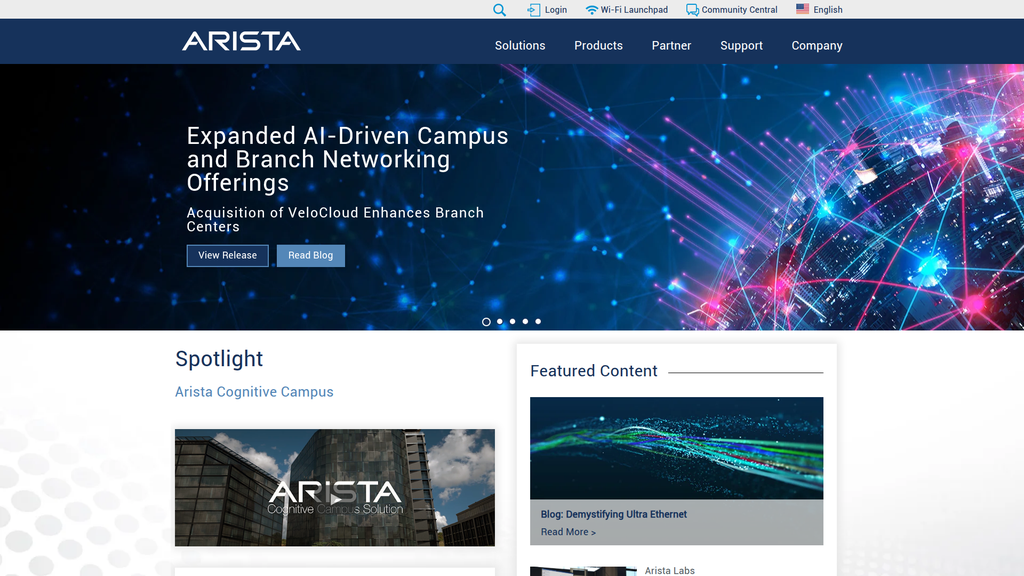
# 1 | Clarity Score High | Location Homepage Hero Banner | Message Expanded AI-Driven Campus and Branch Networking Offerings | Prominence Primary |
# 2 | Clarity Score High | Location Homepage Hero Banner | Message Introducing Intelligent Innovations for AI Networking | Prominence Primary |
# 3 | Clarity Score Medium | Location Homepage Hero Banner (Sub-headline) | Message Arista EOS Smart AI Suite fuels peak AI workload performance | Prominence Secondary |
# 4 | Clarity Score High | Location Homepage - Products Section | Message Arista is the leader in building scalable high-performance and ultra-low-latency networks for today's data center and cloud computing environments. | Prominence Secondary |
# 5 | Clarity Score High | Location Homepage Hero Banner | Message 10 years as a public company • 20 years founded • 100M ports shipped | Prominence Primary |
The message hierarchy is strong and focused. The most prominent messages consistently and immediately position Arista at the forefront of AI-driven networking. This singular focus is effective for establishing a clear market position. Secondary messages about performance, scalability, and milestones effectively support this primary claim by providing evidence and building credibility.
Messaging is highly consistent across the marketing-focused sections of the website. The theme of 'AI Networking' is central and reinforced through press releases, blog posts, and product descriptions. A significant, though expected, tonal and linguistic shift occurs in technical and legal documents like the Master Services Agreement, which moves from strategic, benefit-oriented language to precise, formal, and risk-averse legal terminology. This is standard for the industry but represents a different facet of the overall brand communication.
Brand Voice›
Voice Attributes›
- Attribute:
Authoritative
Strength:Strong
Examples›
- •
Arista Networks is the leader in building scalable high-performance and ultra-low-latency networks...
- •
Introducing Intelligent Innovations for AI Networking
- •
Arista is Proud to Celebrate Significant Milestones in 2024
- Attribute:
Innovative
Strength:Strong
Examples›
- •
Expanded AI-Driven Campus and Branch Networking Offerings
- •
Arista EOS Smart AI Suite fuels peak AI workload performance
- •
The Ultra Ethernet Consortium Launches Specification 1.0
- Attribute:
Technical
Strength:Strong
Examples›
- •
Arista EOS Smart AI Suite
- •
Multi-Vendor MPLS & SDN Interoperability Test Report 2025
- •
Demystifying Ultra Ethernet
- Attribute:
Formal & Legalistic
Strength:Strong
Examples›
- •
PLEASE READ THIS MASTER SERVICES AGREEMENT (“AGREEMENT”) CAREFULLY...
- •
BY PURCHASING OR USING THE ARISTA NETWORKS PRODUCTS AND/OR SERVICES, YOU ARE CONSENTING TO BE BOUND BY THIS AGREEMENT.
- •
IN NO EVENT SHALL ARISTA... BE LIABLE FOR ANY INCIDENTAL, SPECIAL, INDIRECT, PUNITIVE OR CONSEQUENTIAL DAMAGES...
Tone Analysis›
Expert
Secondary Tones›
Forward-looking
Confident
Tone Shifts›
The most significant tone shift is from the confident, forward-looking marketing language on the main site to the dense, formal, and cautionary tone of the Master Services Agreement. This is a necessary shift for the document's purpose but highlights the different communication modes the company must adopt.
Voice Consistency Rating›
Good
Consistency Issues›
While consistent within their respective domains (marketing vs. legal), there is little attempt to bridge the two voices. A more unified brand voice could soften the transition for customers moving from marketing discovery to procurement, though the target audience is technically savvy and likely expects this separation.
Value Proposition Assessment›
Arista provides industry-leading, AI-driven, software-defined networking solutions that deliver the high performance, scalability, and low latency required for the most demanding data center, cloud, and enterprise environments.
Value Proposition Components›
| # | Clarity | Component | Notes | Uniqueness |
|---|---|---|---|---|
# 1 | Clarity Clear | Component Leadership in AI Networking | Notes Arista strongly claims this space, which is a powerful differentiator in the current market. | Uniqueness Somewhat Unique |
# 2 | Clarity Clear | Component High Performance & Low Latency | Notes This is table stakes in the high-end networking market, but Arista effectively links it to the specific needs of AI workloads. | Uniqueness Common |
# 3 | Clarity Somewhat Clear | Component Software-Driven Architecture (EOS) | Notes Mentioned as 'Arista EOS Smart AI Suite', but the strategic importance of a single, extensible OS could be explained more clearly in terms of business benefits (e.g., operational simplicity, automation). | Uniqueness Unique |
# 4 | Clarity Clear | Component Scalability for Large Environments | Notes Communicated effectively through their target customer descriptions ('Cloud Titans', 'Large Data Center'). | Uniqueness Common |
Arista's messaging effectively differentiates the company by relentlessly focusing on the future of networking, specifically AI. While competitors like Cisco and Juniper also offer high-performance networking, Arista's brand communication is more tightly focused on being the purpose-built solution for the AI era. This positions them not just as a provider, but as an innovator and thought leader in the industry's most critical growth area. Their emphasis on an open, standards-based approach also contrasts with more traditionally proprietary competitors.
The messaging positions Arista as a premium, forward-thinking leader, targeting the most technologically advanced and demanding customers, such as 'Cloud Titans' and large financial institutions. They are not competing to be the solution for everyone, but the best solution for mission-critical, high-scale environments. This is a classic 'thought leader' positioning that justifies premium pricing and builds a powerful brand halo.
Audience Messaging›
Target Personas›
- Persona:
Technical Decision-Makers (Network Architects, Data Center/Cloud Engineers, CTOs)
Tailored Messages›
- •
Arista EOS Smart AI Suite fuels peak AI workload performance
- •
Report: Driving AI Networking at Scale with Standards- Based Ethernet
- •
Blog: Demystifying Ultra Ethernet
- •
Multi-Vendor MPLS & SDN Interoperability Test Report 2025
Effectiveness:Effective
- Persona:
Large Enterprise & Cloud Provider Executives (CIOs, VPs of Infrastructure)
Tailored Messages›
- •
10 years as a public company • 20 years founded • 100M ports shipped
- •
Acquisition of VeloCloud Enhances Branch Centers
- •
Arista Networks, Inc. Reports Second Quarter 2025 Financial Results
Effectiveness:Somewhat Effective
Audience Pain Points Addressed›
- •
Network performance bottlenecks for AI/ML workloads
- •
Complexity of scaling and managing massive data center networks
- •
Need for network automation and operational simplicity
- •
Avoiding vendor lock-in through standards-based solutions
Audience Aspirations Addressed›
- •
Building a future-proof network infrastructure ready for next-generation applications
- •
Enabling cutting-edge AI innovation within their organization
- •
Achieving market leadership through superior technology infrastructure
- •
Simplifying network operations to focus on strategic initiatives
Persuasion Elements›
Emotional Appeals›
- Appeal Type:
Confidence/Trust (Logos & Ethos)
Effectiveness:High
Examples›
- •
Arista is Proud to Celebrate Significant Milestones in 2024
- •
100M ports shipped
- •
The Arista Advantage (Whitepaper)
- Appeal Type:
Ambition/Aspiration (Future-focus)
Effectiveness:Medium
Examples›
Introducing Intelligent Innovations for AI Networking
The Ultra Ethernet Consortium Launches Specification 1.0
Social Proof Elements›
- Proof Type:
Milestones & Scale
Impact:Strong
Examples›
10 years as a public company • 20 years founded • 100M ports shipped
- Proof Type:
Expert Endorsement (Third-party reports)
Impact:Strong
Examples›
Multi-Vendor MPLS & SDN Interoperability Test Report 2025
Report: Driving AI Networking at Scale with Standards- Based Ethernet
- Proof Type:
Financial Performance
Impact:Moderate
Examples›
Arista Networks, Inc. Reports Second Quarter 2025 Financial Results
Trust Indicators›
- •
Publicly traded company status (NYSE: ANET)
- •
Detailed financial reporting
- •
Links to technical whitepapers and in-depth reports
- •
Prominent celebration of company milestones and stability
Scarcity Urgency Tactics›
Calls To Action›
Primary Ctas›
| # | Clarity | Location | Text |
|---|---|---|---|
# 1 | Clarity Clear | Location Homepage Hero Banners | Text View Release |
# 2 | Clarity Clear | Location Homepage Hero Banners | Text Read Blog |
# 3 | Clarity Clear | Location Product Sections | Text Learn More |
# 4 | Clarity Clear | Location Featured Content | Text Launch Labs |
# 5 | Clarity Clear | Location Featured Content | Text Watch Intro |
The CTAs are highly effective for the target audience. They are 'low-friction' and focus on education and exploration ('Learn More', 'Read Blog', 'Launch Labs') rather than sales pressure ('Contact Sales'). This aligns perfectly with the long, considered purchase cycle for enterprise networking hardware. The 'Launch Labs' CTA is particularly powerful as it offers a hands-on experience, which is a compelling form of persuasion for a technical audience.
Messaging Gaps Analysis›
Critical Gaps›
Lack of explicit business outcome messaging. The site excels at explaining 'what' the technology is and 'how' it works, but is weaker on explicitly stating the tangible business outcomes (e.g., 'Reduce AI model training time by X%', 'Lower network operational costs by Y%').
Absence of prominent customer proof. While Arista has prestigious customers, their logos, testimonials, or case studies are not featured prominently on the homepage, which is a missed opportunity for building immediate credibility and social proof.
Contradiction Points›
Underdeveloped Areas›
Persona-based content journeys. The site treats all visitors as technical experts. There isn't a clear messaging track for a less technical but highly influential CIO or CFO who may be more interested in Total Cost of Ownership (TCO), ROI, and strategic business alignment.
Solution-based messaging for specific industries. While their customer base includes finance and service providers, the homepage messaging is generic. Tailoring the value proposition to specific industry challenges (e.g., 'AI Networking for Financial Services') could be more impactful.
Messaging Quality›
Strengths›
- •
Clear, consistent, and powerful positioning around AI networking.
- •
Authoritative and credible brand voice that resonates with a technical audience.
- •
Excellent use of data points and milestones to build trust and demonstrate leadership.
- •
Content strategy (blogs, reports, labs) is perfectly aligned with the target audience's needs.
Weaknesses›
- •
Over-reliance on technical jargon can alienate business-focused stakeholders.
- •
Lack of emotional storytelling and relatable customer success narratives on the homepage.
- •
Value proposition is not always translated into quantifiable business benefits.
Opportunities›
- •
Develop a dedicated 'Solutions' section on the homepage targeting key industries (Cloud, Finance, Enterprise AI).
- •
Create a 'Why Arista for the C-Suite' content track focusing on business metrics like TCO, agility, and competitive advantage.
- •
Integrate customer logos and short, powerful case study headlines on the homepage to provide immediate social proof.
Optimization Roadmap›
Priority Improvements›
| # | Area | Expected Impact | Recommendation |
|---|---|---|---|
# 1 | Area Homepage Value Proposition | Expected Impact High | Recommendation Incorporate a messaging block that explicitly translates key technical features into business outcomes. For example: 'Arista's low-latency fabric reduces AI training times, accelerating your time-to-market.' |
# 2 | Area Social Proof | Expected Impact High | Recommendation Add a 'Trusted By' section on the homepage featuring logos of key enterprise customers and cloud titans. Accompany this with a rotating 'Customer Spotlight' module linking to case studies. |
# 3 | Area Audience Segmentation | Expected Impact Medium | Recommendation Create distinct content modules or navigation paths for different personas. For example, a 'For Technologists' path leading to labs and whitepapers, and a 'For Business Leaders' path leading to ROI calculators and business-focused solution briefs. |
Quick Wins›
- •
Add a sub-headline to the main hero banner that frames the benefit in business terms.
- •
Feature a compelling quote from a customer testimonial directly on the homepage.
- •
Re-title some 'Featured Content' from technical terms to benefit-oriented headlines (e.g., change 'Demystifying Ultra Ethernet' to 'How Ultra Ethernet Future-Proofs Your AI Investment').
Long Term Recommendations›
- •
Develop a comprehensive messaging matrix that maps product features to technical benefits and then to specific business outcomes for key target personas and industries.
- •
Invest in video-based customer testimonials that tell a story of transformation, moving beyond purely technical case studies.
- •
Build out a library of industry-specific content that addresses the unique networking challenges and opportunities within sectors like financial trading, media production, and scientific research.
Arista Networks has crafted a powerful and highly effective messaging strategy that successfully positions it as the undisputed leader in the high-growth AI networking sector. The brand voice is authoritative, innovative, and technically proficient, speaking directly and credibly to its core audience of network architects and engineers at the world's largest cloud and enterprise companies. The message architecture is clear and hierarchical, with 'AI-Driven Networking' serving as the unambiguous primary message, supported by strong proof points like company milestones and technical leadership. Persuasion is achieved through appeals to logic and authority (ethos and logos), leveraging technical reports, industry-first announcements, and impressive scale metrics ('100M ports shipped') to build trust and confidence.
The primary weakness and most significant opportunity for Arista's messaging lies in its singular focus on a technical audience. The communication does an excellent job of explaining what the technology is and how it's superior but falls short in translating these technical advantages into the explicit, quantifiable business outcomes that resonate with C-suite executives like CIOs and CFOs. Critical messaging elements such as customer success stories, case studies, and clear ROI propositions are absent from the high-level homepage narrative. While the current strategy is clearly successful, enhancing the messaging to include a parallel track focused on business value—addressing pain points around TCO, business agility, and competitive advantage—would broaden its appeal and strengthen its position during high-level procurement discussions. Implementing an optimization roadmap focused on showcasing customer proof and translating features into business benefits would evolve Arista's messaging from being merely best-in-class for engineers to being an undeniable strategic investment for the entire enterprise.
Growth Readiness
Growth Foundation›
Product Market Fit›
Strong
Evidence›
- •
Market share leadership in the high-speed data center switching market, having surpassed Cisco in Q4 2023 in this segment.
- •
Strong penetration with hyperscale and 'Cloud Titan' customers like Microsoft and Meta, which constitute a significant portion of revenue.
- •
Robust revenue growth, with a raised forecast for 2025 to approximately 25% growth, driven by demand for AI and cloud solutions.
- •
The flagship Extensible Operating System (EOS) and CloudVision management platform are highly regarded for reliability, programmability, and automation, creating a sticky software ecosystem.
- •
Successful expansion into adjacent markets through strategic acquisitions like Awake Security (network security) and VeloCloud (SD-WAN).
Improvement Areas›
- •
Deepen penetration into the enterprise campus and branch networking markets to diversify revenue away from hyperscaler concentration.
- •
Strengthen the go-to-market strategy for the broader enterprise segment, which requires a different sales motion and channel partner ecosystem than the direct-sales model for cloud titans.
- •
Enhance the integration and cross-selling of acquired technologies (Awake Security, VeloCloud) with the core Arista portfolio to create unified solutions.
Market Dynamics›
The core cloud networking and data center markets are growing robustly. The multi-cloud networking market is projected to grow at a CAGR of 26.5% in 2025. The broader AI in networking market is forecasted to grow at a CAGR between 15.9% and 33.8%.
Mature with high-growth segments
Market Trends›
| # | Business Impact | Trend |
|---|---|---|
# 1 | Business Impact Drives massive demand for high-performance, low-latency Ethernet fabrics (800G and beyond), which is Arista's core strength. Arista projects over $1.5 billion from AI-related solutions in 2025. | Trend Explosive Growth in AI/ML Workloads |
# 2 | Business Impact Increases the need for consistent network operations and automation across disparate environments, creating strong demand for management platforms like Arista's CloudVision. | Trend Hybrid and Multi-Cloud Adoption |
# 3 | Business Impact Creates a large new addressable market in campus and branch networking. The VeloCloud acquisition is a direct strategic response to this trend. | Trend Expansion of the Enterprise Edge and SD-WAN |
# 4 | Business Impact Offers a significant opportunity to bundle security services (from the Awake acquisition) with networking hardware and software, increasing the average revenue per customer. | Trend Convergence of Networking and Security (SASE) |
Excellent. Arista is well-positioned at the intersection of several powerful, long-term secular growth trends, particularly the build-out of AI infrastructure.
Business Model Scalability›
High
Characterized by high upfront R&D investment in EOS and hardware design, which scales effectively with high-volume production. Arista maintains a lean operational expense structure compared to competitors.
High. The single EOS software image across all products creates significant operational leverage in R&D, support, and customer training, reducing complexity and cost.
Scalability Constraints›
Potential supply chain constraints for advanced merchant silicon and optical components required for high-speed switches.
Scaling a high-touch, enterprise-focused sales and support organization globally presents a different challenge than serving a concentrated set of hyperscale customers.
Team Readiness›
Exceptional. Led by a seasoned and highly-respected executive team with deep industry experience and a proven track record of innovation and execution.
Historically optimized for the data center market. The recent acquisition of VeloCloud will require further integration and potential restructuring to effectively target the enterprise SD-WAN and campus markets.
Key Capability Gaps›
Enterprise-focused channel management and marketing expertise to compete with incumbents like Cisco in the campus and branch markets.
Broader security expertise beyond network detection and response to build a comprehensive SASE platform.
Growth Engine›
Acquisition Channels›
| # | Channel | Effectiveness | Optimization Potential | Recommendation |
|---|---|---|---|---|
# 1 | Channel Direct Sales to Cloud Titans/Hyperscalers | Effectiveness High | Optimization Potential Medium | Recommendation Deepen strategic alignment with key customers' AI roadmaps to co-develop next-generation networking solutions and secure long-term design wins. |
# 2 | Channel Channel Partners (VARs, System Integrators) | Effectiveness Medium | Optimization Potential High | Recommendation Aggressively expand and enable the channel partner ecosystem for the campus, branch, and broader enterprise markets, leveraging the VeloCloud acquisition to attract new partners. |
# 3 | Channel Digital/Inbound Marketing | Effectiveness Low | Optimization Potential High | Recommendation Invest in content marketing and thought leadership focused on solving enterprise challenges in AI, multi-cloud, and campus networking to generate qualified inbound leads. |
Customer Journey›
Dominated by a long, high-touch B2B sales cycle involving technical evaluations, proof-of-concepts (PoCs), and competitive bake-offs, especially in enterprise accounts.
Friction Points›
- •
High switching costs for enterprises deeply embedded with competitor ecosystems (e.g., Cisco's proprietary protocols and certifications).
- •
Perceived complexity of migrating from legacy three-tier network architectures to Arista's preferred leaf-spine architecture.
- •
Lack of a single-vendor solution for the full networking and security stack (though this is changing with recent acquisitions).
Journey Enhancement Priorities›
Migration Tools & Services
Develop and promote automated tools and professional service packages to simplify migration from Cisco and other legacy vendors.
Enterprise Proof-of-Concept Programs
Create streamlined, low-friction PoC programs for campus and SD-WAN solutions, making it easy for enterprise IT teams to evaluate Arista's technology.
Retention Mechanisms›
| # | Effectiveness | Improvement Opportunity | Mechanism |
|---|---|---|---|
# 1 | Effectiveness High | Improvement Opportunity Expand CloudVision's capabilities with more AI-driven analytics, predictive insights, and third-party integrations to make it indispensable for network operations. | Mechanism EOS and CloudVision Ecosystem Lock-in |
# 2 | Effectiveness High | Improvement Opportunity Develop specialized service offerings tailored to AI cluster deployments and SASE implementations to drive higher services attachment rates. | Mechanism A-Care Support and Professional Services |
# 3 | Effectiveness High | Improvement Opportunity Maintain technological leadership in performance and latency, particularly for AI workloads, to ensure customers have no technical reason to switch. | Mechanism High Performance & Reliability |
Revenue Economics›
Excellent. Arista commands premium pricing for its high-performance hardware and software, supported by strong gross margins (though these can fluctuate with customer mix).
High (Undetermined public value). Large initial deal sizes, multi-year support contracts, and software subscriptions combined with high retention in the core market lead to a very favorable LTV/CAC ratio.
High. The company demonstrates strong revenue growth and profitability, with a more efficient sales and marketing spend as a percentage of revenue compared to key competitors.
Optimization Recommendations›
- •
Increase software and services revenue as a percentage of total revenue to create more predictable, recurring revenue streams.
- •
Drive expansion revenue within the existing customer base by cross-selling the newly acquired security and SD-WAN solutions.
- •
Implement value-based pricing tiers for CloudVision to capture more value from customers leveraging its advanced AI/ML features.
Scale Barriers›
Technical Limitations›
| # | Impact | Limitation | Solution Approach |
|---|---|---|---|
# 1 | Impact High | Limitation Keeping Pace with AI Hardware Innovation | Solution Approach Maintain deep co-engineering partnerships with silicon vendors (Broadcom, Nvidia, etc.) and AI accelerator manufacturers to ensure network capabilities match the demands of next-gen GPUs/TPUs. |
Operational Bottlenecks›
| # | Bottleneck | Growth Impact | Resolution Strategy |
|---|---|---|---|
# 1 | Bottleneck Supply Chain for Advanced Components | Growth Impact High. Can lead to extended lead times and impact ability to meet surges in demand from hyperscalers. | Resolution Strategy Further diversify the supplier base for critical components like optics and ASICs. Implement advanced supply chain forecasting models based on customer AI build-out plans. |
# 2 | Bottleneck Scaling Professional and Support Services for Enterprise | Growth Impact Medium. A failure to provide enterprise-grade global support could hinder adoption in the campus/branch market. | Resolution Strategy Invest heavily in training and certification programs for channel partners to co-deliver services. Build out global TAC (Technical Assistance Center) capabilities to support new technologies like SD-WAN. |
Market Penetration Challenges›
| # | Challenge | Mitigation Strategy | Severity |
|---|---|---|---|
# 1 | Challenge Displacing Incumbent Competitors (Cisco) | Mitigation Strategy Compete on technical superiority (open standards, programmability, single OS) while creating a compelling economic case through lower TCO. Leverage the VeloCloud acquisition to offer a market-leading SD-WAN solution. | Severity Critical |
# 2 | Challenge Intensifying Competition in AI Networking (Nvidia) | Mitigation Strategy Champion open, standards-based Ethernet as the superior choice for large-scale AI clusters versus proprietary interconnects like InfiniBand. Form alliances with other server and AI chip vendors to create a broad ecosystem. | Severity Major |
# 3 | Challenge High Customer Concentration | Mitigation Strategy Successfully execute the enterprise and campus/branch expansion strategy to diversify the customer base and reduce reliance on a few 'Cloud Titan' accounts. | Severity Major |
Resource Limitations›
Talent Gaps›
- •
Experienced enterprise and channel sales leaders.
- •
Software engineers with expertise in cybersecurity and SASE.
- •
AI/ML engineers to further develop the capabilities of CloudVision and other AI-driven offerings.
Low. The company is highly profitable with a strong balance sheet ($8.15B in cash as of Q1 2025), capable of funding both organic growth and strategic acquisitions.
Infrastructure Needs›
Expansion of global logistics and parts depots to support enterprise service level agreements (SLAs) for the VeloCloud customer base.
Investment in advanced R&D labs to test and validate large-scale AI fabrics.
Growth Opportunities›
Market Expansion›
| # | Expansion Vector | Implementation Complexity | Potential Impact | Recommended Approach |
|---|---|---|---|---|
# 1 | Expansion Vector Enterprise Campus & Branch Networking | Implementation Complexity High | Potential Impact High | Recommended Approach Fully integrate the VeloCloud acquisition into Arista's sales and marketing engine. Build a robust channel program to attack this market where Cisco is the entrenched incumbent. |
# 2 | Expansion Vector Geographic Expansion (Asia-Pacific, Europe) | Implementation Complexity Medium | Potential Impact Medium | Recommended Approach Invest in regional sales and support infrastructure, tailoring solutions to local market needs and regulatory environments. |
# 3 | Expansion Vector Tier 2/3 Cloud Providers and Large Enterprises | Implementation Complexity Medium | Potential Impact High | Recommended Approach Develop targeted go-to-market campaigns and solution bundles that bring hyperscale principles and automation to this segment in a more turnkey fashion via CloudVision. |
Product Opportunities›
| # | Development Recommendation | Market Demand Evidence | Opportunity | Strategic Fit |
|---|---|---|---|---|
# 1 | Development Recommendation Accelerate integration of existing assets and consider further tuck-in acquisitions for missing components like Zero Trust Network Access (ZTNA) or Cloud Access Security Broker (CASB). | Market Demand Evidence The convergence of networking and security is a major industry trend, with a projected market size exceeding $10 billion in 2025. | Opportunity Develop a Comprehensive SASE Platform | Strategic Fit High. Leverages the core networking portfolio, the Awake Security acquisition for threat detection, and the VeloCloud acquisition for the network edge. |
# 2 | Development Recommendation Double down on R&D for AI/ML features within CloudVision, focusing on predictive failure analysis, automated remediation, and generative AI-powered troubleshooting assistants. | Market Demand Evidence Enterprises are struggling with network complexity; AIOps solutions that offer automation and predictive analytics are in high demand. | Opportunity AI-Native Networking Operations (AIOps) | Strategic Fit Excellent. This is a natural evolution of the CloudVision platform, leveraging its network-wide data lake. |
# 3 | Development Recommendation Develop ruggedized hardware and software packages optimized for edge deployment scenarios, managed seamlessly via CloudVision. | Market Demand Evidence The growth of IoT and edge applications requires robust, centrally managed networking solutions at the edge. The edge computing market is growing rapidly. | Opportunity Edge Computing Networking Solutions | Strategic Fit High. Extends Arista's data center principles to the edge, complementing the new campus/branch portfolio. |
Channel Diversification›
| # | Channel | Fit Assessment | Implementation Strategy |
|---|---|---|---|
# 1 | Channel Managed Service Providers (MSPs) | Fit Assessment Excellent. VeloCloud has a strong existing MSP channel that can be leveraged to sell a broader Arista portfolio. | Implementation Strategy Create a formal MSP program with multi-tenant management capabilities in CloudVision, consumption-based pricing models, and dedicated partner support. |
# 2 | Channel Two-Tier Distribution | Fit Assessment Good for high-volume enterprise and campus products. | Implementation Strategy Partner with major global distributors to reach a wider base of smaller VARs that are not feasible to manage directly. |
Strategic Partnerships›
- Partnership Type:
AI Ecosystem Alliance
Potential Partners›
- •
Nvidia
- •
AMD
- •
Intel
- •
Major AI framework providers (e.g., PyTorch, TensorFlow)
Expected Benefits:Ensure seamless interoperability and performance of Arista's Ethernet fabrics with AI accelerators. Co-develop reference architectures for AI pods and clusters to simplify customer deployments.
- Partnership Type:
Multi-Cloud Integration
Potential Partners›
- •
Amazon Web Services (AWS)
- •
Microsoft Azure
- •
Google Cloud Platform (GCP)
Expected Benefits:Deeper integration of CloudVision and CloudEOS with native cloud networking constructs, simplifying hybrid and multi-cloud management for customers and driving marketplace sales.
- Partnership Type:
Cybersecurity Technology Alliance
Potential Partners›
- •
CrowdStrike
- •
Zscaler
- •
Palo Alto Networks
Expected Benefits:Create integrated security solutions that share telemetry between the network and endpoint/cloud security platforms, providing better threat detection and response, and forming a foundational SASE ecosystem.
Growth Strategy›
North Star Metric›
Number of Devices Under CloudVision Management
This metric encapsulates hardware sales (new devices), software adoption (CloudVision license), and customer stickiness. Growth in this metric indicates not just product sales, but deeper customer integration into Arista's management ecosystem, which is a strong predictor of retention and expansion revenue.
30% Year-over-Year Growth
Growth Model›
Hybrid: Sales-Led Acquisition & Product-Led Expansion
Key Drivers›
- •
Direct sales force landing large enterprise and cloud accounts.
- •
Channel partners driving volume in the campus and mid-enterprise.
- •
CloudVision platform acting as the vehicle for up-selling new software modules (e.g., advanced analytics, security).
- •
Seamless integration of new hardware into the existing EOS/CloudVision ecosystem.
Equip the sales team to lead with the platform vision ('Arista 2.0'). Create a frictionless process for customers to trial and adopt new CloudVision features, driving organic expansion within accounts.
Prioritized Initiatives›
| # | Expected Impact | First Steps | Implementation Effort | Initiative | Timeframe |
|---|---|---|---|---|---|
# 1 | Expected Impact High | First Steps Launch a unified Arista + VeloCloud branding and messaging campaign. Create a fast-track channel partner onboarding program for VeloCloud partners to sell the broader Arista portfolio. | Implementation Effort High | Initiative Aggressive Enterprise SD-WAN & Campus Market Push | Timeframe 12-24 months |
# 2 | Expected Impact High | First Steps Publish reference architectures and performance benchmarks for building large-scale AI clusters using Arista Ethernet. Launch a targeted marketing campaign aimed at CTOs and AI infrastructure leaders. | Implementation Effort Medium | Initiative Dominate the AI Networking Backend | Timeframe 6-18 months |
# 3 | Expected Impact High | First Steps Create a bundled SKU for VeloCloud edge devices with Awake security sensors, managed through a unified CloudVision dashboard. Pilot the solution with 5-10 strategic enterprise customers. | Implementation Effort Medium | Initiative Launch 'SASE 1.0' Solution Bundle | Timeframe 9-15 months |
Experimentation Plan›
High Leverage Tests›
Consumption-based pricing models for CloudVision in the MSP channel.
A pay-as-you-grow model will accelerate adoption by MSPs compared to traditional perpetual or subscription licenses.
Bundled 'Campus Starter Kits' (Switches + Wi-Fi + CloudVision) sold through distribution.
Pre-packaged, simplified bundles will lower the barrier to entry for smaller enterprises and accelerate channel sales.
Track key metrics including new customer acquisition cost (CAC), sales cycle length, channel partner activation rate, and expansion revenue from new offerings.
Quarterly review of experiment results to inform strategic adjustments and resource allocation.
Growth Team›
Establish dedicated, cross-functional 'Growth Pods' for each key strategic initiative (e.g., 'Enterprise Edge Pod', 'AI Networking Pod') comprising members from product, marketing, sales, and engineering.
Key Roles›
- •
Head of Channel Strategy & Enablement (Enterprise)
- •
Director of Product Marketing, SASE
- •
AI Networking Solutions Architect
- •
Growth Product Manager
Invest in training for the existing sales force on solution-selling the new portfolio. Hire external talent with deep experience in enterprise channels and cybersecurity go-to-market strategies.
Arista Networks is in an exceptionally strong position for sustained, high-speed growth, standing at the epicenter of the two most significant trends in technology today: Artificial Intelligence and multi-cloud adoption. Its foundation is rock-solid, built upon a superior, software-defined architecture (EOS & CloudVision) that has earned it market leadership in the demanding hyperscale data center space. The company's timing is impeccable, as the demand for high-performance Ethernet fabrics for AI workloads is exploding, directly playing to its core competency. The recent strategic acquisition of VeloCloud is a transformative move that cracks open the vast enterprise campus and branch networking market, providing a powerful new growth vector to diversify its customer base away from the highly concentrated cloud titans. This move, combined with its Awake Security assets, lays a clear path toward building a formidable Secure Access Service Edge (SASE) platform, a multi-billion dollar opportunity. The primary challenges are not existential but executional. Arista must navigate the significant market penetration challenge of displacing the entrenched incumbent, Cisco, in the enterprise, which requires a fundamentally different go-to-market motion and a robust channel ecosystem. Simultaneously, it faces intensifying competition from Nvidia in its core AI networking business. The overarching growth strategy must be a 'two-front war': first, to defend and dominate the AI data center with open, standards-based solutions, and second, to aggressively attack the enterprise edge with an integrated, secure networking platform. Success will hinge on flawlessly integrating its recent acquisitions, building a world-class enterprise channel, and continuing to out-innovate the competition with its software-first approach. If executed effectively, Arista has a clear trajectory to not only grow but to redefine the landscape of modern networking for the AI era.
Legal Compliance
Arista Networks maintains a comprehensive and globally-oriented Privacy Policy, accessible from the website's footer. The policy is detailed, addressing requirements under major data protection regimes including GDPR and CCPA/CPRA. It clearly outlines the categories of personal information collected, the purposes for processing, and the legal bases for doing so (e.g., consent, contractual necessity). The policy effectively distinguishes Arista's role as a data controller for its own website and marketing activities from its role as a data processor when providing cloud services to customers. It informs users of their data subject rights (access, deletion, etc.) and provides contact methods for exercising these rights. The policy also details data sharing practices with affiliates and service providers. Overall, the policy is a strong foundational document demonstrating a mature understanding of global privacy obligations. However, its implementation on the website, particularly regarding CCPA/CPRA-specific requirements for links, presents a minor gap.
Arista employs a dual-layer approach to its terms. For general website visitors, there is a clear 'Terms of Use' agreement accessible via the footer. This document covers standard provisions such as intellectual property rights for website content, disclaimers of liability, and acceptable use. For commercial customers, Arista utilizes a detailed and robust 'Master Services Agreement' (MSA), provided in the prompt. The MSA is a sophisticated B2B legal instrument that governs the purchase of products and services. It includes specific exhibits for different service lines like A-Care Support, Professional Services, and Awake Security Services. This modular approach is excellent for clarity and enforceability. The MSA clearly defines terms, payment obligations, limitation of liability, and crucial industry-specific clauses like export controls. This strong contractual framework is a significant business asset, providing legal certainty and managing risk in its customer relationships.
Upon visiting the website, a cookie consent banner is presented to the user. The banner offers 'Accept All Cookies' and 'Reject All' options, which is a positive step toward compliance. It also provides a 'Cookie Settings' option for more granular control, allowing users to opt-in or out of different categories of cookies (e.g., Performance, Functional, Targeting). The banner appropriately blocks non-essential cookies from being placed before the user gives explicit consent. This mechanism aligns well with the stringent opt-in requirements of GDPR. The ability to easily reject all non-essential cookies is a key strength. The presence of a persistent 'Cookie Settings' link in the footer allows users to change their preferences at any time.
Arista's overall data protection framework appears robust, anchored by its detailed Privacy Policy and a comprehensive Data Privacy Addendum (DPA) available for its cloud services customers. The DPA outlines Arista's commitments as a data processor, including implementing appropriate technical and organizational security measures, ensuring data confidentiality, and assisting customers with their own compliance obligations like Data Protection Impact Assessments (DPIAs) under GDPR. The 'Awake Security Services Exhibit' within the MSA is particularly noteworthy, as it carefully delineates responsibilities and liabilities when handling highly sensitive customer network data during incident response, which is a critical risk-mitigation strategy for this service line. The clear distinction between processor/controller roles shows legal sophistication and helps manage customer expectations and regulatory risk effectively.
A high-level analysis of arista.com indicates a reasonable baseline for web accessibility, though it falls short of full WCAG 2.1 AA conformance. Strengths include a logical site structure, readable fonts, and generally good color contrast. However, some gaps are apparent upon inspection. For instance, some interactive elements and images on the homepage lack descriptive alt-text, which would hinder users relying on screen readers. Keyboard navigation is functional but could be improved for a smoother user experience. While not a severe legal risk for a B2B company compared to a public-facing government or consumer site, improving accessibility to meet WCAG 2.1 AA standards would broaden audience reach and mitigate potential future legal challenges.
Arista demonstrates a strong command of two critical, industry-specific compliance areas: Export Controls and Cybersecurity Service Provider Obligations. The Master Services Agreement contains a detailed and explicit 'Export' clause (Section 9) that references U.S. and E.U. regulations and specifically prohibits sales to sanctioned regions, reflecting a robust compliance program for its hardware and software products. For its cybersecurity offerings ('Awake Security Services'), the legal terms are strategically drafted to manage the high-risk nature of the work. The terms include crucial disclaimers about not guaranteeing the detection of all malware, clarifying customer responsibility for data backup, and obtaining necessary customer consents for network access. This demonstrates a mature understanding of the legal risks inherent in providing incident response and network monitoring services.
Compliance Gaps›
- •
Missing Prominent 'Do Not Sell or Share' Link: The website footer and Privacy Policy lack a distinct and easily accessible link titled 'Do Not Sell or Share My Personal Information,' which is a specific requirement under the California Privacy Rights Act (CPRA). While the privacy policy describes user rights, the lack of this explicit link is a clear compliance gap.
- •
No Explicit Mention of US State Privacy Laws Beyond California: The privacy policy focuses heavily on GDPR and CCPA/CPRA but lacks specific mention of other emerging US state privacy laws (e.g., from Colorado, Virginia, Utah, Connecticut), which have slightly different requirements and definitions.
- •
Incomplete Web Accessibility: The website does not fully conform to WCAG 2.1 AA standards, with issues like missing alt-text on some key images and less-than-optimal keyboard navigation flow.
Compliance Strengths›
- •
Robust B2B Contractual Framework: The comprehensive Master Services Agreement (MSA) with detailed, service-specific exhibits provides exceptional legal clarity and risk management for customer engagements.
- •
Mature Privacy Policy: The global Privacy Policy is well-structured, addresses major international regulations like GDPR, and clearly defines Arista's roles as both a data controller and processor.
- •
Strong Export Control Posture: The MSA and Partner Code of Conduct explicitly address and enforce compliance with complex U.S. and E.U. export control laws, a critical requirement for a global hardware and software provider.
- •
Effective Cookie Consent Mechanism: The website features a GDPR-compliant cookie banner that allows for granular control and properly blocks non-essential cookies prior to user consent.
- •
Detailed Data Privacy Addendum (DPA): The availability of a DPA demonstrates a commitment to helping their customers meet their own data protection obligations, a key selling point for enterprise clients.
Risk Assessment›
| # | Recommendation | Risk Area | Severity |
|---|---|---|---|
# 1 | Recommendation Immediately add a link titled 'Do Not Sell or Share My Personal Information' to the website footer. This link should direct users to a page where they can easily opt-out of the sale or sharing of their data, which includes data used for cross-context behavioral advertising via third-party cookies. | Risk Area CCPA/CPRA Compliance | Severity Medium |
# 2 | Recommendation Conduct a formal accessibility audit against WCAG 2.1 AA standards. Prioritize fixing high-impact issues such as adding descriptive alt-text to all functional images and ensuring all interactive elements are fully accessible via keyboard. | Risk Area Web Accessibility (ADA/WCAG) | Severity Low |
# 3 | Recommendation Update the Privacy Policy to explicitly acknowledge and address the rights provided under other key U.S. state privacy laws (CO, VA, CT, UT), even if they largely overlap with GDPR and CCPA. This demonstrates proactive compliance. | Risk Area U.S. State Privacy Laws | Severity Low |
# 4 | Recommendation Continue to maintain and regularly update the robust export control compliance program. Ensure ongoing training for sales, logistics, and partner management teams on the specifics of the Export Administration Regulations (EAR) and international sanctions lists. | Risk Area Export Control Violation | Severity High |
High Priority Recommendations›
- •
Add a 'Do Not Sell or Share My Personal Information' link to the website footer to achieve full compliance with the California Privacy Rights Act (CPRA).
- •
Continue rigorous enforcement and regular training on the company's Export Control policies due to the high severity of potential violations.
- •
Initiate a formal web accessibility audit to identify and remediate gaps against WCAG 2.1 AA standards to enhance inclusivity and mitigate legal risk.
Arista Networks demonstrates a highly sophisticated and mature legal positioning for its core B2B operations, which serves as a significant strategic asset. The company's legal framework, built around a robust Master Services Agreement and service-specific exhibits, effectively manages risk, provides commercial clarity, and builds trust with its enterprise customer base. This is particularly evident in high-stakes areas like cybersecurity services and international export controls, where Arista's legal documentation is meticulous and comprehensive. This strong contractual posture enhances market access, especially with large, regulated customers who prioritize legal and compliance certainty.
However, there is a minor disconnect between this strong B2B legal posture and the compliance of its public-facing digital property, the company website. While foundational elements like the Privacy Policy and cookie consent mechanism are strong, the website has a distinct compliance gap regarding the California Privacy Rights Act (CPRA) by failing to provide the required 'Do Not Sell or Share My Personal Information' link. Furthermore, while not a critical flaw, the lack of full WCAG 2.1 AA accessibility presents a minor reputational and legal risk. These public-facing gaps, while less severe than a core contractual failure, are 'low-hanging fruit' for regulators and plaintiffs. By addressing these straightforward website compliance issues, Arista can align its public-facing legal posture with the exceptional standards it has set for its commercial operations, creating a more holistic and defensible compliance framework.
Visual
Business Context›
Arista Networks
Cloud Networking, Data Center Technology, AI Infrastructure
B2B
Primary Products›
- •
High-performance network switches and routers
- •
EOS (Extensible Operating System) software
- •
CloudVision® network management platform
- •
Cognitive Wi-Fi and NDR Security solutions
Target Audience›
- •
Large data centers and cloud service providers ('Cloud Titans')
- •
Large enterprises and campus environments
- •
Financial services (high-frequency trading)
- •
High-performance computing (HPC) and AI/ML environments
Key Competitors›
- •
Cisco Systems
- •
Juniper Networks
- •
Hewlett Packard Enterprise
- •
Dell Technologies
- •
Broadcom
A leader in data-driven, client-to-cloud networking, focusing on high-performance, scalability, and software-driven innovation through its EOS platform. Differentiates by challenging legacy, proprietary systems with open, programmable, and cost-effective solutions.
Design System›
Modern Corporate Tech
Excellent
Advanced
Color Palette›
Dark Blue (#002855), Medium Blue (#3477b6)
White, Light Gray (#f2f2f2)
Light Blue (#89c4f4)
The color scheme is professional, trustworthy, and evokes a sense of technology and reliability. The use of blue is consistent and reinforces the brand identity.
Typography›
Sans-serif (likely a custom or licensed font similar to Proxima Nova or Lato)
Good
Excellent
Clean, modern sans-serif typography is used consistently. Font weights and sizes are used effectively to create a clear hierarchy. Readability is strong across the site.
Iconography›
Outline, minimalist
Good
Subtle, technical outline-style icons are used to visually support product categories, reinforcing the high-tech nature of the business without being distracting.
User Experience›
Navigation›
Horizontal Mega Menu
Intuitive
Excellent
The top-level navigation is clear (Solutions, Products, Partner, Support, Company). On hover, it likely expands into well-organized mega menus, which is a standard and effective pattern for content-rich B2B tech sites.
Information Architecture›
Logical
Clear
Light
The homepage layout follows a logical flow, starting with a high-level value proposition (AI-Driven Networking), followed by spotlights, news, featured content, and product summaries. This structure caters to various user intents, from exploring news to diving into product specifics.
Conversion Elements›
| # | Effectiveness | Element | Improvement | Prominence |
|---|---|---|---|---|
# 1 | Effectiveness Somewhat effective | Element Hero Section Primary CTA ('View Release', 'Read Blog') | Improvement The CTA text is passive. Change to more action-oriented and benefit-driven language. For example, 'Explore the Acquisition' or 'Get the AI Networking Guide'. The visual distinction between the primary ('View Release') and secondary ('Read Blog') CTAs could be stronger. | Prominence High |
# 2 | Effectiveness Effective | Element Bottom Banner CTA ('Contact Us') | Improvement This is a well-placed, persistent CTA for users who have scrolled through the page and are ready to engage. Consider making the text more specific, e.g., 'Talk to an Expert' or 'Request a Demo'. | Prominence Medium |
# 3 | Effectiveness Effective | Element Product Section CTAs ('View Platforms', 'Learn More') | Improvement These CTAs are clear and contextually relevant. To further optimize, A/B test language that hints at the outcome, such as 'Discover Our Switches' or 'See CloudVision in Action'. | Prominence Medium |
Assessment›
Strengths›
| # | Aspect | Description | Impact |
|---|---|---|---|
# 1 | Aspect Clear Visual Hierarchy | Description The page uses size, color, and whitespace effectively to guide the user's eye. The main hero banner is immediately dominant, followed by clearly delineated sections for 'Spotlight', 'News', and 'Products'. This reduces cognitive load and allows users to quickly scan and find relevant information. | Impact High |
# 2 | Aspect Professional & Trustworthy Aesthetic | Description The design exudes competence and reliability, which is critical for a B2B company dealing with mission-critical network infrastructure. The polished look, high-quality imagery, and consistent branding build immediate trust with their target audience of technical decision-makers. | Impact High |
# 3 | Aspect Effective Content Chunking | Description Information is broken down into digestible cards and lists (e.g., 'News', 'Featured Content'). This makes complex topics scannable and less intimidating, encouraging users to click through and engage deeper with content marketing assets like blogs and reports. | Impact Medium |
Weaknesses›
| # | Aspect | Description | Impact |
|---|---|---|---|
# 1 | Aspect Generic Hero Imagery | Description The abstract hero image of a connected city is visually appealing but generic for the tech industry. It doesn't specifically showcase Arista's products or the unique environments they operate in (e.g., a modern data center), missing an opportunity for visual storytelling and differentiation. | Impact Medium |
# 2 | Aspect Passive Call-to-Action Language | Description CTAs like 'Read More' and 'View Release' are functional but lack persuasive power. This can lead to lower click-through rates on key content and product pages, potentially reducing lead generation and user engagement with marketing collateral. | Impact Medium |
# 3 | Aspect Lack of Social Proof or Customer Logos | Description For a company that serves Fortune 500 companies and 'Cloud Titans', the homepage lacks immediate social proof like customer logos or testimonials. While potentially reserved for deeper pages, a subtle display on the homepage could significantly boost credibility for new visitors. | Impact Low |
Priority Recommendations›
| # | Effort Level | Impact Potential | Rationale | Recommendation |
|---|---|---|---|---|
# 1 | Effort Level Medium | Impact Potential High | Rationale The hero section is the most valuable real estate. Replace the generic stock image with high-quality video or photography of Arista's technology in a real-world data center or campus environment. Simultaneously, A/B test more compelling, benefit-oriented CTA copy to increase click-through rates to key announcements and thought leadership content. | Recommendation Revamp Hero Section with Authentic Visuals and Stronger CTAs |
# 2 | Effort Level Low | Impact Potential Medium | Rationale Add a section below the hero or above the footer featuring the logos of key customers (with permission). This is a low-effort, high-impact way to immediately establish credibility and authority for prospective customers, aligning with their market position as a leader. | Recommendation Incorporate a 'Trusted By' Social Proof Section |
# 3 | Effort Level Low | Impact Potential Medium | Rationale Create a clear visual distinction in the design system for primary, secondary, and tertiary CTAs. Audit and update CTA copy across the site to be more active and value-driven (e.g., 'Get the Report' instead of 'Read More'). This small, site-wide change can cumulatively increase engagement and conversion rates. | Recommendation Standardize and Enhance CTA Design and Copy |
Mobile Responsiveness›
Excellent
The design appears well-structured to adapt cleanly to various breakpoints. The multi-column layouts on desktop will logically stack into single columns on mobile devices.
Mobile Specific Issues›
Potential for long scrolling on the homepage due to the vertical stacking of all desktop sections.
Mega menus in the navigation will need to be converted into a clean, accessible mobile menu (e.g., a hamburger menu with an accordion-style dropdown).
Desktop Specific Issues›
None observed; the desktop layout is clean, well-organized, and utilizes the screen real estate effectively.
As a senior UI/UX strategist, my audit of Arista.com reveals a mature, professional, and highly effective digital presence that aligns perfectly with its brand identity as a leader in high-performance networking. The website successfully projects an image of trust, technological sophistication, and reliability, which is paramount for its B2B target audience of technical experts and enterprise decision-makers.
Design System & Brand Identity:
The visual design is governed by a robust and mature design system. There is excellent consistency in the use of color, typography, spacing, and component styling, creating a cohesive and polished user experience. The 'Modern Corporate Tech' aesthetic feels current and authoritative, avoiding flashy trends in favor of timeless clarity. The brand identity is expressed strongly through the consistent use of the blue color palette and the prominent, clean logo.
User Experience & Information Architecture:
The user experience is a significant strength. The information architecture is logical, catering to a diverse audience by providing clear pathways to solutions, products, support, and corporate information. The homepage design skillfully balances timely content (News, Featured Content) with evergreen entry points into Arista's core offerings (Products, CloudVision). This structure supports multiple user journeys, from a researcher investigating a recent announcement to a potential customer exploring product capabilities. Cognitive load is kept low through effective content chunking and a clear visual hierarchy, making the site easy to scan and navigate.
Conversion & Actionability:
While the site's structure is strong, there is a clear opportunity for conversion optimization, particularly in the language and visual prominence of calls-to-action. The current CTAs are functional but often passive. By shifting to more active, benefit-driven language and creating a stronger visual hierarchy for primary vs. secondary buttons, Arista could significantly increase engagement with its valuable content marketing assets and drive more qualified leads into the sales funnel.
Strategic Recommendations:
The highest-impact recommendation is to enhance the visual storytelling in the hero section. Replacing the abstract graphic with more authentic imagery or video that showcases Arista's technology in its native environment would create a more powerful and differentiating first impression. Secondly, the integration of social proof, such as customer logos, would immediately bolster credibility. These strategic enhancements, combined with a tactical refinement of CTA design and copy, would elevate an already excellent website into a more powerful engine for brand storytelling and lead generation.
Discoverability
Market Visibility Assessment›
Arista has established itself as a premier authority in high-performance networking for data centers and cloud environments. Its digital presence strongly reinforces its reputation for engineering excellence and software-driven innovation, particularly with its EOS (Extensible Operating System). The company is aggressively positioning itself as a thought leader in the emerging and highly lucrative AI networking space, leveraging its expertise in low-latency, high-bandwidth fabrics. Content and press releases about the 'EOS Smart AI Suite' and the 'Ultra Ethernet Consortium' demonstrate a clear strategy to own the narrative around open, standards-based networking for AI, directly challenging proprietary alternatives.
Digitally, Arista's visibility is exceptionally strong within its core market of data center and cloud switching, especially for high-intent keywords related to performance and scalability. While it may not match the sheer volume of general networking traffic captured by legacy giants like Cisco, it effectively dominates niche, high-value search landscapes. The key challenge and opportunity is to translate this authority into the broader enterprise campus and branch networking markets, where acquisitions like VeloCloud position them to compete but where brand visibility is still developing.
The potential for customer acquisition through digital channels is high, though it is geared towards generating highly qualified leads for a complex, high-value B2B sales cycle. Digital assets such as in-depth whitepapers, technical webinars, and the interactive 'Arista Labs' are powerful tools for engaging network architects and IT leaders. The strategy is not about immediate online sales but about educating a sophisticated audience, demonstrating technical superiority, and initiating conversations that lead to significant enterprise deals.
Arista's digital presence reflects a mature global strategy, with legal entities and support structures clearly defined for the Americas, EMEA, and specific European countries. Recent announcements, such as an expanded commitment to India, indicate active market development in key growth regions. A strategic opportunity exists to create more region-specific content, including local case studies and webinars, to deepen penetration and address market-specific challenges.
The company demonstrates exceptional depth in its core topics: cloud networking, data center modernization, low-latency performance, and network automation. It is rapidly building out extensive coverage on AI networking, which is now a central pillar of its messaging. Coverage also extends to campus networking and network security (via the Awake Security acquisition), showcasing a comprehensive portfolio. The content is consistently targeted at a highly technical audience, reinforcing its brand as an expert-to-expert solution provider.
Strategic Content Positioning›
Arista's content strategy effectively maps to the B2B customer journey. 'Awareness' is driven by thought leadership blogs and press releases on topics like AI networking and Ultra Ethernet. The 'Consideration' phase is supported by a rich library of technical whitepapers, case studies, and webinar recordings. The 'Decision' phase is powerfully addressed by 'Arista Labs,' which allows hands-on evaluation, and detailed product documentation and service agreements that provide the necessary assurance for a major investment.
The primary thought leadership opportunity is to become the definitive voice for open, Ethernet-based AI networking. By championing the Ultra Ethernet Consortium and consistently publishing content that contrasts the benefits of an open ecosystem with the risks of proprietary, single-vendor solutions (like NVIDIA's InfiniBand), Arista can position itself as the strategic, future-proof choice for AI infrastructure. Further opportunities lie in creating content that translates complex technical advantages into tangible business outcomes for C-level executives.
While Arista excels in technical deep-dive content, there is a gap in content tailored for senior business leaders (CIOs, CTOs) that focuses on the financial and strategic impact of their solutions (e.g., Total Cost of Ownership, ROI, business agility). Additionally, to effectively challenge incumbents in the campus and branch market, Arista could develop more direct comparison guides and migration-focused content to ease the decision-making process for customers considering a switch from competitors like Cisco or HPE/Aruba.
Brand messaging is exceptionally consistent across all digital touchpoints. The core tenets of 'software-driven,' 'open standards,' 'high performance,' and 'quality' are woven into everything from the homepage banners to the most technical documentation. This consistency builds a powerful and trustworthy brand identity that resonates strongly with its target audience of discerning engineers and architects.
Digital Market Strategy›
Market Expansion Opportunities›
- •
Dominate the AI Networking Narrative: Create a dedicated content pillar around 'Ethernet for AI', producing definitive guides, performance benchmarks, and ROI models that target organizations building AI clusters.
- •
Penetrate the Cognitive Campus: Launch targeted campaigns for enterprise verticals (e.g., healthcare, finance, education), showcasing how Arista's data center principles of automation and AI-driven insights provide a competitive advantage in campus environments.
- •
Targeted Vertical Solutions: Develop solution-specific content for high-growth verticals like Financial Services (high-frequency trading), Media & Entertainment, and Public Sector, demonstrating a deep understanding of their unique networking challenges.
Customer Acquisition Optimization›
- •
Scale 'Arista Labs' Promotion: Position the 'Arista Labs' virtual test drive as a primary call-to-action across all relevant product and solution pages to capture high-intent, technically-qualified leads.
- •
Implement an ABM Content Strategy: Utilize high-value assets (e.g., analyst reports, exclusive webinars) within an Account-Based Marketing framework to nurture and engage key strategic accounts identified by sales.
- •
Develop Executive-Level Gated Content: Create compelling, business-focused content (e.g., 'The CIO's Guide to AI-Ready Infrastructure') to capture leads from economic buyers and senior decision-makers.
Brand Authority Initiatives›
- •
Amplify Ultra Ethernet Consortium Leadership: Continue to heavily promote Arista's role in the UEC through press, webinars, and executive keynotes to solidify its image as a market-making innovator.
- •
Launch an Executive Thought Leadership Platform: Create a podcast or video series featuring Arista's leadership and industry peers discussing the future of networking, AI, and cloud.
- •
Showcase Flagship AI Customer Deployments: Aggressively pursue and promote case studies from early adopters of Arista's AI networking solutions to provide powerful social proof and build market confidence.
Competitive Positioning Improvements›
- •
Highlight the 'Power of One' EOS: Develop content that explicitly articulates the operational and financial benefits of a single, consistent network operating system across data center, cloud, and campus environments—a key differentiator against competitors with fragmented portfolios.
- •
Frame the 'Open vs. Closed' Debate: Create strategic content that frames the choice for AI networking as one between Arista's open, standards-based ecosystem and the 'vendor lock-in' of proprietary alternatives.
- •
Emphasize Software Quality as a Strategic Asset: Leverage Arista's reputation for bug-free, stable software by creating content around the business cost of network downtime and the reliability of the Arista platform.
Business Impact Assessment›
Success can be measured by tracking the 'share of voice' for strategic keywords like 'AI networking solutions' and '400G/800G Ethernet switching'. Another key indicator is the prominence and positive sentiment in reports from major industry analyst firms like Gartner and Forrester.
Key metrics should focus on the quality and velocity of leads, not just volume. Track the number of Marketing Qualified Leads (MQLs) generated from high-value content, the conversion rate of 'Arista Labs' users to sales opportunities, and the overall marketing-influenced sales pipeline.
Authority can be measured by organic search rankings for non-branded, thought-leadership topics, the volume of inbound press and analyst inquiries, invitations for executives to speak at major industry conferences, and social media engagement rates on technical posts.
Establish benchmarks for search visibility, content engagement, and media mentions against primary competitors (Cisco, Juniper/HPE, NVIDIA Networking) for the key battlegrounds of AI networking and the enterprise campus. Regularly track win/loss rates where digital content was a known factor in the deal.
Strategic Recommendations›
High Impact Initiatives›
- Initiative:
Launch 'The AI Fabric' Content Campaign
Business Impact:High
Market Opportunity:Capture mindshare and market share in the rapidly expanding multi-billion dollar AI infrastructure market by establishing Ethernet as the dominant fabric.
Success Metrics›
- •
Share of voice for 'AI networking' keywords
- •
Number of qualified leads from AI-focused content
- •
Mentions in key analyst reports on AI infrastructure
- Initiative:
Develop a 'Campus Migration' Program
Business Impact:High
Market Opportunity:Displace entrenched legacy competitors in the large enterprise campus market by providing a clear, compelling, and low-risk migration path to Arista's modern, automated platform.
Success Metrics›
- •
Number of engaged target accounts
- •
Pipeline generated from migration-focused leads
- •
Competitive win-rate in the campus networking segment
- Initiative:
Elevate 'Arista Labs' as the Core Conversion Engine
Business Impact:Medium
Market Opportunity:Shorten the sales cycle and improve conversion rates by providing a frictionless, hands-on evaluation experience, a significant advantage over competitors that require physical proof-of-concept hardware.
Success Metrics›
- •
Volume of 'Arista Labs' sign-ups
- •
Conversion rate from lab user to sales-accepted opportunity
- •
Reduction in average sales cycle duration for lab-sourced leads
Position Arista as the strategic infrastructure partner for the AI era. This strategy emphasizes Arista as the intelligent, open, and high-performance alternative to both legacy incumbents and new proprietary systems. The core message is that Arista's software-first approach provides the foundation for the most demanding and critical workloads, from cloud data centers to AI supercomputers.
Competitive Advantage Opportunities›
- •
EOS as a Unified Platform: Aggressively market the architectural and operational superiority of having a single, consistent network operating system (EOS) from the data center core to the campus edge.
- •
Champion of Open Standards: Leverage leadership in the Ultra Ethernet Consortium to build a powerful ecosystem and position Arista as the trusted advocate for customer choice and interoperability, directly contrasting with closed, single-vendor approaches.
- •
Proven Scalability with Cloud Titans: Utilize their deep-rooted success with the world's largest cloud providers as undeniable proof of their technology's performance, reliability, and scalability for any enterprise.
Digital Market Presence Analysis: Arista Networks
Overall Assessment:
Arista Networks has cultivated a formidable digital presence that perfectly mirrors its business strategy: a sharp, technically proficient, and authoritative voice in the high-performance networking market. The company's digital ecosystem is not designed for broad, low-value engagement but as a precision instrument to attract, educate, and convert a sophisticated audience of network architects, engineers, and technology leaders. Their current strategic thrust to dominate the AI networking landscape is clearly and consistently communicated across their digital properties.
Strategic Imperatives & Recommendations:
-
Own the AI Networking Narrative: Arista's most significant market opportunity is to become synonymous with Ethernet-based AI networking.
- Action: Launch a comprehensive thought leadership campaign titled 'The Open AI Fabric'. This should include technical whitepapers benchmarking Ethernet vs. InfiniBand, ROI calculators for building open AI clusters, and high-profile case studies.
- Business Impact: This initiative directly targets the fastest-growing segment of the infrastructure market. Success will position Arista as the foundational networking layer for the AI revolution, driving significant revenue growth.
-
Challenge the Campus Incumbents: To gain market share in the enterprise campus, Arista must digitally create a compelling case for change.
- Action: Develop a 'Campus Modernization Program' featuring targeted content for key verticals. Create direct, professional comparison guides and tools that illustrate the operational benefits of Arista's AI-driven, automated approach over legacy solutions from Cisco and HPE.
- Business Impact: Successfully penetrating the campus market diversifies Arista's revenue streams and significantly expands its total addressable market.
-
Weaponize the 'Arista Labs' Platform: The ability to offer a virtual, hands-on test drive is a powerful competitive differentiator and an under-leveraged conversion tool.
- Action: Make 'Launch Labs' the primary call-to-action on all relevant technical and product-focused pages. Optimize the user journey to move seamlessly from learning about a feature to experiencing it firsthand.
- Business Impact: This will generate a pipeline of highly-qualified, product-aware leads, shortening the traditionally long sales cycle and increasing the efficiency of the sales organization.
Market Positioning Statement:
Arista should position itself as the strategic, software-driven infrastructure partner for the AI era. This messaging frames them not just as a hardware vendor, but as a critical enabler of modern, high-stakes computing. It contrasts their open, standards-based philosophy against the vendor lock-in of proprietary systems and highlights their proven performance and reliability, honed in the world's most demanding cloud environments.
Strategic Priorities
Strategic Priorities›
Arista's heavy reliance on a few 'Cloud Titan' customers creates significant revenue concentration risk. Aggressively penetrating the large enterprise campus, branch, and SD-WAN market is the single most important strategy for revenue diversification and long-term, sustainable growth.
This initiative transforms Arista from a data center specialist into an end-to-end enterprise networking provider, directly challenging Cisco's most profitable market segment and dramatically increasing the company's total addressable market.
Success Metrics›
- •
Increase enterprise revenue contribution from ~35% to >50% of total revenue
- •
Achieve a target market share of 15% in the campus switching market within 3 years
- •
Number of net-new enterprise logos acquired per quarter
HIGH
Strategic Initiative (3-12 months)
Market Position
The AI networking market is the single largest growth driver for the industry. Arista faces a critical threat from NVIDIA's proprietary, vertically-integrated InfiniBand solution. Winning this battle requires positioning Arista's open, Ethernet-based architecture as the superior, multi-vendor standard for the future of AI.
By leading the Ultra Ethernet Consortium (UEC) and championing an open ecosystem, Arista can become the foundational networking layer for the AI revolution. This cements its technological leadership and captures a dominant share of the decade's most significant infrastructure build-out.
Success Metrics›
- •
AI-related revenue growth exceeding $1.5B annually
- •
Number of top-tier AI companies and cloud providers adopting UEC-based Arista solutions
- •
Market share of Ethernet vs. InfiniBand in new large-scale AI cluster deployments
HIGH
Strategic Initiative (3-12 months)
Market Position
While hardware sales are strong, long-term valuation and revenue predictability are driven by high-margin, recurring software and services revenue. Transitioning the business model is key to increasing customer lifetime value and insulating the company from hardware commoditization and cyclical capex spending.
This fundamentally evolves Arista's business model from a hardware-first to a software-and-services-led company. It builds a powerful, sticky ecosystem around the CloudVision platform, making it the indispensable management layer for modern networks and the engine for future growth.
Success Metrics›
- •
Increase recurring revenue (Services & Subscriptions) to 25% of total revenue
- •
Growth in number of devices managed by CloudVision (the 'North Star Metric')
- •
Increase in attach rate of premium software subscriptions (e.g., advanced AIOps) on new hardware sales
HIGH
Long-term Vision (12+ months)
Revenue Model
Arista's messaging excels with technical audiences but fails to articulate value for economic buyers (CIOs, CFOs). To win large enterprise deals against incumbents, Arista must translate its technical superiority into tangible business outcomes like reduced TCO, accelerated time-to-market, and improved operational efficiency.
This initiative elevates Arista's brand from a best-in-class technology vendor to a strategic business partner. It equips the sales organization to engage in executive-level conversations, shortening sales cycles and increasing win rates in the competitive enterprise market.
Success Metrics›
- •
Reduction in sales cycle length for large enterprise deals
- •
Increase in average deal size in the enterprise segment
- •
Development and deployment of an ROI/TCO calculator used in >50% of enterprise sales pursuits
MEDIUM
Quick Win (0-3 months)
Brand Strategy
NVIDIA's strength lies in its fully integrated stack of GPUs and networking. Arista's counter-strategy must be to build a broad, powerful, open ecosystem. Deep partnerships with other AI chipmakers (AMD, Intel), server vendors, and storage providers are critical to providing customers with a viable, best-of-breed alternative.
This strategy positions Arista as the central networking hub of a powerful, open AI ecosystem. It mitigates the threat of single-vendor lock-in, accelerates market adoption of Ethernet for AI, and creates a defensible network effect that competitors will find difficult to replicate.
Success Metrics›
- •
Number of certified, co-marketed reference architectures with major AI hardware partners
- •
Volume of partner-influenced pipeline for AI networking solutions
- •
Public commitments from key ecosystem partners to the UEC standard
MEDIUM
Strategic Initiative (3-12 months)
Partnerships
Arista must leverage its software superiority to execute a two-front expansion: aggressively capture the enterprise edge to diversify its revenue base, while simultaneously solidifying its position as the open, foundational networking standard for the AI era. This dual transformation will secure its long-term growth and market leadership.
The core sustainable competitive advantage is the unified, software-first architecture, centered on the Extensible Operating System (EOS) and the CloudVision management plane. This delivers unparalleled operational simplicity, automation, and reliability across all networking domains from the cloud to the campus.
The primary growth catalyst is the generational technology shift to AI, which creates massive demand for Arista's core competency in high-performance, low-latency networking and provides a compelling event for customers to displace legacy systems and proprietary architectures.