

eScore
dominos.comThe eScore is a comprehensive evaluation of a business's online presence and effectiveness. It analyzes multiple factors including digital presence, brand communication, conversion optimization, and competitive advantage.
Domino's exhibits a masterful digital presence, functioning as a technology leader that sells pizza. Its strategy ensures overwhelming dominance for high-intent, transactional search queries like 'pizza delivery,' driven by a massive brand footprint and app-first approach. The company's 'AnyWare' technology and innovations like Pinpoint Delivery demonstrate a sophisticated approach to capturing customers across a multitude of digital platforms, including voice and text, ensuring a consistent multi-channel presence. While its content authority is built on technological innovation rather than traditional content marketing, its domain authority is exceptionally high, solidifying its top search rankings.
Exceptional search intent alignment and dominance for high-value, transactional keywords, seamlessly converting user intent into orders through a highly optimized digital ecosystem.
Proactively create and optimize content around its technological innovations (e.g., 'pizza delivery to a park,' 'AI food ordering') to capture emerging search queries and further solidify its brand identity as a tech leader.
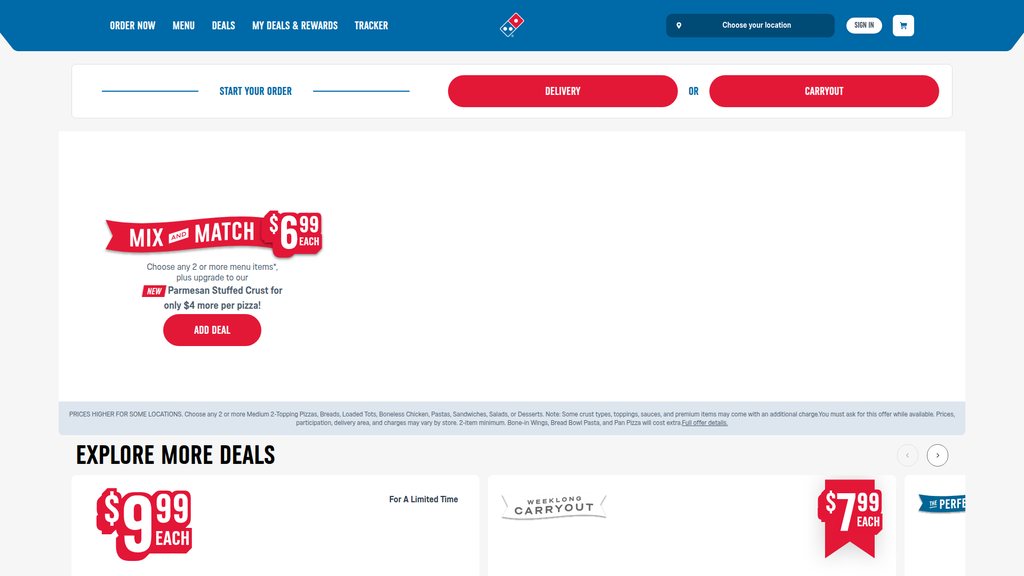
The brand's communication is a masterclass in transactional efficiency, relentlessly focused on value and calls to action that drive immediate orders. Messaging around promotions like the 'Mix & Match' deal is exceptionally clear and effectively targets value-conscious families and students. However, this strength comes with a significant weakness: a near-total failure to communicate its most powerful differentiator—its technological superiority—on its primary consumer-facing platforms. This creates a purely transactional relationship, missing the opportunity to build brand equity around innovation.
An incredibly clear and consistent messaging hierarchy that prioritizes value and direct calls-to-action, minimizing friction and expertly guiding users toward conversion.
Integrate messaging about technology leadership (e.g., Pizza Tracker, Pinpoint Delivery) into the main user journey to differentiate the brand beyond price and build long-term brand equity.
Domino's website and app are ruthlessly optimized for conversion, serving as a benchmark for frictionless e-commerce. The user journey is designed to minimize cognitive load and guide users from landing page to checkout in the fewest possible steps. Due to the landmark *Robles v. Domino's* lawsuit, the company maintains a high level of accessibility compliance, which not only mitigates legal risk but also expands its addressable market. The entire experience is engineered for speed and efficiency across all devices, perfectly aligning with the brand's core promise.
A laser-focused, low-friction conversion funnel that eliminates virtually all barriers to ordering, making the process exceptionally fast and intuitive for new and returning users.
The user interface, while functional, is visually dated. A modernization of the UI with subtle micro-interactions and improved aesthetics could enhance perceived brand quality and user delight without compromising its hallmark efficiency.
Domino's credibility is anchored in its globally recognized brand, which serves as the ultimate trust signal. This is reinforced by a consistent product and a reliable digital experience, including transparent features like the Pizza Tracker. The company offers unique risk mitigation through its 'Delivery Insurance' program and maintains a high degree of transparency in its privacy policies and pricing. While it lacks traditional third-party seals or numerous customer testimonials on its site, its market leadership and sheer scale of successful daily transactions provide overwhelming proof of reliability.
Immense brand recognition and market leadership act as the primary trust signal, assuring customers of a reliable and consistent experience.
Incorporate social proof elements, such as customer ratings or 'fan favorite' tags on menu items, to build deeper trust and help guide user choice.
Domino's competitive advantage is formidable and highly sustainable, rooted in a 'moat' built from technology, operational efficiency, and a massive scale. Its proprietary tech stack, vertically integrated supply chain, and efficient franchise model are incredibly difficult for competitors to replicate. This system allows for continuous innovation in both the digital customer experience and delivery logistics. While competitors can match prices, they struggle to match the seamless integration of Domino's entire value chain.
A deeply integrated ecosystem of proprietary technology, a vast and efficient franchisee network, and a vertically-integrated supply chain that creates a highly sustainable competitive advantage.
Address the brand perception of lower food quality compared to competitors like Papa John's, which position themselves as a premium alternative and represent a key vulnerability.
The business model is exceptionally scalable due to its asset-light, 99% franchised structure, which allows for rapid global expansion with minimal corporate capital expenditure. Strong unit economics and a focus on franchisee profitability fuel continued growth. The centralized supply chain and technology platforms create significant operational leverage. While domestic markets show signs of saturation, a significant runway for international growth remains, particularly in emerging markets like India and China.
An asset-light franchise model that facilitates rapid, capital-efficient global expansion while generating high-margin, predictable revenue from royalties and supply chain sales.
Mitigate the growing operational bottleneck of labor shortages, especially for delivery drivers, which is a primary constraint on meeting demand and ensuring service quality.
Domino's possesses one of the most coherent and effective business models in the QSR industry. There is perfect alignment between its technology-first strategy, its franchisee-focused operational model, and its value/convenience-based customer value proposition. Resources are strategically allocated to technology and franchisee support, which are the primary drivers of growth. This strategic focus has allowed Domino's to perfectly time the market's shift to digital and off-premise dining, creating a self-reinforcing system of success.
Exceptional alignment between the core strategy (tech-driven convenience), the business structure (asset-light franchise model), and revenue streams (royalties, supply chain), creating a powerful, self-reinforcing growth engine.
Reduce the model's heavy dependence on the financial health of its franchisees, who are vulnerable to macroeconomic pressures like rising food and labor costs, posing a systemic risk.
As the world's largest pizza company, Domino's wields significant market power, consistently gaining share and setting industry standards for digital innovation. Its massive scale provides substantial leverage over suppliers and partners. While it engages in promotional pricing, its strong brand loyalty and convenient digital platform give it a degree of pricing power. The primary threat to its power is the rise of third-party delivery aggregators, which can disintermediate the customer relationship and commoditize the market.
Dominant market share and the ability to influence industry trends, particularly in digital ordering and delivery logistics, forcing competitors to constantly react to its innovations.
Counter the strategic threat from third-party delivery aggregators, which erode Domino's direct customer relationship and challenge its core in-house delivery advantage.
Business Overview
Business Classification›
Franchise-based Quick Service Restaurant (QSR)
eCommerce & Food Delivery
Foodservice
Sub Verticals›
- •
Pizza Delivery
- •
Fast Food
- •
Food Technology
Mature
Maturity Indicators›
- •
Extensive global presence with over 20,000 stores in 90+ markets.
- •
High brand recognition and established market leadership.
- •
Consistent dividend payments and share repurchase programs.
- •
Focus on operational efficiency, franchisee profitability, and incremental growth.
Enterprise
Steady
Revenue Model›
Primary Revenue Streams›
| # | Customer Segment | Description | Estimated Importance | Estimated Margin | Stream Name |
|---|---|---|---|---|---|
# 1 | Customer Segment Franchisees | Description Sale of pizza dough, food ingredients, and equipment to franchisees. This is the largest revenue segment, accounting for approximately 60% of total revenue, but operates on lower margins to ensure franchisee profitability. | Estimated Importance Primary | Estimated Margin Low | Stream Name Supply Chain Sales to Franchisees |
# 2 | Customer Segment Franchisees | Description Collection of ongoing royalties (typically 5.5% of sales) and one-time franchise fees from store operators. This is a high-margin, stable revenue source. | Estimated Importance Primary | Estimated Margin High | Stream Name Franchise Royalties and Fees |
# 3 | Customer Segment General Consumers | Description Direct sales of pizza and other food items to consumers through a smaller number of corporate-owned stores. This represents a smaller portion of overall revenue compared to the franchise-based streams. | Estimated Importance Secondary | Estimated Margin Medium | Stream Name Company-Owned Store Sales |
# 4 | Customer Segment Franchisees | Description Franchisees pay technology-related fees for use of the proprietary point-of-sale system (PULSE), online ordering platforms, and other digital innovations. | Estimated Importance Tertiary | Estimated Margin High | Stream Name Technology Fees |
Recurring Revenue Components›
- •
Franchise Royalties
- •
Ongoing Supply Chain Purchases by Franchisees
- •
Technology Fees
Pricing Strategy›
Value-Based & Promotional Pricing
Mid-range
Transparent
Pricing Psychology›
- •
Bundling (e.g., 'Mix & Match' deals)
- •
Charm Pricing (e.g., $6.99)
- •
Promotional Discounts (App-only deals, coupons)
- •
Loyalty Program Incentives
Monetization Assessment›
Strengths›
- •
Highly diversified and resilient revenue model not solely dependent on food sales.
- •
Franchise model allows for rapid, capital-light expansion.
- •
Vertically integrated supply chain creates a stable, albeit low-margin, revenue stream and ensures product consistency.
- •
High-margin royalties provide predictable cash flow.
Weaknesses›
- •
Heavily reliant on the financial health and operational performance of franchisees.
- •
Low margins in the dominant supply chain segment.
- •
Growth is tied to the ability to open new franchise locations, which may be reaching saturation in some domestic markets.
Opportunities›
- •
Increasing technology fees as more digital services are rolled out to franchisees.
- •
Strategic price increases within the supply chain, balanced against franchisee profitability.
- •
Monetizing data analytics by providing premium insights to franchisees.
- •
Expanding partnerships with third-party delivery aggregators, projected to be a significant sales driver.
Threats›
- •
Rising food and labor costs could squeeze franchisee margins, potentially impacting royalty payments and store growth.
- •
Intense price competition from other major pizza chains and QSRs.
- •
Economic downturns reducing consumer discretionary spending on food delivery.
Market Positioning›
Technology-enabled convenience, speed, and value
Market Leader in the U.S. and global pizza delivery segment.
Target Segments›
- Segment Name:
Value-Seeking Families
Description:Families with children looking for a convenient, affordable, and crowd-pleasing meal option, particularly for evening and weekend meals.
Demographic Factors›
- •
Age 25-50
- •
Middle-income households
- •
Reside in suburban and urban areas.
Psychographic Factors›
- •
Value convenience and time-saving solutions
- •
Budget-conscious
- •
Seek reliable and consistent food options
Behavioral Factors›
- •
High frequency of ordering for delivery or carryout
- •
Responsive to promotions and bundle deals (e.g., 'Mix & Match')
- •
Often order for shared occasions (e.g., family dinner, parties)
Pain Points›
- •
Time-consuming meal preparation
- •
Finding meal options that satisfy everyone in the family
- •
High cost of dining out or ordering from multiple places
Fit Assessment:Excellent
Segment Potential:Medium
- Segment Name:
Tech-Savvy Young Adults & Students
Description:Individuals aged 15-30, including high school/college students and young professionals, who prioritize digital convenience and are frequent users of mobile and online ordering.
Demographic Factors›
- •
Age 15-30
- •
Lower to middle income
- •
Urban and semi-urban dwellers.
Psychographic Factors›
- •
Early adopters of technology
- •
Value speed and efficiency
- •
Spontaneous and occasion-driven (e.g., late-night study, social gatherings).
Behavioral Factors›
- •
Primarily use mobile apps for ordering
- •
High engagement with loyalty programs
- •
Likely to order during non-traditional hours
- •
Influenced by digital marketing and social media
Pain Points›
- •
Clunky or slow ordering processes
- •
Lack of transparency in delivery time
- •
Limited budget for meals
Fit Assessment:Excellent
Segment Potential:High
Market Differentiation›
| # | Factor | Strength | Sustainability |
|---|---|---|---|
# 1 | Factor Technology & Digital Ordering Platform | Strength Strong | Sustainability Sustainable |
# 2 | Factor Efficient Delivery & Logistics Network | Strength Strong | Sustainability Sustainable |
# 3 | Factor Franchise Model & Scalability | Strength Strong | Sustainability Sustainable |
# 4 | Factor Brand Recognition & Marketing | Strength Strong | Sustainability Sustainable |
Value Proposition›
Delivering craveable pizza and more with unparalleled convenience, speed, and value, powered by industry-leading technology.
Excellent
Key Benefits›
- Benefit:
Convenience
Importance:Critical
Differentiation:Unique
Proof Elements›
- •
AnyWare ordering technology (via app, web, voice, smart devices).
- •
Extensive network of stores for rapid delivery/carryout
- •
Real-time Pizza Tracker
- Benefit:
Speed
Importance:Critical
Differentiation:Somewhat unique
Proof Elements›
- •
Historical '30 minutes or less' guarantee which built the brand's reputation.
- •
Optimized delivery logistics and store placement
- •
AI-powered tools for order prediction and prep planning.
- Benefit:
Value
Importance:Important
Differentiation:Common
Proof Elements›
- •
Mix & Match deal
- •
Domino's Rewards loyalty program
- •
Regular promotional offers and coupons
Unique Selling Points›
| # | Defensibility | Sustainability | Usp |
|---|---|---|---|
# 1 | Defensibility Strong | Sustainability Long-term | Usp Technology-First Approach: A food company that operates like a tech company, focusing on a seamless digital customer experience from ordering to tracking. |
# 2 | Defensibility Moderate | Sustainability Medium-term | Usp Fortressing Strategy: High saturation of stores in a given market to reduce delivery times, improve service, and dominate local market share. |
Customer Problems Solved›
| # | Problem | Severity | Solution Effectiveness |
|---|---|---|---|
# 1 | Problem The need for a quick, easy, and reliable meal solution. | Severity Critical | Solution Effectiveness Complete |
# 2 | Problem Uncertainty and lack of transparency in food delivery times. | Severity Major | Solution Effectiveness Complete |
# 3 | Problem The high cost of convenient food options for families and groups. | Severity Major | Solution Effectiveness Partial |
Value Alignment Assessment›
High
The value proposition directly aligns with the growing consumer demand for convenience, speed, and digital integration in the QSR and food delivery market.
High
The focus on digital convenience and value strongly resonates with the core target segments of tech-savvy young adults and budget-conscious families.
Strategic Assessment›
Business Model Canvas›
Key Partners›
- •
Franchisees (over 99% of stores).
- •
Technology Partners (for AI, cloud services, and digital platforms).
- •
Third-Party Delivery Aggregators (e.g., Uber Eats, DoorDash).
- •
Food and Equipment Suppliers.
Key Activities›
- •
Franchise management and support
- •
Supply chain and logistics management.
- •
Technology development and innovation (e.g., ordering platforms, AI tools).
- •
Brand marketing and advertising
- •
Menu innovation and product development.
Key Resources›
- •
Strong global brand recognition.
- •
Proprietary technology platforms (e.g., PULSE POS, online ordering).
- •
Extensive franchise and store network.
- •
Efficient and vertically integrated supply chain.
Cost Structure›
- •
Supply chain costs (food, equipment, distribution)
- •
Marketing and advertising expenses (funded by franchisees and corporate)
- •
Technology infrastructure and R&D
- •
General and administrative expenses for corporate operations
Swot Analysis›
Strengths›
- •
Asset-light, highly scalable franchise business model.
- •
Industry-leading digital and mobile ordering technology.
- •
Powerful brand recognition and a massive global footprint.
- •
Efficient, vertically integrated supply chain ensuring consistency and cost control.
Weaknesses›
- •
Over-reliance on the success and compliance of franchisees.
- •
Menu is less diverse compared to broader QSR competitors.
- •
Perception as a 'value' brand can make it difficult to compete in the premium pizza segment.
- •
Negative publicity from a single franchise can impact the entire brand.
Opportunities›
- •
Further international expansion, particularly in emerging markets.
- •
Leveraging AI and data analytics for hyper-personalization and operational efficiency.
- •
Expanding menu offerings to capture new dayparts and customer preferences.
- •
Growing revenue from third-party delivery aggregator partnerships.
Threats›
- •
Intense competition from other pizza chains (Pizza Hut, Papa John's) and third-party delivery platforms offering wide restaurant choices.
- •
Rising food, labor, and energy costs impacting franchisee profitability.
- •
Shifting consumer preferences towards healthier eating habits.
- •
Economic volatility impacting discretionary consumer spending.
Recommendations›
Priority Improvements›
| # | Area | Expected Impact | Recommendation |
|---|---|---|---|
# 1 | Area Menu Diversification | Expected Impact High | Recommendation Strategically expand beyond pizza-centric offerings to include more diverse meal options, such as expanded salads, bowls, or premium sandwiches, to increase order frequency and capture a wider range of meal occasions. |
# 2 | Area Franchisee Profitability Tools | Expected Impact Medium | Recommendation Develop and deploy more advanced AI-driven tools for franchisees that focus on optimizing labor scheduling, inventory management, and local marketing spend to help mitigate the impact of rising operational costs. |
# 3 | Area Loyalty Program Enhancement | Expected Impact Medium | Recommendation Evolve the 'Domino's Rewards' program to incorporate tiered loyalty levels and personalized, non-monetary rewards to increase customer engagement and lifetime value beyond simple discounts. |
Business Model Innovation›
- •
Launch a 'Domino's Kitchen' concept in dense urban areas—smaller footprint, carryout/delivery-only locations (ghost kitchens) with a curated menu to lower overhead and accelerate expansion.
- •
Develop a B2B supply chain service, leveraging its logistics network to supply other smaller, non-competing food businesses with ingredients or distribution services.
- •
Explore subscription models, such as a 'Pizza Pass' offering a set number of discounted orders per month to create a more predictable, recurring consumer revenue stream.
Revenue Diversification›
- •
Introduce a line of branded, store-sold grocery items like pizza sauces, dough, or spice blends.
- •
Monetize its technology stack by licensing a white-label version of its ordering and delivery management software to independent pizzerias or other QSR chains.
- •
Expand catering services with dedicated packages and ordering platforms for corporate and large-scale events.
Domino's operates a highly mature, resilient, and technologically advanced business model that has positioned it as a global leader in the QSR pizza industry. The company's core strength lies in its asset-light franchise structure, which facilitates rapid, low-cost global expansion while generating high-margin, predictable revenue through royalties and fees. This is brilliantly complemented by a vertically integrated supply chain that, while operating on lower margins, ensures product consistency, creates a symbiotic relationship with franchisees, and represents the largest single source of revenue.
The company's strategic pivot from a traditional food retailer to a 'tech company that sells pizza' has been the primary driver of its competitive advantage. Its industry-leading digital ordering platforms, customer-facing innovations like the Pizza Tracker, and internal AI-driven operational tools create significant defensibility and align perfectly with modern consumer behavior. This technological focus has solidified its value proposition of convenience and speed, allowing it to effectively serve its core target segments of value-seeking families and tech-savvy young adults.
However, the model's maturity presents challenges. Key markets like the U.S. may be approaching store saturation, making incremental growth more difficult. The model is also heavily exposed to external economic pressures, such as rising food and labor costs, which directly impact the profitability of its franchisees—the lifeblood of the system. Intense competition from both direct rivals and third-party delivery aggregators who offer greater choice poses a continuous threat.
Future evolution hinges on strategic innovation. The integration with delivery aggregators is a necessary defensive and offensive move to capture a wider audience. The next phase of growth will require further diversification beyond its core pizza offerings to increase ticket sizes and capture new meal occasions. Furthermore, deepening its technological moat through advanced AI and data analytics will be critical to enhance personalization, optimize logistics, and provide greater value to franchisees, thereby ensuring the long-term sustainability and steady growth trajectory of its powerful business model. The 'Hungry for MORE' strategy, focusing on product, operations, value, and franchisee success, provides a clear roadmap to address these challenges and capitalize on future opportunities.
Competitors
Competitive Landscape›
Mature
Oligopoly
Barriers To Entry›
| # | Barrier | Impact |
|---|---|---|
# 1 | Barrier Brand Recognition & Marketing Spend | Impact High |
# 2 | Barrier Supply Chain & Logistics Network | Impact High |
# 3 | Barrier Franchise Network Scale | Impact High |
# 4 | Barrier Technology & Digital Infrastructure | Impact Medium |
# 5 | Barrier Capital Investment | Impact Medium |
Industry Trends›
| # | Impact On Business | Timeline | Trend |
|---|---|---|---|
# 1 | Impact On Business Reinforces Domino's core strength but requires continuous investment in mobile ordering, AI-powered personalization, and automation to maintain leadership. | Timeline Immediate | Trend Digital Transformation & AI |
# 2 | Impact On Business Shifts focus from purely low-cost deals to a balance of price, quality, and convenience. Domino's Mix & Match offer is well-positioned, but perceived quality vs. competitors is a constant battle. | Timeline Immediate | Trend Value Redefined Beyond Price |
# 3 | Impact On Business Creates both a threat by disintermediating the customer relationship and an opportunity if leveraged strategically. Domino's in-house delivery is a key differentiator but faces pressure from the convenience of aggregators. | Timeline Immediate | Trend Rise of Third-Party Delivery Apps |
# 4 | Impact On Business Drives demand for 'better-for-you' ingredients, plant-based options, and menu transparency. Requires menu innovation to cater to health-conscious segments without alienating the core customer base. | Timeline Near-term | Trend Health & Wellness Focus |
# 5 | Impact On Business Customers, especially younger demographics, seek novel and global flavors. Domino's must innovate beyond pizza with items like Loaded Tots and Oven-Baked Dips to maintain excitement and capture new dayparts. | Timeline Near-term | Trend Menu Diversification & Flavor Innovation |
Direct Competitors›
https://www.pizzahut.com
Second largest, approx. 23%-29% of online/chain market share.
High
Positions as a family-friendly brand with a legacy in dine-in, offering a broad menu beyond pizza (e.g., pasta, wings).
Strengths›
- •
Strong global brand recognition and loyalty.
- •
Extensive menu with diverse non-pizza offerings like wings and pasta.
- •
Perceived as a more traditional, dine-in restaurant experience.
- •
Strong backing from parent company Yum! Brands.
Weaknesses›
- •
Slower to adapt to the digital-first, delivery-focused model.
- •
Reports of declining customer satisfaction and inconsistent franchisee quality.
- •
Perceived as less of a value player compared to Domino's or Little Caesars.
- •
Brand franchising in remote and rural areas is a weakness, creating market gaps.
Differentiators›
- •
Iconic menu items like the 'Stuffed Crust Pizza'.
- •
Focus on the dine-in experience in many locations.
- •
Broader menu variety, positioning as a full casual dining option.
https://www.papajohns.com
Third largest, approx. 21%-22% of online/chain market share.
High
Focuses on premium quality with its 'Better Ingredients. Better Pizza.' slogan.
Strengths›
- •
Strong brand identity centered on quality ingredients.
- •
High customer satisfaction ratings and brand loyalty.
- •
Successful product innovations like 'Papadias'.
- •
Robust digital sales platform.
Weaknesses›
- •
Higher price point compared to competitors, making it vulnerable in a price-sensitive market.
- •
Past brand reputation issues and controversies.
- •
Heavy reliance on promotional activities can erode margins.
- •
Limited menu variety compared to Pizza Hut.
Differentiators›
- •
Explicit marketing focus on the quality and freshness of ingredients.
- •
Unique side items like Garlic Knots and signature dipping sauces.
- •
Slightly more premium positioning.
https://www.littlecaesars.com
Fourth largest, approx. 13% of chain market share.
Medium
Extreme value and convenience, epitomized by its 'Hot-N-Ready' model for immediate carryout.
Strengths›
- •
Unbeatable value proposition with very low price points.
- •
'Hot-N-Ready' model provides instant gratification for carryout customers.
- •
Strong brand recognition and simple, effective marketing ('Pizza! Pizza!').
- •
Largest carry-out pizza chain in the world.
Weaknesses›
- •
Lower perceived quality compared to the other 'big three'.
- •
Historically weak delivery infrastructure, though this is changing.
- •
Limited menu options and customization.
- •
Inconsistent store management and franchisee issues.
Differentiators›
- •
The 'Hot-N-Ready' concept is a unique service model in the pizza industry.
- •
Price leadership, positioning as the most affordable option.
- •
Focus on the carryout segment.
Indirect Competitors›
https://www.doordash.com, https://www.ubereats.com
These platforms offer consumers a single app to order from a vast array of local restaurants, including local pizzerias, other QSRs, and casual dining chains.
High
They are already competing for 'share of stomach' and control of the customer ordering interface. They could launch their own ghost kitchens or private label food brands.
https://www.mcdonalds.com, https://www.tacobell.com
Compete for the same convenient, affordable meal occasions. Their offerings (burgers, tacos, chicken sandwiches) are direct substitutes for a quick pizza dinner.
High
Low likelihood of selling pizza, but high likelihood of innovating on delivery and value to capture Domino's customer base.
https://www.modpizza.com
Offer a more customizable, higher-quality, and 'build-your-own' pizza experience at a slightly higher price point. They appeal to consumers seeking fresher ingredients and personalization.
Medium
Their model is fundamentally different (fast-casual vs. delivery), but they are capturing a growing segment of the pizza market and setting new quality expectations.
Offer a wide variety of frozen, take-and-bake, and pre-made hot pizzas that represent a significant, low-cost alternative for at-home consumption.
Medium
Low, but their improvement in quality and variety chips away at the low-end market.
Competitive Advantage Analysis›
Sustainable Advantages›
| # | Advantage | Competitor Replication Difficulty | Sustainability Assessment |
|---|---|---|---|
# 1 | Advantage Technology & Digital Ordering Platform | Competitor Replication Difficulty Hard | Sustainability Assessment Highly sustainable. Domino's has a significant first-mover advantage and a culture of innovation (e.g., Domino's Tracker, AnyWare ordering) that is deeply integrated into its operations. |
# 2 | Advantage Efficient Delivery & Logistics Network | Competitor Replication Difficulty Hard | Sustainability Assessment Highly sustainable. The vertically integrated supply chain and vast, experienced franchisee/driver network are optimized for speed and cost-efficiency, which is difficult for competitors or third parties to replicate profitably. |
# 3 | Advantage Strong Brand Recognition & Market Penetration | Competitor Replication Difficulty Hard | Sustainability Assessment Sustainable. With over 18,800 stores globally and decades of marketing, Domino's has immense brand equity and top-of-mind awareness in the pizza delivery category. |
# 4 | Advantage Franchisee Profitability Model | Competitor Replication Difficulty Medium | Sustainability Assessment Sustainable. The business model is designed to create profitable franchisees (over 95% of whom started as employees), ensuring alignment, operational excellence, and continued growth. |
Temporary Advantages›
Specific Value Promotions (e.g., Mix & Match $6.99)
1-2 years
Novelty Menu Items (e.g., Loaded Tots)
6-18 months
Disadvantages›
| # | Addressability | Disadvantage | Impact |
|---|---|---|---|
# 1 | Addressability Moderately | Disadvantage Perception of Lower Food Quality vs. Premium Competitors | Impact Major |
# 2 | Addressability Difficult | Disadvantage Dependence on In-House Delivery in a Market Shifting to Aggregators | Impact Major |
# 3 | Addressability Easily | Disadvantage Limited Menu Customization Compared to Fast-Casual Players | Impact Minor |
Strategic Recommendations›
Quick Wins›
| # | Expected Impact | Implementation Difficulty | Recommendation |
|---|---|---|---|
# 1 | Expected Impact Medium | Implementation Difficulty Easy | Recommendation Launch a targeted marketing campaign emphasizing the speed and reliability of in-house delivery versus the potential pitfalls of third-party apps (e.g., cold food, incorrect orders). |
# 2 | Expected Impact Medium | Implementation Difficulty Moderate | Recommendation Introduce a 'Gourmet Creations' line of limited-time offer (LTO) pizzas with premium ingredients to test the waters in the higher-margin, premium quality segment. |
# 3 | Expected Impact High | Implementation Difficulty Moderate | Recommendation Enhance the Domino's Rewards program with more personalized offers and gamification elements to increase order frequency and customer loyalty. |
Medium Term Strategies›
| # | Expected Impact | Implementation Difficulty | Recommendation |
|---|---|---|---|
# 1 | Expected Impact Medium | Implementation Difficulty Moderate | Recommendation Expand plant-based and healthier menu options, including alternative crusts (e.g., cauliflower) and more salad/vegetable-forward sides, to attract health-conscious consumers. |
# 2 | Expected Impact High | Implementation Difficulty Moderate | Recommendation Invest in AI-driven personalization within the app to predict customer orders, suggest relevant add-ons, and tailor promotions, increasing average order value. |
# 3 | Expected Impact High | Implementation Difficulty Difficult | Recommendation Develop a formal catering and bulk-ordering program ('Domino's for Business') with a dedicated ordering portal to capture the B2B and large-events market. |
Long Term Strategies›
| # | Expected Impact | Implementation Difficulty | Recommendation |
|---|---|---|---|
# 1 | Expected Impact High | Implementation Difficulty Difficult | Recommendation Continue R&D and pilot programs for autonomous delivery vehicles and drone technology to reduce long-term labor costs and further solidify delivery leadership. |
# 2 | Expected Impact Medium | Implementation Difficulty Difficult | Recommendation Explore strategic acquisition of a smaller, fast-casual pizza chain to gain a foothold in the premium segment and acquire talent/recipes without diluting the core Domino's brand. |
# 3 | Expected Impact High | Implementation Difficulty Difficult | Recommendation Redesign store formats to create smaller, more efficient delivery/carryout hubs ('Domino's Go') in dense urban areas, reducing real estate costs and improving delivery times. |
Maintain and fortify the position as the unparalleled leader in convenient, technology-driven pizza delivery, while strategically introducing premium options to elevate brand perception and capture higher-margin sales.
Double down on technological superiority and delivery efficiency as the core differentiator. Layer this with menu innovation that creates buzz and selectively targets new customer segments (e.g., health-conscious, flavor-seekers) to broaden appeal beyond the core value proposition.
Whitespace Opportunities›
| # | Competitive Gap | Feasibility | Opportunity | Potential Impact |
|---|---|---|---|---|
# 1 | Competitive Gap Direct competitors (Pizza Hut, Papa John's) have a slightly more premium perception but have not fully captured the 'gourmet' market. There's a gap between mass-market pizza and expensive local pizzerias. | Feasibility Medium | Opportunity Premium/Artisanal Pizza Segment | Potential Impact High |
# 2 | Competitive Gap None of the major pizza chains have a robust, user-friendly B2B catering platform. This market is served by local pizzerias and non-pizza caterers. | Feasibility High | Opportunity Comprehensive Catering Services | Potential Impact High |
# 3 | Competitive Gap While competitors offer some options, no major chain is the 'go-to' for consumers with specific dietary needs (vegan, gluten-free). Owning this niche could build significant loyalty. | Feasibility Medium | Opportunity Expanded Plant-Based & Allergen-Free Menus | Potential Impact Medium |
# 4 | Competitive Gap The late-night food delivery market is fragmented and often dominated by third-party apps with high fees. A concerted marketing and operational focus on being the most reliable late-night option could capture significant share. | Feasibility High | Opportunity Late-Night Delivery Dominance | Potential Impact Medium |
The competitive landscape for Domino's is mature and dominated by an oligopoly consisting of itself, Pizza Hut, Papa John's, and Little Caesars. Domino's has successfully positioned itself as the undisputed market leader, not by having the 'best' pizza, but by creating the most efficient, technologically advanced, and convenient ordering and delivery system in the industry. This technological prowess, combined with a massive, efficient franchise and supply chain network, forms its primary sustainable competitive advantage.
Direct competitors present distinct challenges: Pizza Hut leverages its legacy brand recognition and broader menu; Papa John's competes on a platform of higher-quality ingredients at a premium price; and Little Caesars dominates the extreme value, carryout-focused segment. While Domino's leads them all in market share, it remains vulnerable to perceptions of lower food quality compared to Papa John's and the growing fast-casual segment.
The most significant disruptive threat comes from indirect competitors, specifically third-party delivery aggregators like DoorDash and Uber Eats. These platforms are fundamentally changing consumer behavior by offering choice and convenience that challenges Domino's core value proposition. While Domino's has strategically avoided these platforms to maintain control over its customer data and delivery experience, this insular approach risks losing customers who prioritize the convenience of a single aggregator app. Other QSRs also compete intensely for the same meal occasions, leveraging their own value deals and delivery partnerships.
Strategic whitespace for Domino's lies in areas its hyper-efficient model has traditionally overlooked. There is a significant opportunity to capture a share of the premium/gourmet market with a dedicated sub-brand or line of LTOs, elevating brand perception without alienating its core value-conscious customer. Furthermore, a formalized and digitally streamlined catering service for businesses and events is a largely untapped market by the major chains. Expanding into more diverse dietary categories, such as becoming a leader in plant-based or allergen-free options, could also build a loyal new customer base.
To sustain its leadership, Domino's must pursue a dual strategy: first, continue to relentlessly innovate its core technology and delivery operations to widen its efficiency gap with competitors. Second, it must selectively and strategically innovate its menu to address evolving consumer tastes for higher quality, healthier options, and flavor variety. This will allow it to defend its market share from direct competitors while mitigating the long-term threat from market disruptors.
Messaging
Message Architecture›
Key Messages›
| # | Clarity Score | Location | Message | Prominence |
|---|---|---|---|---|
# 1 | Clarity Score High | Location Homepage Hero Banner (Spanish site) | Message Get a great deal on food with the Mix & Match offer for $6.99 each. | Prominence Primary |
# 2 | Clarity Score High | Location Top banner of the homepage (English site) | Message Join Domino's Rewards to earn free rewards in just 2 orders. | Prominence Primary |
# 3 | Clarity Score High | Location Main initial prompt on the homepage | Message Start your order for Delivery or Carryout. | Prominence Primary |
# 4 | Clarity Score High | Location Browse Menu section | Message Explore our wide variety of menu items, including a New Crust! | Prominence Secondary |
The messaging hierarchy is exceptionally effective and ruthlessly prioritized for conversion. Value-based offers (Mix & Match) and direct calls to order ('Empieza tu Pedido') are the most prominent elements. Secondary messages are organized around menu exploration, successfully guiding a user from 'What's for dinner?' to placing an order.
Messaging is highly consistent across the observed pages. Whether in English or Spanish, the core focus remains on immediate ordering, value promotions, and the loyalty program. The brand does not deviate into brand storytelling or quality messaging, maintaining a singular transactional focus.
Brand Voice›
Voice Attributes›
- Attribute:
Promotional
Strength:Strong
Examples›
- •
Oferta Mix & Match
- •
$6.99 cada uno
- •
Join now to start earning towardsFreerewards
- Attribute:
Direct & Action-Oriented
Strength:Strong
Examples›
- •
Empieza tu Pedido
- •
Pide ya
- •
Build Your Own
- •
Sign In/Join Now
- Attribute:
Functional
Strength:Moderate
Examples›
- •
Browse Menu
- •
Entregar o Llevar
- •
We value your privacy.
- Attribute:
Enthusiastic
Strength:Weak
Examples›
New Crust!
Tone Analysis›
Transactional
Secondary Tones›
Promotional
Urgent
Tone Shifts›
The tone shifts significantly to a formal, legalistic style in the mandatory 'We value your privacy' section, which is an unavoidable but stark contrast to the promotional main content.
Voice Consistency Rating›
Excellent
Consistency Issues›
Value Proposition Assessment›
Domino's provides a wide variety of convenient, craveable food, delivered quickly and at an affordable price.
Value Proposition Components›
| # | Clarity | Comment | Component | Uniqueness |
|---|---|---|---|---|
# 1 | Clarity Clear | Comment The '$6.99 each' Mix & Match deal is a highly specific and well-marketed price point that gives Domino's a strong anchor in the value space, even if competitors offer similar deals. | Component Affordability & Value | Uniqueness Somewhat Unique |
# 2 | Clarity Clear | Comment The focus on 'Delivery or Carryout' is central to the user experience. While fast delivery is a brand hallmark, the homepage messaging doesn't explicitly highlight speed (e.g., the old '30 minutes or it's free' promise), making it a standard industry offering at this stage. | Component Convenience & Speed | Uniqueness Common |
# 3 | Clarity Clear | Comment The extensive menu ('Pizzas', 'Breads', 'Loaded Tots', 'Pastas', etc.) is clearly communicated, positioning Domino's as a complete meal provider. However, broad menus are now standard among major competitors. | Component Menu Variety & Customization | Uniqueness Common |
# 4 | Clarity Unclear | Comment Despite being known as a 'tech company that sells pizza,' the website's initial messaging completely omits any mention of its key technological differentiators like the Pizza Tracker, AI ordering, or Pinpoint Delivery. | Component Technology & Innovation | Uniqueness Unique |
The website messaging differentiates Domino's primarily on aggressive, clear-cut pricing promotions and its rewards program. It successfully carves out a position as the reliable, value-driven choice. However, it fails to capitalize on its significant and unique investments in technology, which could elevate the brand beyond just price.
The messaging positions Domino's as the champion of fast, easy, and affordable meals, directly competing with Pizza Hut and Papa John's on convenience and price. While Papa John's message often leans towards 'better ingredients,' Domino's focuses squarely on the transactional benefits of value and variety. This positioning targets customers who prioritize budget and convenience above all else.
Audience Messaging›
Target Personas›
- Persona:
Value-Seeking Families & Groups
Tailored Messages›
- •
Oferta Mix & Match
- •
$6.99 cada uno
- •
Elige dos o más
Effectiveness:Effective
- Persona:
Convenience-Driven Professionals & Students
Tailored Messages›
- •
Empieza tu Pedido
- •
Entregar o Llevar
- •
Pide ya
Effectiveness:Effective
- Persona:
Loyal, Repeat Customers
Tailored Messages›
Join now to start earning towardsFreerewards in just 2 orders.
Sign In
Effectiveness:Somewhat
Audience Pain Points Addressed›
- •
Feeding multiple people affordably
- •
Needing a quick and easy meal solution without cooking
- •
Decision fatigue (by offering simple, clear deals)
Audience Aspirations Addressed›
- •
Feeling like a smart shopper by getting a good deal
- •
Enjoying a satisfying, hassle-free meal
- •
Gaining rewards and recognition for loyalty
Persuasion Elements›
Emotional Appeals›
- Appeal Type:
Desire for Savings/Value
Effectiveness:High
Examples›
$6.99 cada uno
- Appeal Type:
Anticipation of Gratification
Effectiveness:Medium
Examples›
- •
Browse Menu
- •
New Crust!
- •
Loaded Tots
- Appeal Type:
Desire for Ease/Simplicity
Effectiveness:High
Examples›
Empieza tu Pedido
Pide ya
Social Proof Elements›
Trust Indicators›
- •
Strong, established brand recognition
- •
Professional and functional website design
- •
Clear, albeit legally-mandated, privacy policy
Scarcity Urgency Tactics›
The primary urgency tactic is implicit in the nature of ordering food for immediate consumption. The messaging 'Pide ya' (Order now) leverages this inherent urgency.
Calls To Action›
Primary Ctas›
| # | Clarity | Location | Text |
|---|---|---|---|
# 1 | Clarity Clear | Location Mix & Match Offer Banner | Text Pide ya (Order now) |
# 2 | Clarity Clear | Location Top Rewards Banner | Text Join Now |
# 3 | Clarity Clear | Location Initial order prompt | Text Entregar (Delivery) / Llevar (Carryout) |
# 4 | Clarity Clear | Location Browse Menu section | Text Build Your Own |
The CTAs are extremely effective. They are concise, use strong action verbs, and are placed at logical decision points in the user journey. Their clarity leaves no room for ambiguity, efficiently funneling users directly into the ordering process.
Messaging Gaps Analysis›
Critical Gaps›
- •
Messaging around technology and innovation (e.g., Pizza Tracker, autonomous delivery efforts) is completely absent, despite being a core part of their business model and a key differentiator.
- •
There is no brand storytelling or messaging related to the company's mission, values, or history. The connection is purely transactional.
- •
Messages highlighting food quality, ingredient sourcing, or freshness are missing. This is a key area where competitors like Papa John's attempt to differentiate.
Contradiction Points›
Underdeveloped Areas›
Emotional Connection: The messaging focuses exclusively on the rational benefits of price and convenience, missing the opportunity to connect with the emotional aspects of sharing a meal.
Social Proof: The website lacks testimonials, user ratings, or indications of popular items ('Fan Favorite'), which are common persuasive elements in e-commerce.
Messaging Quality›
Strengths›
- •
Exceptional clarity and focus on driving orders.
- •
Powerful communication of value through specific, memorable price points.
- •
A seamless and intuitive messaging hierarchy that guides users to conversion.
- •
High consistency in voice and tone across different language versions of the site.
Weaknesses›
- •
Over-reliance on price, which can devalue the brand and create price-sensitive, disloyal customers.
- •
Complete failure to message key technological differentiators, ceding a powerful brand position.
- •
Lack of brand-building content creates a purely transactional relationship with customers.
- •
Absence of social proof or quality indicators that could build deeper trust.
Opportunities›
- •
Integrate subtle messaging about the Pizza Tracker or other tech innovations into the ordering flow to reinforce the brand's tech-forward identity without disrupting the user journey.
- •
A/B test value propositions that balance price with quality or convenience, such as 'Hot, fresh, and tracked to your door.'
- •
Use the rewards program to build a sense of community and emotional loyalty, beyond just points accumulation.
- •
Highlight 'Most Popular' or 'Fan Favorite' items within the menu to leverage social proof and simplify choice for new customers.
Optimization Roadmap›
Priority Improvements›
| # | Area | Expected Impact | Recommendation |
|---|---|---|---|
# 1 | Area Value Proposition | Expected Impact High | Recommendation Incorporate a secondary headline on the homepage that communicates the technology/convenience value proposition. Example: 'The easiest way to get your favorites. Track your order from our store to your door.' |
# 2 | Area Persuasion Elements | Expected Impact Medium | Recommendation Integrate social proof elements directly into the 'Browse Menu' section by adding 'Fan Favorite' or 'Most Ordered' tags to specific items. |
# 3 | Area Brand Building | Expected Impact Medium | Recommendation Develop a dedicated 'Our Story' or 'Innovation' section in the footer to house content about the brand's history, tech leadership, and commitment to service for users who want to engage beyond a simple transaction. |
Quick Wins›
- •
Add a small, non-intrusive icon or banner referencing the Pizza Tracker early in the user journey.
- •
Test CTA button copy to include more benefits, e.g., 'Start My $6.99 Deal' vs. 'Order Now'.
- •
Rephrase the rewards message to be more compelling: 'Get free pizza faster. Start earning rewards now.'
Long Term Recommendations›
- •
Develop a content marketing strategy that tells stories about the user experience, moving beyond the functional aspects of ordering pizza to the emotional outcomes of sharing a meal.
- •
Invest in personalizing the homepage messaging for returning customers, for example, highlighting their 'usual' order or progress towards their next reward.
- •
Evolve the brand voice to incorporate more personality and fun, reflecting the brand's identity as a casual, enjoyable meal choice, not just a utility.
Domino's website messaging is a masterclass in transactional efficiency. The communication strategy is single-mindedly focused on converting a user's intent to order into a completed sale as quickly and frictionlessly as possible. The message hierarchy is flawless in this regard, prioritizing aggressive value offers (Mix & Match $6.99 deal) and direct, unambiguous calls-to-action ('Order Now,' 'Delivery or Carryout'). The brand voice is direct, promotional, and exceptionally consistent, ensuring the user is never confused about the next step. This laser focus on conversion directly supports business objectives by driving high order volume and catering effectively to its core audience of value- and convenience-seeking customers.
However, this strength is also its primary weakness. The messaging is so transactional that it completely neglects brand building. Domino's has invested heavily in becoming a 'tech company that sells pizza,' yet its most powerful technological differentiator—the Pizza Tracker—and other innovations are absent from the homepage messaging. This is a significant missed opportunity to differentiate on a unique value proposition beyond price, which is a common and easily replicated tactic in the highly competitive fast-food pizza market. The communication builds no emotional connection; it sells a commodity, not an experience. There is no story, no mention of quality, and no social proof to build deeper trust or brand affinity.
In essence, the website's messaging has perfected the science of customer acquisition economics for the short term but invests little in the art of long-term brand equity and differentiation. The immediate business outcome is high sales volume, but the strategic risk is a brand image tied solely to price, making it vulnerable to competitors who can match its deals while also telling a more compelling story about quality or community.
Growth Readiness
Growth Foundation›
Product Market Fit›
Strong
Evidence›
- •
Global market leader in the Quick Service Restaurant (QSR) pizza segment with over 21,000 stores in 90+ markets.
- •
Exceptional brand recognition and consistent same-store sales growth over many consecutive quarters.
- •
High volume of digital sales (over 85% in the U.S.), indicating strong adoption of its technology-forward ordering platforms.
- •
Resilient financial performance and market share gains against key competitors like Pizza Hut and Papa John's.
Improvement Areas›
- •
Catering to the growing demand for healthier, 'clean-label', and plant-based menu options.
- •
Developing a more robust 'premium' or 'artisanal' product tier to compete with emerging craft pizzerias.
- •
Further adapting menus to hyper-local tastes in international growth markets.
Market Dynamics›
The global QSR market is projected to grow at a CAGR of 4-9% annually.
Mature
Market Trends›
| # | Business Impact | Trend |
|---|---|---|
# 1 | Business Impact Continued investment in digital ordering, delivery technology, and carryout efficiency is critical. Over 85% of Domino's U.S. sales are already digital, providing a strong competitive advantage. | Trend Digital and Off-Premises Dominance |
# 2 | Business Impact Creates both a competitive threat and a partnership opportunity. Domino's has strategically partnered with Uber Eats to reach new customers while aiming to keep the best value on its own channels. | Trend Rise of Third-Party Aggregators |
# 3 | Business Impact Value-driven promotions (e.g., Mix & Match) are key for customer acquisition. The 'fortressing' strategy of building more stores in dense areas directly addresses the need for faster, more convenient delivery and carryout. | Trend Demand for Value and Convenience |
# 4 | Business Impact Consumers, especially younger demographics, seek bold and novel flavors (e.g., hot honey, global-inspired toppings). Menu innovation is crucial for relevance and attracting new customer segments. | Trend Flavor Innovation and Customization |
The market is mature but dynamic. The timing is opportune for growth through market share capture, driven by technological superiority and operational efficiency, rather than pure market expansion.
Business Model Scalability›
High
Highly scalable due to a 98-99% franchise-based model, which outsources most store-level operational costs and capital expenditure to franchisees.
Significant operational leverage is derived from the centralized supply chain, which sells ingredients to franchisees, and the proprietary technology platform that serves the entire network.
Scalability Constraints›
- •
Availability and quality of new franchisees.
- •
Rising labor costs and availability, especially for delivery drivers.
- •
Supply chain vulnerabilities and increasing ingredient costs.
- •
Potential for franchisee friction or cannibalization from the 'fortressing' strategy.
Team Readiness›
Proven and experienced leadership team with a track record of successful strategic pivots and digital transformation.
A highly effective decentralized franchise structure supported by a centralized corporate team focused on technology, supply chain, and brand marketing.
Key Capability Gaps›
- •
Advanced Data Science & AI for hyper-personalization and predictive delivery logistics.
- •
Talent acquisition and retention at the store and driver level.
- •
International market development teams with deep local expertise in emerging regions.
Growth Engine›
Acquisition Channels›
| # | Channel | Effectiveness | Optimization Potential | Recommendation |
|---|---|---|---|---|
# 1 | Channel Digital (Website/App) | Effectiveness High | Optimization Potential High | Recommendation Leverage AI to implement hyper-personalized offers and recommendations based on individual order history and behavior. |
# 2 | Channel National TV & Brand Marketing | Effectiveness Medium | Optimization Potential Medium | Recommendation Shift budget towards campaigns that highlight technology leadership (e.g., Pinpoint Delivery) and the loyalty program to drive digital sign-ups. |
# 3 | Channel Loyalty Program (Domino's Rewards) | Effectiveness High | Optimization Potential High | Recommendation Introduce tiered rewards to incentivize higher frequency and AOV. The program already has over 35 million members and is a key growth driver. |
# 4 | Channel Third-Party Aggregators (Uber Eats) | Effectiveness Medium | Optimization Potential High | Recommendation Optimize menu pricing and promotions on these platforms to acquire new users, with clear calls-to-action to join the native rewards program for better value. |
Customer Journey›
Highly optimized for speed and convenience, with features like 'one-click reorder' and Pizza Builder simplifying the process from ~13 steps to just 4.
Friction Points›
- •
Initial setup and sign-in process for new users.
- •
Decision fatigue from an extensive menu and customization options.
- •
Uncertainty around delivery times during peak hours, despite the Domino's Tracker.
Journey Enhancement Priorities›
| # | Area | Recommendation |
|---|---|---|
# 1 | Area Onboarding | Recommendation Implement social sign-on (Google, Apple) to expedite account creation and first-time orders. |
# 2 | Area Ordering | Recommendation Develop an AI-powered 'Quick Suggest' feature based on past orders, time of day, and trending items. |
# 3 | Area Post-Purchase | Recommendation Enhance the Domino's Tracker with more interactive elements or gamification to improve the waiting experience. |
Retention Mechanisms›
| # | Effectiveness | Improvement Opportunity | Mechanism |
|---|---|---|---|
# 1 | Effectiveness High | Improvement Opportunity Implement exclusive, members-only menu items or early access to new products to increase program value and stickiness. The recent program relaunch has already significantly boosted active members. | Mechanism Domino's Rewards Program |
# 2 | Effectiveness Medium | Improvement Opportunity Move from broadcast promotions to triggered, personalized offers based on customer lifecycle (e.g., 'we miss you' offers for lapsed users, upsell offers for frequent customers). | Mechanism Email & Push Notifications |
# 3 | Effectiveness High | Improvement Opportunity Utilize franchisee data to identify and standardize best practices for speed and order accuracy across the entire system. | Mechanism Consistent Product & Service |
Revenue Economics›
Extremely strong. The franchise model ensures high-margin revenue from royalties and supply chain sales, with low corporate capital expenditure. Franchisee EBITDA is best-in-class.
Likely very high, driven by high repeat purchase frequency, strong retention via the loyalty program, and relatively low marginal cost of digital customer acquisition.
High
Optimization Recommendations›
- •
Increase Average Order Value (AOV) through AI-powered suggestive upselling of high-margin sides, drinks, and desserts.
- •
Implement dynamic pricing strategies during off-peak hours to stimulate demand and improve asset utilization.
- •
Promote the carryout option more aggressively, as it has a different, highly incremental customer base and lower variable costs.
Scale Barriers›
Technical Limitations›
| # | Impact | Limitation | Solution Approach |
|---|---|---|---|
# 1 | Impact Medium | Limitation Franchisee Technology Standardization | Solution Approach Incentivize or mandate adoption of the latest proprietary POS (DOM OS) and operational tech to ensure system-wide data consistency and efficiency. |
Operational Bottlenecks›
| # | Bottleneck | Growth Impact | Resolution Strategy |
|---|---|---|---|
# 1 | Bottleneck Last-Mile Delivery Driver Shortage | Growth Impact High. This directly impacts delivery times, customer satisfaction, and ability to meet demand. | Resolution Strategy Continue the 'fortressing' strategy to shorten delivery times and increase deliveries-per-hour. Experiment with autonomous and e-bike delivery solutions in dense urban markets. |
# 2 | Bottleneck In-Store Labor Availability | Growth Impact Medium. Can lead to longer prep times and order errors, impacting the entire customer experience. | Resolution Strategy Invest in in-store automation for tasks like dough preparation and topping distribution. Enhance employee value proposition to improve retention. |
Market Penetration Challenges›
| # | Challenge | Mitigation Strategy | Severity |
|---|---|---|---|
# 1 | Challenge Intense Price Competition | Mitigation Strategy Compete on overall value, speed, and digital experience rather than just price. Emphasize the quality and convenience differentiators. | Severity Critical |
# 2 | Challenge Competition from Third-Party Aggregators | Mitigation Strategy Embrace a dual strategy: partner with aggregators for customer acquisition while ensuring the best value and experience remains on native platforms to drive direct, long-term relationships. | Severity Major |
# 3 | Challenge Market Saturation in North America | Mitigation Strategy Focus on incremental growth through the 'fortressing' strategy to boost carryout and delivery efficiency in existing markets, and expand into non-traditional venues (e.g., campuses, airports). | Severity Major |
Resource Limitations›
Talent Gaps›
- •
Delivery Drivers
- •
Data Scientists & AI/ML Engineers
- •
In-store operational staff
Low at the corporate level due to the franchise model. Growth is more constrained by franchisee access to capital for new store development and remodels.
Infrastructure Needs›
Enhanced data infrastructure to support real-time personalization at scale.
Expansion of supply chain commissaries to support international growth and domestic 'fortressing'.
Growth Opportunities›
Market Expansion›
| # | Expansion Vector | Implementation Complexity | Potential Impact | Recommended Approach |
|---|---|---|---|---|
# 1 | Expansion Vector International Growth in Emerging Markets | Implementation Complexity High | Potential Impact High | Recommended Approach Continue focusing on strategic markets like China and India through master franchisee agreements, adapting the menu and marketing to local preferences. |
# 2 | Expansion Vector Non-Traditional Store Formats | Implementation Complexity Medium | Potential Impact Medium | Recommended Approach Develop smaller, carryout-focused store models for high-traffic areas like airports, college campuses, and military bases. |
# 3 | Expansion Vector Hyper-Local Delivery with Pinpoint Tech | Implementation Complexity Medium | Potential Impact Medium | Recommended Approach Scale the 'Domino's Pinpoint Delivery' technology that allows delivery to locations without a traditional address, such as parks and beaches, opening up new ordering occasions. |
Product Opportunities›
| # | Development Recommendation | Market Demand Evidence | Opportunity | Strategic Fit |
|---|---|---|---|---|
# 1 | Development Recommendation Partner with a leading plant-based meat provider to co-brand new pizza and side item offerings. | Market Demand Evidence Growing consumer trend towards flexitarian, vegetarian, and vegan diets. | Opportunity Expanded Plant-Based & Alternative Protein Menu | Strategic Fit High - Aligns with attracting younger, health-conscious demographics. |
# 2 | Development Recommendation Launch a limited-time-offer (LTO) line of 'Domino's Finest' pizzas with premium toppings (e.g., prosciutto, goat cheese, balsamic glaze) to test market reception. | Market Demand Evidence Rise of artisanal and craft pizza restaurants indicates a willingness to pay more for premium ingredients. | Opportunity Gourmet / 'Upmarket' Pizza Line | Strategic Fit Medium - Must be carefully positioned to avoid brand dilution. |
# 3 | Development Recommendation Develop a dedicated B2B ordering portal with simplified billing and scheduled delivery options for corporate clients. | Market Demand Evidence Return-to-office trends and corporate events create demand for large, convenient meal solutions. | Opportunity Catering and Bulk Ordering for B2B | Strategic Fit High - Leverages existing operational capacity. |
Channel Diversification›
| # | Channel | Fit Assessment | Implementation Strategy |
|---|---|---|---|
# 1 | Channel In-Car Commerce Platforms | Fit Assessment High | Implementation Strategy Partner with automotive manufacturers (e.g., Ford, GM) to integrate Domino's ordering into their in-vehicle infotainment systems for 'order-ahead' convenience. |
# 2 | Channel Voice and Conversational AI | Fit Assessment High | Implementation Strategy Expand existing 'AnyWare' technology capabilities on platforms like Alexa and Google Assistant to allow for more complex, conversational ordering beyond simple reorders. |
Strategic Partnerships›
- Partnership Type:
Entertainment & Streaming Bundles
Potential Partners›
- •
Netflix
- •
Disney+
- •
Spotify
Expected Benefits:Create co-branded 'Dinner and a Movie' deals to tap into at-home entertainment occasions, driving AOV and creating unique marketing angles.
- Partnership Type:
CPG Product Licensing
Potential Partners›
Kraft Heinz
Nestlé
Expected Benefits:License the Domino's brand for frozen pizza or sauce lines in grocery stores to increase brand presence and create a new, high-margin revenue stream.
Growth Strategy›
North Star Metric›
Weekly Active Customers
This metric combines both new customer acquisition and, crucially for a mature business, the frequency and retention of existing customers. Growth in this metric indicates a healthy, expanding, and loyal customer base.
Increase Weekly Active Customers by 5-7% year-over-year.
Growth Model›
Hybrid: Digital Product-Led & Brand Marketing
Key Drivers›
- •
Digital user experience (ease of ordering)
- •
Order frequency (driven by loyalty program and personalized marketing)
- •
Operational efficiency (delivery speed and accuracy)
Focus on a virtuous cycle: brand marketing drives traffic to digital platforms; a seamless digital experience converts users; a rewarding loyalty program drives repeat orders; data from orders is used to personalize future marketing.
Prioritized Initiatives›
| # | Expected Impact | First Steps | Implementation Effort | Initiative | Timeframe |
|---|---|---|---|---|---|
# 1 | Expected Impact High | First Steps Consolidate customer data into a unified CDP. Build and test initial AI/ML models for offer personalization and product recommendations on 10% of app users. | Implementation Effort Medium | Initiative Hyper-Personalization Engine Rollout | Timeframe 6-9 months |
# 2 | Expected Impact High | First Steps Pilot in-store digital order status boards, curbside pickup technology, and carryout-specific value offers in select 'fortressed' markets to improve speed and convenience. | Implementation Effort Medium | Initiative Carryout Experience Overhaul | Timeframe 9-12 months |
# 3 | Expected Impact Medium | First Steps Begin consumer research and R&D for a dedicated plant-based menu line and a new category of loaded sides (expanding on 'Loaded Tots'). Announce at least two new products in 2025. | Implementation Effort High | Initiative Launch Two New Product Platforms | Timeframe 12 months |
Experimentation Plan›
High Leverage Tests›
| # | Hypothesis | Test |
|---|---|---|
# 1 | Hypothesis Offering variable points (e.g., 1.5x points on Tuesdays) will shift demand and increase order frequency during off-peak times. | Test Dynamic Loyalty Rewards |
# 2 | Hypothesis A monthly subscription ('Domino's Plus') for free delivery and exclusive deals will significantly increase LTV for high-frequency customers. | Test Subscription Model Pilot |
# 3 | Hypothesis Using generative AI to create unique pizza combinations based on user preferences will increase engagement and AOV. | Test AI-Generated Menu Recommendations |
Utilize A/B testing methodology, tracking the North Star Metric (Weekly Active Customers), Average Order Value (AOV), and Order Frequency as primary KPIs. Use cohort analysis to measure long-term impact on LTV.
Run a continuous cycle of bi-weekly growth experiments managed by a dedicated growth team.
Growth Team›
A centralized Growth Team reporting to the Chief Digital Officer, composed of cross-functional 'squads' aligned to key metrics (e.g., Acquisition, Retention, Monetization).
Key Roles›
- •
Head of Growth
- •
Data Scientist (Personalization)
- •
Product Manager (Loyalty & Rewards)
- •
Lifecycle Marketing Manager
- •
UX/UI Designer (Conversion Rate Optimization)
Invest in internal training and external hiring for advanced data analytics, AI/ML engineering, and experimentation best practices.
Domino's Pizza is in an exceptionally strong position for continued growth, built upon a foundation of world-class brand recognition, a highly scalable franchise business model, and a significant, long-standing competitive advantage in digital technology. The company has successfully transformed from a fast-food chain into a technology-driven e-commerce leader that happens to sell pizza.
The primary growth foundation is solid, with demonstrable product-market fit and a business model that generates substantial operational leverage through its franchise and supply chain structure. The key challenge in this mature market is not finding growth, but capturing it from competitors and defending against disruption from third-party delivery aggregators. Domino's proactive 'fortressing' strategy is a shrewd defensive and offensive move, simultaneously improving delivery efficiency and boosting the highly incremental carryout business.
The growth engine is already high-performing, driven by a sophisticated digital ordering ecosystem and a successful loyalty program. The next horizon of growth will come from leveraging its massive repository of customer data to move from broad value offerings to hyper-personalized experiences. By using AI to anticipate customer needs, optimize promotions, and enhance the digital journey, Domino's can increase order frequency and average order value, further strengthening its impressive unit economics.
Key barriers to scale are primarily operational and market-based rather than technical or financial. The ongoing challenge of attracting and retaining delivery and in-store labor is the most significant bottleneck. Market saturation in developed regions and intense price competition necessitate a focus on operational excellence and brand differentiation to win.
Numerous growth opportunities exist. Internationally, there is still significant white space in emerging markets. Domestically, growth will be driven by product innovation (particularly in plant-based and premium categories), channel diversification (in-car commerce), and strategic partnerships that embed Domino's into new consumption occasions (e.g., entertainment bundles). The recommended growth strategy is to double down on technological leadership. The North Star Metric of 'Weekly Active Customers' will focus the organization on the dual priorities of acquisition and retention. Prioritized initiatives should center on deploying an AI-powered personalization engine, overhauling the carryout experience to capitalize on its profitability, and launching new product platforms to expand the addressable market. By executing this strategy, Domino's can solidify its market leadership and continue to deliver sustained, profitable growth.
Legal Compliance
Domino's provides a comprehensive privacy policy that is easily accessible from the website footer and the cookie consent banner. The policy explicitly details the types of information collected (e.g., contact data, transaction information, geolocation data), how it's used (e.g., order fulfillment, marketing, analytics), and with whom it's shared (e.g., franchisees, affiliates, service providers). It includes specific, detailed sections for California residents under the CCPA/CPRA and for data subjects in Europe, indicating a global approach to compliance. The policy clearly explains user rights, such as access and deletion, and provides a dedicated portal for submitting such requests, which requires identity verification for security. The distinction between data controlled by Domino's corporate and its independent franchisees is also clarified, directing users to contact local stores for franchisee-specific data requests. This demonstrates a mature understanding of its franchise-based business model's implications for data privacy.
The Terms of Use are clearly structured and accessible. A key strategic element is the clarification of the legal relationship between the customer, Domino's corporate, and the independent franchisee. The terms state that the legal contract for an order is between the customer and the local franchisee, with Domino's acting as an agent on their behalf. This is a crucial liability-limiting position. The terms also cover standard aspects such as user conduct, intellectual property rights, and limitations of liability. Specific conditions for promotions, like the 'Mix & Match' offer, are detailed with clear disclaimers regarding price variations by location, which helps manage customer expectations and reduce claims of deceptive advertising. The presence of specific terms for features like 'Group Order' and 'Driver Tipping' shows a granular and up-to-date approach to governing their evolving digital services.
Domino's employs a best-in-class cookie consent banner that is immediately visible upon visiting the site. It offers clear choices: 'Allow All', 'Reject All', and a 'Configure' option for granular control. The inclusion of a 'Reject All' button is a strong compliance feature aligned with GDPR and CCPA/CPRA principles. The banner text is commendably transparent, explicitly mentioning the use of cookies for 'sales, shares, and targeted advertising' and notifying users of their ability to opt-out via a recognized preference signal like Global Privacy Control (GPC). This proactive support for GPC places them ahead of many competitors in honoring user-driven privacy signals. The mechanism also correctly distinguishes between browser-level, app-level, and system-level opt-outs, providing different links and instructions for each, which, while complex, is legally precise and comprehensive.
Domino's demonstrates a robust data protection framework. For US consumers, the CCPA/CPRA compliance is evident through the explicit 'Do Not Sell or Share My Personal Information' language, support for GPC, and a dedicated portal for exercising privacy rights. The privacy policy details what constitutes a 'sale' under CCPA's broad definition, including certain advertising technology activities. For European users, the policy references GDPR, the invalidation of the EU-U.S. Privacy Shield, and a commitment to using appropriate safeguards for data transfers. Their UK-specific policies further detail the joint controller relationship between the corporate entity and franchisees under GDPR, a sophisticated and necessary clarification for their business model. The use of reCAPTCHA is noted on the site, and the privacy implications of data sharing with Google are implicitly covered by the general disclosures, but could be more explicit. The company also highlights its cybersecurity operations and use of AI/ML for threat detection as part of its data protection strategy.
Accessibility is a mission-critical and historically significant compliance area for Domino's. Following the landmark case Robles v. Domino's Pizza LLC, which established that the Americans with Disabilities Act (ADA) applies to commercial websites and mobile apps, the company operates under intense legal scrutiny. The court ordered Domino's to bring its website into compliance with the Web Content Accessibility Guidelines (WCAG) 2.0. Evidence of compliance on the current site includes basic features like a 'Skip to main content' link. Given the legal precedent, it is highly probable that Domino's engages in regular accessibility audits and maintains a high level of compliance with WCAG standards to mitigate the significant legal risk. This history turns accessibility from a mere compliance checkbox into a core component of their risk management strategy. Failure to maintain these standards would represent a severe and easily targeted legal vulnerability.
As a major player in the online foodservice industry, Domino's must adhere to several specific regulations. Firstly, food safety and information transparency are key. This includes providing accessible nutritional and allergen information, a critical aspect of FDA regulations and consumer trust. Secondly, as a heavily franchised business, they must comply with the FTC Franchise Rule regarding disclosures to potential franchisees, which is handled in corporate sections of their operations. Thirdly, the online ordering and delivery model is subject to an increasing number of local and state regulations, including rules on delivery fees and pricing transparency. Domino's use of clear disclaimers on promotional pricing on its website is a direct measure to comply with consumer protection laws against deceptive advertising. The company's 'Delivery Insurance' program is a unique marketing and customer service feature that also preemptively addresses potential disputes over order quality upon arrival.
Compliance Gaps›
- •
Localization of Legal Notices: The scraped content shows the English-language cookie banner appearing on the Spanish-language (
/es) version of the site. While legally functional, this is a gap in user experience and clarity that could be seen as failing to provide notice in an easily understandable manner for all users. - •
Complexity of Opt-Out Process: Offering three distinct opt-out paths (browser cookies, mobile app settings, and a separate link for system data like email) is legally thorough but can be confusing for the average user, potentially leading to incomplete opt-outs and user dissatisfaction.
- •
Third-Party Script Transparency: While the site uses tools like Google reCAPTCHA and DoubleClick, the direct privacy impact and data-sharing specifics with these third parties are not immediately apparent in the initial consent banner, relying on the user to investigate the full privacy policy.
Compliance Strengths›
- •
Advanced Cookie Consent Mechanism: The consent banner's inclusion of a 'Reject All' button and, most notably, support for the Global Privacy Control (GPC) signal represents a proactive and best-practice approach to user privacy.
- •
Mature CCPA/CPRA Framework: The company has a well-defined process for handling California privacy rights, including a dedicated portal for verifiable consumer requests and a clear understanding of what constitutes a 'sale' or 'share' of data.
- •
Battle-Tested Accessibility Posture: As a direct result of the Robles v. Domino's lawsuit, the company's presumed high level of adherence to WCAG standards serves as a significant competitive advantage and risk mitigator compared to other businesses that have not faced similar legal challenges.
- •
Clear Delineation of Franchisee Liability: The Terms of Service effectively position Domino's corporate as an agent, placing the contractual relationship for orders with the independent franchisee, which is a strategically sound method of limiting liability.
Risk Assessment›
| # | Recommendation | Risk Area | Severity |
|---|---|---|---|
# 1 | Recommendation Due to the legal precedent set by *Robles v. Domino's*, any regression in WCAG compliance would expose the company to immediate, high-profile litigation and regulatory action. Implement continuous, automated accessibility monitoring and conduct regular third-party audits (at least quarterly) of the website and mobile applications to ensure ongoing compliance and formally document these efforts. | Risk Area Web Accessibility (ADA/WCAG) | Severity High |
# 2 | Recommendation While current CCPA/CPRA compliance is strong, new privacy laws are being enacted in numerous other states with varying requirements. The complexity of managing different user rights and definitions could lead to unintentional non-compliance. Establish a dedicated internal task force to monitor state-level privacy legislation and ensure the privacy portal and policies can be dynamically updated to accommodate new legal frameworks as they become effective. | Risk Area Patchwork of US State Privacy Laws | Severity Medium |
# 3 | Recommendation The privacy policy correctly states that franchisees are independent entities with their own data practices. However, from a consumer's perspective, Domino's is a single brand. A data breach or privacy violation at a single franchisee could cause significant reputational damage to the entire brand. Enhance franchisee compliance programs with mandatory data privacy and security training, standardized templates for privacy notices, and periodic compliance reviews. | Risk Area Franchisee Compliance Consistency | Severity Medium |
# 4 | Recommendation Reliance on third-party technologies for advertising (DoubleClick) and security (reCAPTCHA) creates data-sharing events that must be meticulously disclosed and managed. A change in a third party's data handling could create a compliance gap. Periodically review the data processing agreements with all third-party vendors and ensure disclosures in the cookie policy and privacy notice remain accurate and transparent. | Risk Area Third-Party Data Sharing | Severity Low |
High Priority Recommendations›
- •
Implement a continuous accessibility auditing and monitoring program with a third-party expert to prevent regressions and maintain robust compliance with WCAG 2.0/2.1 AA standards, creating a defensible record of compliance efforts.
- •
Ensure all legal notices, particularly the cookie consent banner and privacy summaries, are fully translated and localized for all non-English versions of the website to ensure clear and legally effective communication.
- •
Develop a scalable and adaptable privacy rights management framework to proactively address the evolving landscape of U.S. state-level privacy laws beyond California.
- •
Strengthen the franchisee compliance program by providing mandatory, updated data security and privacy training modules annually to ensure brand-wide consistency in protecting customer information.
Domino's presents a highly mature and strategically sophisticated legal compliance posture, particularly for a high-volume, global, consumer-facing e-commerce business. Its approach has clearly been shaped by its history, turning a major past legal vulnerability—web accessibility—into what is now likely a core operational strength and a competitive differentiator. The landmark Robles v. Domino's Pizza lawsuit forced the company to become a leader in ADA compliance for digital platforms, a position it must diligently maintain to mitigate high legal risk.
In the realm of data privacy, Domino's demonstrates a best-in-class implementation of CCPA/CPRA requirements. The advanced cookie consent banner, featuring 'Reject All' and support for Global Privacy Control, is a market-leading example of user-centric privacy design. The company's legal documents show a nuanced understanding of its complex franchise structure, carefully delineating liability between the corporate entity and independent store owners.
While its overall legal positioning is a strategic asset that builds trust and mitigates risk, key challenges remain. The primary risk is not ignorance, but complacency; specifically, any failure to maintain its high accessibility standards could invite immediate legal challenges. Furthermore, the increasing fragmentation of U.S. state privacy laws will require continuous vigilance and investment to maintain their current high standard of compliance. Strategically, Domino's has successfully transformed legal compliance from a cost center into a framework for building a trustworthy and resilient digital business.
Visual
Design System›
Utilitarian & Conversion-Focused
Excellent
Advanced
User Experience›
Navigation›
Horizontal Top Bar (Desktop) / Hamburger (Implied for Mobile)
Intuitive
Good
Information Architecture›
Logical
Clear
Light
Conversion Elements›
| # | Effectiveness | Element | Improvement | Prominence |
|---|---|---|---|---|
# 1 | Effectiveness Effective | Element Delivery/Carryout Toggle | Improvement The toggle is clear, but could benefit from a subtle animation on switch to confirm the user's selection and add a touch of modern interactivity. | Prominence High |
# 2 | Effectiveness Effective | Element Start Your Order CTA | Improvement The red 'Start Your Order' button is visually prominent. A/B testing variations in button copy, such as 'Order Now' or 'Build My Pizza', could potentially optimize click-through rates. | Prominence High |
# 3 | Effectiveness Effective | Element Deal-Based 'Add Deal' CTAs | Improvement These CTAs are well-placed within deal banners and use a clear action-oriented text. To enhance, Domino's could add a sub-textual element of urgency like 'Limited Time Offer' directly within the button container. | Prominence High |
# 4 | Effectiveness Somewhat Effective | Element Rewards Program 'Join Now' CTA | Improvement The rewards section is clear, but the 'Join Now' and 'Sign In' buttons are visually similar. Differentiating the primary action ('Join Now' for new users) with a solid fill color versus a ghost button style for 'Sign In' could guide new user sign-ups more effectively. | Prominence Medium |
Assessment›
Strengths›
| # | Aspect | Description | Impact |
|---|---|---|---|
# 1 | Aspect Clear, Conversion-Driven Layout | Description The homepage is laser-focused on the primary user goal: starting an order. Key elements like the Delivery/Carryout choice, 'Start Your Order' CTA, and prominent deals are placed above the fold, minimizing friction and guiding users directly into the conversion funnel. This aligns perfectly with their business model, which is heavily reliant on online sales. | Impact High |
# 2 | Aspect Strong Brand Identity | Description The website consistently uses Domino's iconic red, white, and blue color palette and bold typography. This reinforces brand recognition and trust, which is crucial in a competitive market. The visual language is confident, straightforward, and aligns with the brand's promise of fast, reliable service. | Impact High |
# 3 | Aspect Effective Use of Visual Hierarchy for Deals | Description Deal promotions are a key part of Domino's strategy. The site uses scale, color, and container styling effectively to make these deals impossible to miss. Large price points and clear 'Add Deal' buttons are designed to capture attention and drive immediate action, directly impacting average order value. | Impact High |
# 4 | Aspect Simple and Accessible Information Architecture | Description The menu navigation is straightforward ('Order Now', 'Deals', 'Tracker'). The on-page content is logically segmented into deals, new items, rewards, and a full menu browser. This clarity reduces cognitive load and allows users to quickly find what they are looking for, whether it's a specific product or the best available offer. | Impact Medium |
Weaknesses›
| # | Aspect | Description | Impact |
|---|---|---|---|
# 1 | Aspect Visually Dated and Generic Design | Description While functional, the overall aesthetic feels somewhat generic and lacks modern design elements. The heavy reliance on flat containers, basic drop shadows, and a lack of engaging micro-interactions makes the site feel less premium than some competitors. A visual refresh could enhance brand perception and user delight without sacrificing usability. | Impact Medium |
# 2 | Aspect Poor Quality and Inconsistent Imagery | Description The product photography, particularly in the main promotional banners of the Spanish-language screenshot, appears somewhat low-resolution and poorly composited. High-quality, appetizing food photography is critical for a food delivery service. Investing in a more professional and consistent photoshoot would significantly elevate the user experience and perceived quality of the product. | Impact Medium |
# 3 | Aspect Lack of Visual Storytelling | Description The website is highly transactional and does little to tell a brand story or build an emotional connection. There is minimal content about ingredient quality, company values, or community engagement on the homepage. While the focus is on conversion, a small, well-placed section could build brand affinity without distracting from the primary goal. | Impact Low |
# 4 | Aspect Content Overload in 'Deals' Section | Description The horizontal scroll for 'Explore More Deals' can lead to choice paralysis. While offering variety is good, the presentation could be overwhelming for some users. Prioritizing or personalizing these deals could improve usability. | Impact Low |
Priority Recommendations›
| # | Effort Level | Impact Potential | Rationale | Recommendation |
|---|---|---|---|---|
# 1 | Effort Level Medium | Impact Potential High | Rationale Introduce a more contemporary design language. This includes refining typography, updating button styles (e.g., adding subtle gradients or rounded corners), using a more sophisticated color palette within the brand guidelines, and implementing smoother transitions. A modernized UI will increase perceived value and trustworthiness, potentially improving conversion rates. | Recommendation Modernize the UI and Component Styling |
# 2 | Effort Level High | Impact Potential High | Rationale Food is a visual product. Replace existing, lower-quality images with professionally shot, high-resolution, and consistently styled photographs. This will make the food appear more appealing, directly influencing the user's desire to order and their perception of the brand's quality. | Recommendation Invest in High-Quality, Appetizing Photography |
# 3 | Effort Level Medium | Impact Potential Medium | Rationale Incorporate small animations on button clicks, hover states, and page transitions. For example, an animated confirmation when a deal is added to the cart. These details enhance the user experience by providing feedback and making the interface feel more responsive and engaging, which can increase user satisfaction. | Recommendation Introduce Subtle Micro-interactions and Animations |
# 4 | Effort Level Low | Impact Potential Medium | Rationale Systematically test variations of the primary CTAs. For instance, test 'Start Your Order' vs. 'Find Deals'. Differentiate the visual treatment of primary vs. secondary CTAs more distinctly (e.g., solid vs. outline buttons) in the rewards section. Small optimizations here can lead to significant gains in user flow and conversion. | Recommendation A/B Test Key CTA Prominence and Copy |
Mobile Responsiveness›
Good
The design appears to adapt well to narrower viewports. The Spanish version showcases a mobile-like single-column layout with larger, touch-friendly elements, indicating a solid responsive strategy.
Mobile Specific Issues›
The horizontal scrolling for deals might be more cumbersome on mobile, requiring users to swipe through multiple options. A vertically stacked, scrollable list might be more user-friendly on smaller devices.
Desktop Specific Issues›
The desktop view has a large amount of unused white space, particularly around the central content column. While this aids focus, it could also be an opportunity to introduce subtle brand elements or more visually engaging layouts.
This visual audit of Dominos.com reveals a website that is a masterclass in conversion-focused, utilitarian design. The entire user experience is streamlined to facilitate the primary goal: placing an order quickly and efficiently. The brand's digital strategy is famously robust, viewing itself as a tech company that sells pizza, and this focus on a seamless ordering process is evident.
Design System and Brand Identity:
The brand's strong red, white, and blue color scheme is used consistently, ensuring immediate brand recognition. The design system, while not aesthetically groundbreaking, is highly mature and consistently applied. The typography is bold and legible, prioritizing clarity over style. This no-nonsense approach aligns with a brand promise of speed and reliability, targeting customers who value convenience.
User Experience and Conversion:
The visual hierarchy is exceptionally clear. The most critical actions—selecting delivery/carryout and starting an order—are located in the most prominent positions. High-contrast colors and large, unambiguous calls-to-action (CTAs) guide the user's eye directly toward conversion points. The strategic placement of deals is a core strength, effectively upselling and increasing order value by presenting compelling offers at the very beginning of the user journey.
Areas for Improvement:
The primary weakness of the site is its dated visual design and lack of engaging visual content. The aesthetic feels safe and corporate, missing an opportunity to build a stronger emotional connection with the user. The quality of food photography is inconsistent and, in some cases, subpar, which is a significant drawback for a food service company where appetite appeal is paramount. While the focus on a frictionless ordering process is correct, the site could benefit from a visual refresh. By introducing subtle micro-interactions, modernizing UI components, and investing in high-quality photography, Domino's could elevate the perceived quality of its brand and product without compromising the efficiency that is its hallmark. This would help it compete not just on convenience, but also on brand desirability against direct competitors like Pizza Hut and Papa John's, as well as indirect competitors on platforms like Uber Eats.
Discoverability
Market Visibility Assessment›
Domino's has successfully positioned itself not just as a pizza provider, but as a technology and logistics leader in the Quick Service Restaurant (QSR) industry. Its brand authority is built on a foundation of digital innovation, such as the Domino's Tracker and the 'AnyWare' ordering platform, rather than traditional content marketing. This tech-forward identity creates a strong perception of convenience, speed, and reliability, which resonates with modern consumer behavior and differentiates it from competitors who often focus on food quality as their primary value proposition.
Domino's commands exceptional market share visibility, consistently ranking as the top pizza company in the world by global retail sales. Its digital presence is dominant for high-intent, transactional search queries ('pizza delivery,' 'pizza near me'), driven by a massive brand footprint and a significant advertising budget. This visibility translates directly into market share, as over 85% of its U.S. sales originate from digital channels, making online search and app usage critical components of its revenue engine.
The potential for customer acquisition through digital channels is extraordinarily high. The website and app are finely tuned conversion engines, minimizing friction from discovery to order completion. Growth is further propelled by a recently revamped loyalty program, which has proven effective at attracting new users and increasing order frequency, particularly among carryout customers. By making rewards easier to earn and redeem, Domino's directly incentivizes digital engagement and repeat business, effectively lowering long-term acquisition costs.
Domino's demonstrates strong geographic market penetration through a digital strategy that seamlessly integrates with its vast network of local franchises. Its website and app are designed for localized ordering, connecting users to their nearest store for delivery or carryout. The availability of a dedicated Spanish-language version of the site (dominos.com/es) indicates a strategic focus on penetrating and serving the Hispanic market in the U.S., a key demographic for growth.
Domino's digital content is laser-focused on the purchase phase of the customer journey. Topic coverage is comprehensive for its menu items, special offers, and ordering processes. However, there is minimal coverage of broader, top-of-funnel industry topics like food sourcing, culinary trends, or cooking, which is a strategic choice to maintain the website's transactional efficiency. Its 'thought leadership' is demonstrated through press releases and news about technological innovation, not through informational blog content.
Strategic Content Positioning›
The digital content strategy is masterfully aligned with the decision and action stages of the customer journey. Brand awareness is driven by large-scale advertising campaigns, while the website and app are designed for conversion. Deals like the 'Mix & Match' offer and the prominent 'Join Now' call-to-action for the rewards program directly address the consideration stage, pushing users immediately toward a purchase decision.
The primary thought leadership opportunity lies in codifying and promoting its identity as a tech innovator. While this is evident in its actions, there is a lack of a central content hub that tells this story. Creating a dedicated 'Domino's Technology' or 'Innovation Lab' section on their website would consolidate their narrative around AI in ordering, delivery logistics, and app development, reinforcing their key market differentiator.
A significant competitive gap exists in content that builds an emotional connection and community around the brand. Competitors like Papa John's focus on a 'quality' narrative ('Better Ingredients. Better Pizza.'), while Domino's is highly transactional. There is an opportunity to develop content around the shared experience of enjoying pizza—targeting families, students, or event planners—to build brand affinity beyond just convenience and value.
Brand messaging is exceptionally consistent across its primary digital touchpoints. The core tenets of speed, convenience, value, and ease-of-ordering are evident in the website's design, user flow, and promotional messaging. This consistency reduces cognitive load for the user and reinforces the brand's core value proposition at every step of the ordering process.
Digital Market Strategy›
Market Expansion Opportunities›
- •
Launch targeted digital campaigns to dominate search visibility for non-pizza menu items like chicken wings, sandwiches, and loaded tots to capture a broader share of the QSR delivery market.
- •
Develop content and targeted offers specifically for catering and large group orders (e.g., 'office lunch deals,' 'party packages') to attract B2B and event-based customers.
- •
Expand targeted marketing to other linguistic demographics beyond Spanish, based on regional data, to deepen market penetration in diverse urban areas.
Customer Acquisition Optimization›
- •
Leverage the vast first-party data from its loyalty program to create hyper-personalized marketing campaigns and predictive offers, increasing order frequency and average order value.
- •
Further optimize the loyalty program to gamify the user experience, introducing challenges or tiered rewards to deepen engagement beyond simple point collection, similar to strategies employed by competitors.
- •
Strategically expand partnerships with third-party delivery aggregators beyond Uber Eats to tap into new customer segments, carefully balancing the potential for new customer acquisition against margin impact.
Brand Authority Initiatives›
- •
Create a 'Future of Food Delivery' content hub showcasing innovations in drone delivery, autonomous vehicles, and predictive ordering technology to solidify its reputation as a tech-first company.
- •
Partner with technology and business publications for features on Domino's digital transformation story, shifting the narrative from a fast-food company to a case study in tech-driven logistics.
- •
Launch a digital campaign highlighting the career paths and stories of its delivery drivers and in-store team members to add a human element to its tech-focused brand.
Competitive Positioning Improvements›
- •
Double-down on the 'convenience' and 'reliability' message to contrast with competitors who are increasingly competing on price or a vague 'quality' promise.
- •
Use digital channels to prominently feature and explain the Domino's Tracker, reminding customers of this unique value proposition that competitors have struggled to replicate effectively.
- •
Invest in creating a superior, more personalized app experience, using AI to tailor recommendations and promotions, making the digital experience itself a key competitive advantage.
Business Impact Assessment›
Success is measured by share of search for high-value transactional keywords, app store rankings and download volume relative to competitors like Pizza Hut and Papa John's, and the percentage of total QSR pizza sales initiated through digital channels.
Key metrics include Cost Per Acquired Customer (CPAC) through digital ads, the growth rate of new loyalty program members, and the conversion rate of first-time website visitors to placed orders. The success of the revamped loyalty program in doubling redemptions is a primary indicator of effective acquisition and retention.
Brand authority is gauged by the volume of branded search queries, positive media mentions related to technology and innovation, and social media sentiment analysis. An increase in media coverage framing Domino's as a tech company signifies a successful authority-building strategy.
Benchmarking should focus on the end-to-end digital customer experience: average time to order, app usability scores, order accuracy for digital orders, and customer satisfaction (CSAT) scores compared directly against key competitors' digital platforms.
Strategic Recommendations›
High Impact Initiatives›
- Initiative:
Develop a 'Domino's Tech Lab' Content Hub
Business Impact:High
Market Opportunity:Solidify Domino's unique market position as a technology company that sells pizza, creating a durable competitive advantage beyond price and product.
Success Metrics›
- •
Media mentions of Domino's innovation
- •
Increase in branded search for terms like 'Domino's technology'
- •
Website traffic to the new content hub
- Initiative:
Launch a Predictive Offers Engine
Business Impact:High
Market Opportunity:Leverage existing first-party data to move from generic deals to hyper-personalized offers, increasing customer lifetime value and order frequency.
Success Metrics›
- •
Increase in repeat purchase rate
- •
Higher average order value (AOV)
- •
Improved offer redemption rate
- •
Growth in active loyalty members
- Initiative:
Execute 'Beyond Pizza' Search Dominance Campaigns
Business Impact:Medium
Market Opportunity:Capture incremental market share from competitors in adjacent fast-food categories like chicken, sandwiches, and sides by ranking for non-pizza delivery queries.
Success Metrics›
- •
Organic search rankings for keywords like 'chicken wings delivery' or 'oven-baked sandwiches near me'
- •
Increase in the sales mix of non-pizza items
- •
Conversion rate for traffic from non-pizza keywords
Transition the brand narrative from a 'pizza delivery company' to a 'tech-driven convenience platform for food'. This strategy repositions Domino's against a broader set of competitors and anchors its value proposition in the reliability and ease of its digital experience, an area where it holds a significant and defensible advantage.
Competitive Advantage Opportunities›
- •
Fully exploit the massive trove of first-party customer data to create a personalization engine that competitors cannot easily replicate.
- •
Continue to innovate the digital ordering and delivery process to create an even more frictionless customer experience, making convenience its strongest competitive moat.
- •
Build brand loyalty through the rewards program and superior digital experience, making customers less susceptible to competitor price-based promotions.
Domino's has executed a masterful digital transformation, pivoting from a struggling pizza chain to a global leader by redefining itself as a technology company first and a food provider second. Its digital presence is a highly optimized conversion machine, focusing exclusively on driving transactions with speed and efficiency. The website and accompanying mobile app are not built for browsing or brand storytelling; they are purpose-built utilities for ordering food, and they excel at this function.
The company's brand authority stems directly from its technological innovations, like the Pizza Tracker and the AnyWare ordering platform, which have become key differentiators. This focus has allowed Domino's to capture a dominant share of the digital ordering market, with online sales accounting for the vast majority of its revenue. Its primary competitors, Pizza Hut and Papa John's, have often played catch-up, allowing Domino's to solidify its leadership position.
Strategically, the path forward involves doubling down on this tech-centric identity while seeking incremental growth. The most significant opportunity lies in leveraging its rich first-party data from its successful loyalty program to deliver hyper-personalized experiences and offers. This can increase customer lifetime value and build a more resilient defense against price-based competition.
Furthermore, there is untapped potential in expanding its digital dominance into adjacent food categories. By strategically targeting search terms for items like chicken wings, sandwiches, and desserts, Domino's can capture a larger 'share of stomach' from customers who may not be considering pizza. While its current content strategy is rightfully lean and conversion-focused, building a content hub around its technology story (a 'Domino's Tech Lab') would crystallize its brand narrative and reinforce its core competitive advantage for years to come.
Strategic Priorities
Strategic Priorities›
Domino's possesses a massive trove of first-party customer data from its loyalty program and digital channels. Currently, the brand relies on broad, value-based promotions (e.g., 'Mix & Match'). A move to hyper-personalization, using AI to predict individual customer orders and deliver unique offers, will significantly increase order frequency, average order value, and long-term loyalty.
This transforms the business from a mass-market promoter to a one-to-one relationship manager. It creates a powerful, data-driven moat that competitors, who lack the same scale of first-party data, cannot easily replicate. This shifts the competitive basis from price to personalized value, increasing customer lifetime value (LTV).
Success Metrics›
- •
Increase in Customer Lifetime Value (LTV) by 15%
- •
Increase in Average Order Value (AOV) through personalized upselling
- •
Growth in repeat order frequency for loyalty members
HIGH
Strategic Initiative (3-12 months)
Customer Strategy
While Domino's operates as a 'tech company that sells pizza,' this core differentiator is completely absent from its consumer-facing messaging. The brand competes on price and convenience but fails to communicate its most sustainable competitive advantage. Formalizing and marketing its tech leadership (e.g., Pizza Tracker, Pinpoint Delivery, AI) will justify its position and build brand equity beyond promotions.
This initiative repositions Domino's from a fast-food company to a technology-driven convenience platform. It elevates the brand conversation above price wars with competitors like Pizza Hut and Little Caesars, reinforcing its market leadership and creating a halo effect of reliability and innovation that builds long-term consumer trust.
Success Metrics›
- •
Increase in brand perception metrics related to 'innovation' and 'technology'
- •
Volume of media mentions referencing 'Domino's technology'
- •
Improved conversion rates on orders where tech features (like Tracker) are highlighted
HIGH
Strategic Initiative (3-12 months)
Brand Strategy
The corporate catering and large group ordering market is a significant, untapped revenue stream currently served by a fragmented collection of local restaurants. Domino's existing network of stores and delivery logistics are perfectly positioned to capture this market at scale. A dedicated digital platform would streamline ordering, billing, and scheduling for business clients.
This initiative opens up a completely new revenue vertical (B2B) with higher average order values and different demand patterns than the consumer market. It leverages existing operational capacity to drive significant incremental growth and establishes Domino's as the default convenient option for office lunches, parties, and events.
Success Metrics›
- •
Incremental revenue generated from the B2B platform
- •
Average order value for B2B accounts vs. consumer accounts
- •
Number of active corporate accounts
HIGH
Strategic Initiative (3-12 months)
Revenue Model
Domino's market position is vulnerable to competitors with a higher quality perception (Papa John's) and shifting consumer trends towards health and wellness. Introducing distinct product tiers—a 'Gourmet' or 'Artisanal' line and a comprehensive plant-based menu—will attract new, higher-margin customer segments without alienating the core value-seeking base.
This strategy elevates the brand's perceived quality and broadens its total addressable market. It allows Domino's to capture a greater 'share of stomach' and compete more effectively against fast-casual and premium competitors, providing a crucial lever for margin expansion in a market facing inflationary pressures.
Success Metrics›
- •
Percentage of sales from new premium/plant-based tiers
- •
Increase in overall blended product margin
- •
Growth in acquisition of new customer demographics
MEDIUM
Long-term Vision (12+ months)
Market Position
The success of the Domino's system is entirely dependent on the financial health of its franchisees, who face significant pressure from rising food and labor costs. Providing franchisees with proprietary, AI-driven tools for labor scheduling, inventory management, and predictive ordering will help them protect their margins.
This initiative strengthens the foundational core of the entire business model. By ensuring franchisee profitability, Domino's fosters system-wide health, encourages further store development, and ensures consistent operational execution. It transforms the corporate-franchisee relationship from one of compliance to a true strategic partnership, solidifying the network's competitive advantage.
Success Metrics›
- •
Improvement in average franchisee EBITDA margins
- •
Reduction in franchisee food and labor costs as a percentage of sales
- •
Increase in franchisee satisfaction and re-investment rates
MEDIUM
Long-term Vision (12+ months)
Operations
Domino's must evolve from a transaction-focused pizza provider into a technology-driven food platform. The next phase of growth requires leveraging its vast first-party data for true personalization while strategically expanding its brand and menu to capture higher-value markets and occasions.
The key competitive advantage to build is the proprietary 'Domino's OS'—an ecosystem of customer-facing technology, first-party data, and franchisee operational tools that creates a superior, personalized convenience experience that no competitor can replicate.
The primary growth catalyst will be the shift from mass-market promotions to AI-driven, hyper-personalized offers, which will unlock significant value by increasing the frequency and lifetime value of its 35 million+ loyalty program members.